

Forget Concrete: 5 Less Expensive Alternatives For Your Driveway
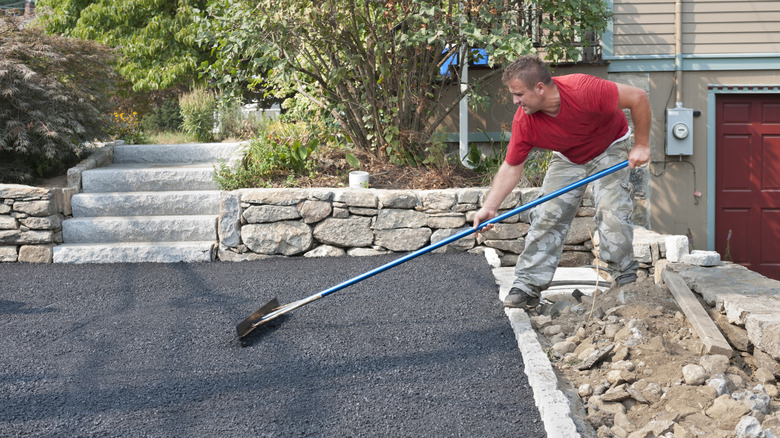
Those of you weighing the cost to upgrade your driveway have probably at least considered laying concrete and calling it a job well done. After all, concrete is highly durable, which is surely the most important thing for a surface that's designed to support your vehicles. It can also last up to 40 years, which ticks a big box for those who are designing for the long haul. The problem is, concrete can be expensive. Indeed, HomeAdvisor puts the average cost of installing a concrete driveway between $8 and $18 per square foot. But what can you do? You need a reliable, durable driveway, so what choice do you have but to pay for concrete?
You actually have several options. There are various driveway materials that can cost less than concrete, although some are better suited to certain properties and levels of vehicle traffic than others. In the sections below, we've highlighted just five concrete driveway alternatives that could help you to tighten your purse strings. It could be that you're working with a tight budget. Or you may be open to all options and want to know which materials to use on your driveway that go beyond concrete. You may even want to know whether it's possible to turn your lawn into a driveway without losing its luscious green looks.
As you'll see below, there are plenty of worthy options beyond concrete, many of which can cost you considerably less. Just bear in mind that you will need to consult your local authority to ensure the below ideas are viable in your area, and to secure the appropriate permissions. Especially if you're changing from one driveway material to another, you'll almost certainly need a permit.
Asphalt driveways are cheaper up front
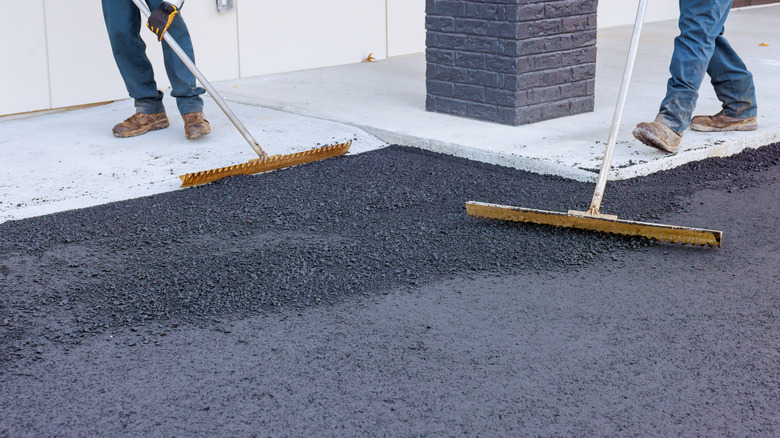
If you're considering upgrading a gravel driveway to add value to your home, asphalt is just as worthy of a place on your shortlist as concrete. It may also cost you less upfront. For example, HomeAdvisor ranges the cost of installed asphalt between $7 and $15 per square foot, which is slightly cheaper than the $8 to $18 range for concrete. Now, these are averages, and several factors could have an impact on final costs. For example, Nerdwallet averages the labor costs alone for asphalt driveways between $5 and $7 per square foot. For concrete, it suggests the range could be even wider — between $2 and $10 per square foot. In other words, while asphalt is usually cheaper upfront, installation costs can vary, so it's always worth getting quotes for both materials.
Now, onto the pros and cons of asphalt versus concrete. Typically speaking, asphalt driveways tend to need replacing every 15 to 30 years. That's a fairly long lifespan, but concrete can last up to 40 years if properly installed and maintained. This brings us to another way that you can further reduce the cost of asphalt, and that's to use recycled asphalt. Since it's made from reclaimed asphalt and broken down into pieces, like gravel, recycled asphalt forms a semi-solid surface. It's still durable, and if properly maintained, can last nearly as long as regular asphalt. Crucially, it may only cost between $6.20 and $8.75 per square foot — including installation. At the high end of these estimates, installing recycled asphalt twice would still cost less than installing concrete once at $18 per square foot. However, actual savings will depend on installation and maintenance costs over time.
Wood chip driveways are rustic and potentially very cheap

Wood chip driveways offer a significantly cheaper alternative to conventional concrete. In fact, they may not actually cost you a dime. To buy wood chips, you may spend between $25 and $100 per cubic yard, which might sound expensive. However, according to Constructem, a cubic yard of concrete can cost anywhere from $125 to $195. That means wood chips could offer considerable upfront material savings over concrete, although the total cost depends on how much material you need and any preparation involved.
But, you may be able to get wood chips for free. You could sign up for ChipDrop, for example. This service matches people who want wood chips with arborists and tree companies who need to get rid of them. You place a request, and if you're successful (delivery timeframes and amounts are not guaranteed), you could potentially cover your entire driveway with free wood. Even if the delivery amount is smaller than your needs, it could still reduce the amount that you actually have to spend.
As for the benefits of wood-chips, they're great for those who want a more rustic, cost-effective alternative to gravel driveways. They look more natural that both gravel and concrete, which is great in rural areas where you want the driveway to match your surroundings. Wood chips are naturally sustainable, which is a plus, and they're much softer underfoot for families. They're also better for the soil beneath than concrete or asphalt. The main downside of wood chip driveways versus concrete is durability. They're generally better suited to firm, well-draining ground and lighter or occasional vehicle traffic. Wood chips can also shift and naturally break down over time, meaning you'll need to replenish them periodically, which could add to your long-term costs.
Crushed shells lend a coastal aesthetic, and they cost less up front
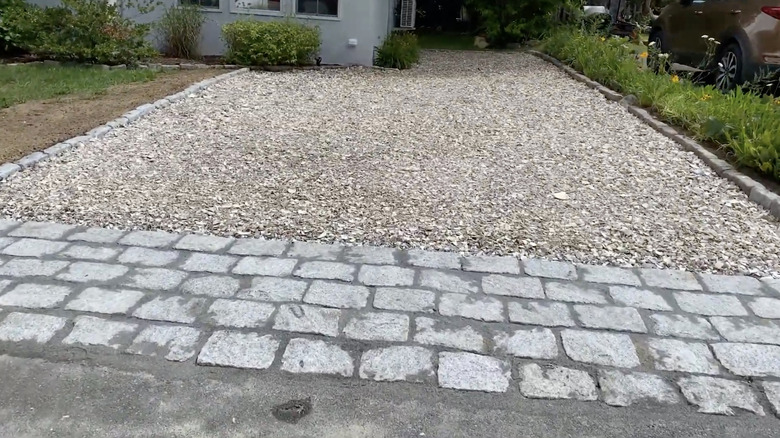
If you want a driveway material that gives your drive a coastal aesthetic, crushed shells are another cost-effective option compared to concrete. In fact, according to Angi, crushed shells can cost anywhere between $20 and $90 per ton in 2026. Depending on the shell type, you may need between 1 and 1.3 tons of crushed shell per cubic yard, which means, at Angi's higher-end price range, you'd pay $117 per cubic yard. Compared with the $125 to $195 per cubic yard price of concrete, crushed shells could offer upfront material savings, although the total cost will also depend on delivery, preparation, and installation.
Now, cost is not the only consideration to bear in mind. While crushed shells are highly attractive, a driveway laid directly over bare soil may need replenishment within about five years. This is for a few reasons. In regions with heavy weather, like high winds and torrential rain, the small, featherweight fragments of shell can easily become displaced. Not only that, but the shells also break down further under vehicle traffic, so you'll likely need to top up the surface periodically, adding to your long-term costs.
A chip seal driveway installation may cost substantially less
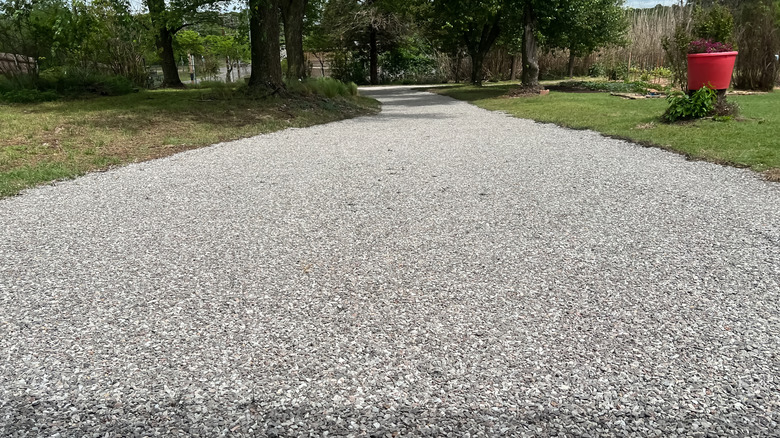
Another cost-effective alternative to concrete is a chip seal driveway. These are created by first preparing your driveway's subsurface, before pouring bitumen over the top and then immediately pressing stones or aggregate into the bitumen. The stones set into the surface give these driveways more decorative appeal than straight-up concrete. As for cost, HomeAdvisor puts chip seal driveways between $5 and $10 per square foot. Compared with the $8 to $18 range for concrete, chip seal could be considerably cheaper upfront.
The biggest downside to chip seal driveways compared to concrete is durability. It's not that they don't last, but their durability depends on how well the surface is installed and maintained. Different things can influence this, too, such as traffic volume, the weight of your vehicles, and even the climate in your area. Indeed, you can expect a chip seal driveway to last for around a decade. A new chip seal layer over the top can add another decade or so once wear begins to show, but as a total lifespan, 20 years is half the potential of concrete. Still, if it's the upfront costs that make concrete unrealistic for you, chip seal is still worth considering, and it'll last much longer without repair or replacement than, say, wood chips or crushed shells.
Grass paver systems can be a surprisingly durable and cost-effective alternative
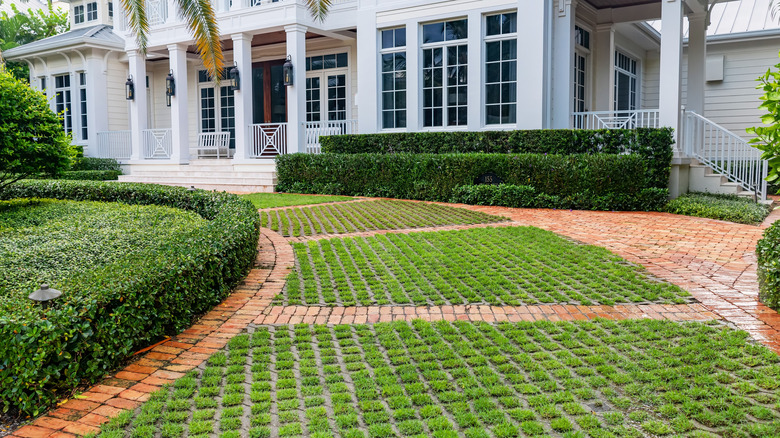
The benefits of grass paver systems are manifold, especially on the driveway. Grass looks more natural than concrete, for starters. Even if you're not too worried about curb appeal, grass drains more easily than a flat slab of concrete, and while you might worry about damaging your grass in the winter with your cars, that's actually the whole point of grass-grid pavers. They provide a stable platform for your car to gain traction, while protecting the roots of your lawn beneath, which means the lawn stays green and healthy. So, what about the cost?
Well, grass paver systems are available from various outlets and manufacturers. As an example, you can buy 35 square feet of grass pavers from Landscape Discount for less than $125, putting the price at under roughly $3.57 per square foot. While this is only a guide, since prices vary between suppliers, the grids themselves can be considerably cheaper than a completed concrete driveway. However, the cost of installing them still needs to be factored in. With grass grids, you can expect labor and additional materials (like the sub base) to double, perhaps even triple the cost. But even after accounting for installation, a reinforced grass driveway may still offer considerable savings compared with concrete, depending on the system you choose and the work required.