

The Native Shrub That Gives Retaining Walls A Burst Of Color And Added Erosion Control
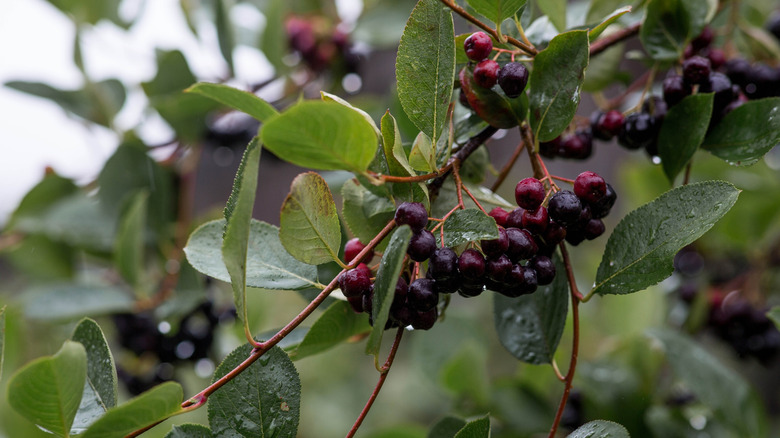
When it comes to double-duty shrubs, the chokeberry (Aronia) reigns supreme. This plant not only provides multi-season interest, including fall color, but can also help top a retaining wall to aid its anti-erosion functions. Of the Aronia species, black chokeberry (A. melanocarpa) is the one most often recommended for erosion control. This subgroup is on the compact side, and has a fuller, less scraggly silhouette than other chokeberries.
Black chokeberries are prized for erosion control because they easily tolerate any wet soil that pools on hillsides above retaining walls. Just as importantly, the shrubs' root systems are prone to suckering, a trait which enables them to quickly form a dense, anti-erosion mat. Black chokeberries are also quite adaptable to varying soil conditions. Along with handling your wet garden soil, the shrubs thrive in a range of pH levels and soil textures. They grow well in full sun or part shade, and are perennial in USDA plant hardiness zones 3 to 8.
Black chokeberries blaze with autumnal color, turning landscaped areas a fiery red. In the spring, the branches are filled with clusters of white flowers. These are followed by black fruits that'll have birds flocking to your yard throughout fall. As a group, black chokeberries can reach heights of between 3 and 10 feet. To landscape retaining walls, opt for compact cultivars such as 'Morton' or 'Nero.' Another strong choice is 'Autumn Magic,' which combines a smaller frame with showy fall foliage and large berries.
Plant black chokeberries strategically for erosion control
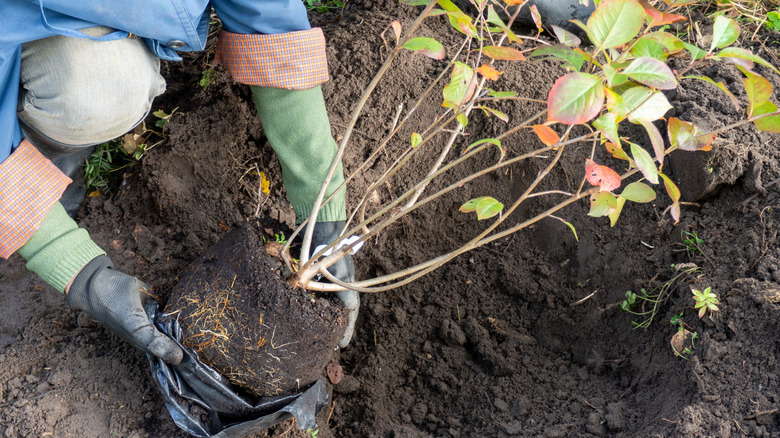
The ideal time to plant chokeberry shrubs is early spring, after the last frost date in your area. The hole should be about the same size as its planting pot or root ball, but roughly twice as wide. For a good-looking, functional hedge that gives your old retaining wall a fresh new vibe, set each young chokeberry about 3 feet apart from one another. For additional help preventing soil loss, add a mulch layer 2 to 3 inches deep.
If you're planting on a slope above a retaining wall, prop the edge of the root system closest to the wall with soil underneath the roots to level the young plant. After planting, consider using hardscaping like clay pots or rocks to temporarily prop up the lower part of any "slanting" plant. Zig-zagging the planting holes, rather than setting chokeberries in straight lines, keeps water from rushing down the retaining wall.
For retaining walls with reinforced parts extending behind them into the earth, set the shrubs about 5 feet away from the top of the wall. This precaution keeps root systems from interfering with the buried wall reinforcements. It also prevents the branches of the shrub from dripping water onto the wall's surface when it matures, especially during the period when it's loaded down with berries. As for the fruits themselves? They make great pies and jams. But while you're unlikely to literally "choke" on the edible berries, they're so tart when uncooked that you'll quickly understand their common name!