

How Long Can Gas Sit In Your Leaf Blower Before It Goes Bad?
We may receive a commission on purchases made from links.
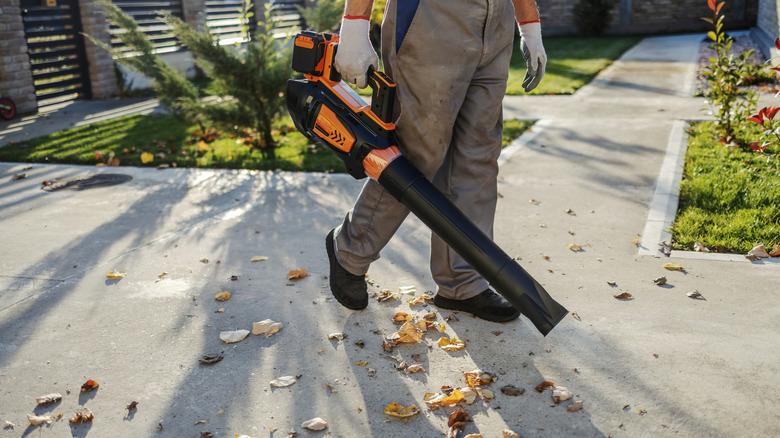
For some, leaf blowers are essential outdoor power tools to have on-hand for a spring-ready yard and garden. After all, curb appeal is important, and you don't want your neighbors or municipality thinking you keep an unkempt landscape. But unless your yard is decked in rows of messy or evergreen trees that drop their leaves year-round, your leaf blower likely doesn't put in much work, save for autumn. This means you might not be able to run the leaf blower fully dry before stowing it away for the winter.
Gasoline is a highly volatile compound and naturally breaks down with time. So, if it's sitting in your leaf blower, expect it to go bad in 30 days, unless you've topped it with a fuel stabilizer. In fact, if your leaf blower is stored in a hot or humid area, gas may weather faster, as also confirmed in a 2016 study undertaken for the Renewable Fuels Association. So, be sure to keep it in a frost-free zone. Given that, it's best to empty the tank before any long-term storage, or you could use your leaf blower for some rain gutter maintenance this fall to exhaust the remnant fuel. As an aside, do note that gas-powered leaf blowers are being banned all around the U.S.
What happens if you retain gas in your leaf blower beyond a month?
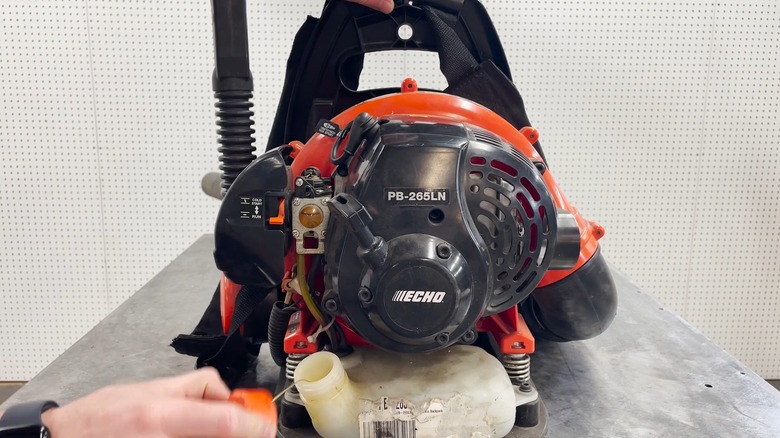
The consequences of not emptying your leaf blower can be dire. Since leaf blowers have small, vented, permeable tanks that remain exposed to air and moisture, the octanes in gasoline easily degrade, turning into thick varnish. For adequate performance, you must use fuel with an 87 Octane rating. In its diminished state, gas often fails to ignite, overstraining the engine or causing it to stall. Worse, it may gum up and clog the carburetor, injector, tracts, valves, and fuel filters, necessitating expensive repairs or replacements. Consequently, if you ever open the assembly, you might find brown deposits. In the worst cases, your leaf blower might not operate at all.
To reduce greenhouse gas emissions, governments have stipulated ethanol mixing with fuel, and it's likely your leaf blower runs on E10 (it contains 10% ethanol). This further leads to the problem of phase separation. Ethanol essentially is hygroscopic, meaning it can absorb moisture. So, when the blended fuel is left long enough, ethanol eventually separates and settles at the bottom. Unlike cars, the parts and rubber seals in leaf blowers aren't built to resist it well, and they eventually corrode, dissolve, or deteriorate the longer the separated mix persists in the tank. Companies void the warranty in such cases. Though it does bear mentioning that the aforementioned study found that phase separation can take about three months to materialize fully, and by then gas has already broken down.
Dry the tank or stabilize the gas to extend usability
As mentioned, standard pump gasoline with ethanol (E10) can only last 30 days in your leaf blower before going bad. So, if you're planning to store it away for a longer duration, it's best to empty the tank and return the gasoline to its original container. After decanting, run the blower without the throttle until it sputters shut to ensure no fuel remains inside.
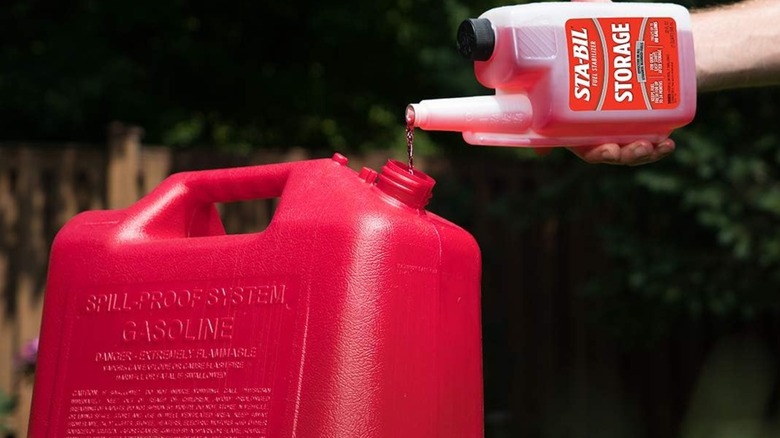
Alternatively, you can add a fuel stabilizer to maintain gasoline's potency. The one from STA-BIL is an excellent option and performed really well over a five-year experiment conducted by Project Farm, a YouTube channel. Basically, a fuel stabilizer sits on top of gas and neutralizes moisture before it can react and break down the octane. However, opinions are split about how long this approach remains effective. Stihl, for instance, recommends against storing stabilized fuel beyond 60 days, while others deem it can easily last around six to eight months, and sometimes even for a year. Briggs & Stratton's takes it up a notch, stating its fuel preserver can extend gas' usability another three years! Regardless, remember that fuel stabilizer will not work on gas that has already degraded. Finally, if you don't mind paying extra, you can also opt for ethanol-free blends, like Stihl MotoMix (for 2-stroke engines) or Moto4 (for 4-stroke engines). These can be left in the tank for winter and won't spoil for up to two years.