

Laundry Rooms Of The Past Would Look Unrecognizable To Anyone Today
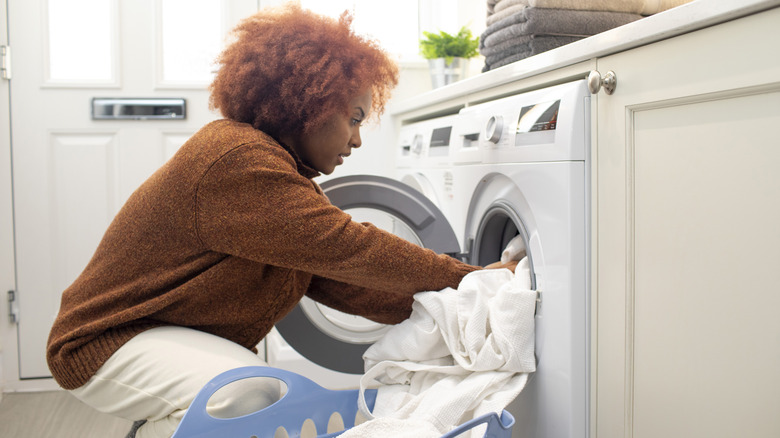
Laundry is a much-hated chore. We get it: It's loud, seemingly never-ending, and time-consuming, but the next time you find yourself moaning and groaning about having to haul your clothes from the washer to the dryer, take a moment to imagine what your grandparents and their parents had to put up with. Clothes have always needed to be washed, but without modern machines, electricity, or running water, the process — and the setting — looked completely different. For centuries, the idea of a dedicated laundry room was a completely foreign concept, but even in the last hundred years, these spaces have seen major changes. Whether it's due to equipment with unrecognizable designs or shelves full of cleaning agents that are a far cry from modern detergents, laundry rooms of the past looked completely different from the setups we have in our homes nowadays.
Today, laundry rooms can either be designed and decorated like clothes-cleaning havens or they can be tiny closets with just enough room for stacked appliances, but a few things remain consistent. You'll have your washer and dryer, a couple of bottles of detergent and fabric softener, and, if you're lucky, some room for folding or pre-treating your items. The space fully revolves around those two machines, so when they're removed from the equation, the laundry process looks very different. Laundry was done manually, occasionally, and outdoors for the vast majority of human history, and what we would consider a somewhat modern, automatic washing machine wasn't invented until the '30s. Models that came complete with electronic components and digital sensors didn't pop up until the '80s, which is when the space starts looking much more familiar to modern eyes.
What the laundry process looked like for most of history
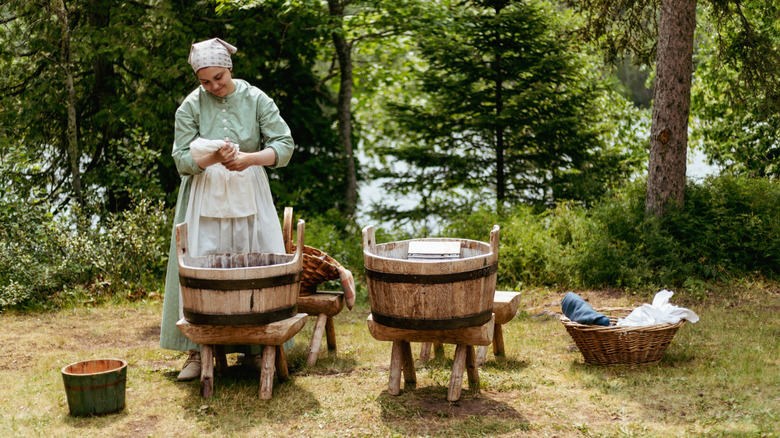
For most of history, laundry wasn't done often. Clothing made of pre-industrial materials like linen and wool was aired out between infrequent launderings. For example, in the 18th century, washing clothes was time-consuming, and soap was an expensive commodity, so for those who spent their hours laboring, finding the time and resources to complete this chore could be challenging.
For centuries before the washing machine, items like wash tubs, washing bats and boards, wringers, and clotheslines were essentials, but they weren't usually found inside the home. Instead, fabric would be washed outdoors, in a stream or heated wash tub. Once it was washed, clothing and linens would be efficiently dried by hanging them on a clothesline, draping them over a bush, or laying them in the grass. Laundry was often soaked in hot water, and some solutions like lye were used as disinfectants, though soap, bleach, starch, and bluing were sometimes used. By the late 1800s and early 1900s, commercially made laundry soaps became much more accessible.
Public laundries were also popular in busier areas — some were communal spaces where people could gather to do their own laundry, while others were more commercial enterprises that allowed those willing to pay to outsource the labor. Because of this, indoor laundry rooms in homes weren't particularly necessary until the development of the modern washing machine. Technically, the first washing machine was invented in the late 1700s, but a machine with a drum wasn't developed until 1905. With the widespread adoption of electricity came change, and the first automatic machine — and the need for a dedicated laundry room — was born in the '30s.
How laundry rooms have changed in the last 100 years
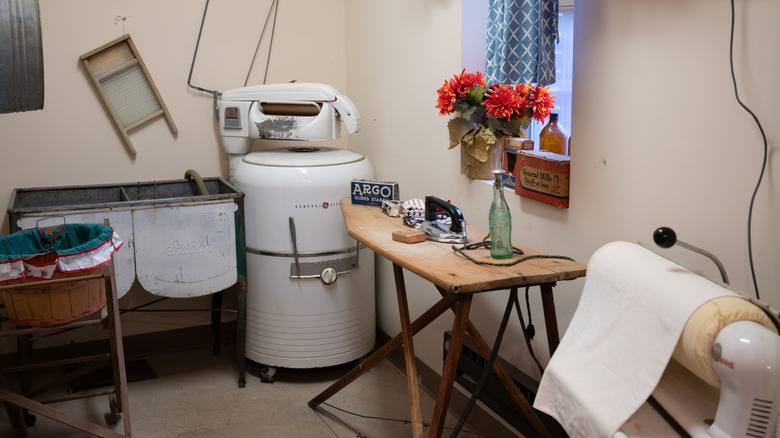
Early electric washing machines looked different than we're familiar with — the first iterations were often cylindrical, featuring a large wringer arm along the top. Some even think this retro laundry room appliance deserves a comeback. Despite the new technology, washing machines took some time to catch on with the general public. Until after World War II, they weren't particularly commonplace, but the boom in the economy gave households a bit more spending money.
During the post-war era, automatic electric clothing dryers also started to become popular, helping to create the dual-appliance system we're so familiar with today. Before this time, line drying outdoors or on a rack indoors was still the go-to method. The mid-century was an era of rapid development, and as more families brought in these new appliances, the idea of the laundry room as we know it started to take shape. The wringer arm style largely fell out of favor, becoming replaced with sleek and squared-off machines with a spin cycle. Appliances were often available in candy-toned pastels as well as simple white in the '50s and '60s, and as the '70s rolled in, they were frequently sold in the en vogueautumnal shades of the era. Things really became "modern" in the '80s once electronic components came in to play. This era saw the development of different cycles, sensors, and water-saving features that brands continue to innovate on.
By the '50s, detergents specifically for laundry machines were widely available in both liquid and powder form, eliminating the need for traditional soap, but still requiring more product than we're used to. By the '60s, we saw specialized stain treatment products. Around the '80s, more concentrated liquid detergents became popular, helping to complete the picture we're now familiar with.