

Not Vinegar Or Baking Soda: Remove Washing Machine Buildup With A Kitchen Staple
When you're starting to see signs that hard water is damaging your laundry, it's time to take action. Hard water comes from the presence of minerals like calcium and magnesium in the water supply, which leads to scaly deposits in faucets and appliances like washing machines. This buildup prevents laundry detergent from fully dissolving, leading to bad smells and bacteria buildup. That means that effectively cleaning your washing machine also requires descaling. But what to do when you want natural solutions with everyday ingredients? That's where citric acid comes to the rescue.
Many commercial products geared to descaling appliances and fixtures contain citric acid. But you can skip the additional ingredients and just use citric acid by itself. Look for it in canning sections of the supermarket, or purchase it online. Citric acid is a mild cleaning agent that doesn't pose health risks or harm the environment. It's most akin to vinegar, another mildly acidic ingredient with useful cleaning properties. As the name suggests, citric acid is naturally found in citrus fruits like lemons and limes.
Not only does citric acid have antiseptic properties, but it's exceptionally useful for getting rid of the hard water stains that are seemingly inevitable in large appliances like washing machines that process gallons of water with each use. That's because the citric acid bonds to the ions within those scaly calcium and magnesium deposits, allowing the hard water deposits to dissolve and wash away.
How to cut through hard water deposits with citric acid
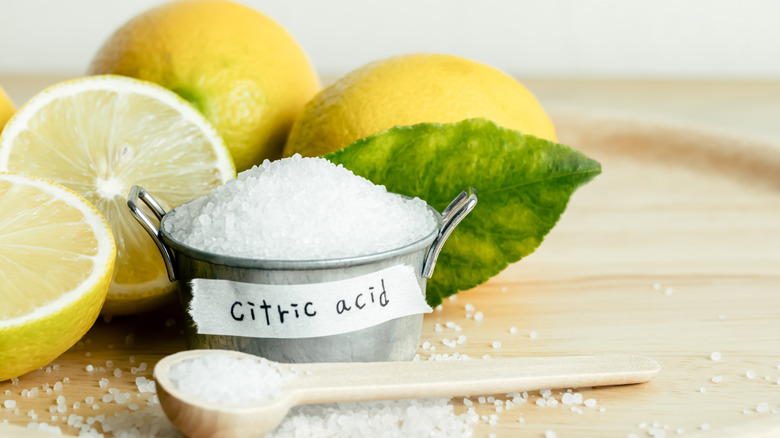
Citric acid is often combined with another common household item, baking soda. Together, the two can lead the charge in removing hard water scales from your washing machine, along with the resulting detergent buildup. To use this method, combine citric acid with baking soda in your detergent tray. Use roughly 2 teaspoons of citric acid and 1 teaspoon of baking soda. Run the washer on a hot cycle. Doing this at least once a month will combat future buildup. If your washing machine doesn't have a detergent compartment, stir ¼ cup citric acid into 1 cup of hot water. Pour the dissolved citric acid liquid into the empty machine, and run a hot water cycle. Run a second empty load to ensure the citric acid gets washed away.
If you're no longer seeing buildup in the drum itself, but the problem seems to be lingering in the gaskets of your washing machine, that problem simply calls for a basic double-down. For grimy buildup on the rubber seals, first use a toothbrush dipped in white vinegar to scrub the grime by hand. Then put the same combination of 2 parts citric acid to 1 part baking soda in the detergent compartment of the washing machine and run a cycle using hot water.
Citric acid is undeniably a kitchen staple for many, especially for avid canners. But sometimes you don't have it on hand, and simply want to get on with descaling. In that case, consider using powdered lemonade mixture, which contains citric acid. Michigan State University's extension program recommends it for cleaning dishwashers with hard water deposits, and the same principle likely holds true for washing machines.