

11 Common Problems With Maytag Washers And Dryers
Maytag is among four American brands most recommended by our appliance repair expert, and for good reason. It's often listed as one of the most reliable washer and dryer brands, with products across different price points and technological capabilities to suit the needs and budgets of various homeowners. Not only that, it's also one of several brands that are owned by Whirlpool, which means it comes with the backing of one of the industry's biggest corporate names. However, that's not to say that its line-up of washing machines and dryers is entirely infallible.
In fact, if you head over to the Maytag website, you'll find a vast array of common problems that crop up for appliance owners. But worry not. Whether you just invested in a Maytag washer or dryer, or keep running into problems with your existing appliance and are wondering what's going on, we're here to help. In the guide below, we've covered 11 common problems that occur with Maytag washers and dryers. Some are very easy fixes, while others may require you to take a dive into your ductwork. We'll cover the problems with your washer that may be the cause behind your smelly laundry room, and if your dryer is failing to live up to its job description, we'll explore potential causes for that, too.
The electric dryer isn't heating
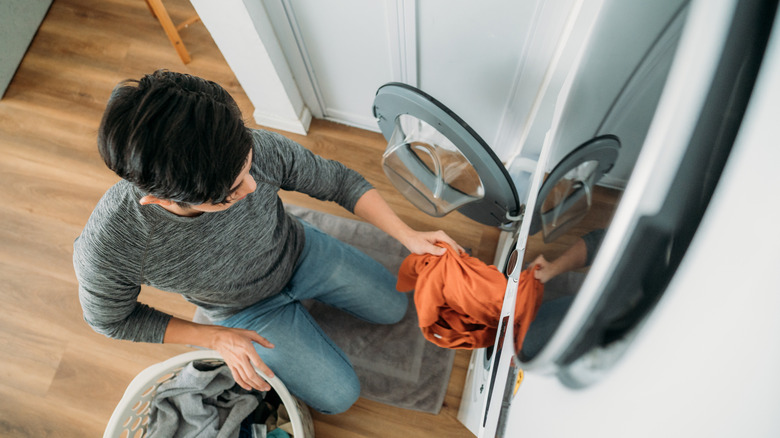
Starting with Maytag electric dryers, one common problem is that they fail to actually dry your clothes. This can happen for several reasons. The first is that, on some dryers, you can specify an "Air Only" setting. If you choose this cycle, then your dryer won't actually use heat at all. It may be shown as "Air Only" or "Air/Fluff." In either case, it's designed to help refresh and de-wrinkle fabrics, without heat. It also helps to remove lint and dust, and it's especially useful for heat-sensitive garments. So, the first thing to check is that you don't have "Air Only" selected.
Next, check your power supply. If your dryer isn't hooked up to a 240V power supply, it may not operate properly. Similarly, if the cord isn't connected to the machine properly — with the terminal screws properly tightened — that could also be at fault. If everything's connected properly and you're using the right cycle, you may be facing a tripped circuit breaker. Maytag suggests checking your breaker board for two — one that powers your dryer's drum, and one that powers the element. If the latter trips, your dryer may not heat. Finally, it could be the heating element itself that's broken and therefore failing to heat your machine. As one Redditor explained, "I had a similar, intermittent issue and it turned out to be the heating element coil which had broken and was no longer making a complete circuit." If you suspect that something electrical has gone, or that a part like this needs replacing, it's best to hire a professional technician to have it fixed. Electrical work is usually best left to the pros, and even if you're qualified, you may find that trying to fix your machine yourself voids the warranty.
The dryer stops mid-cycle
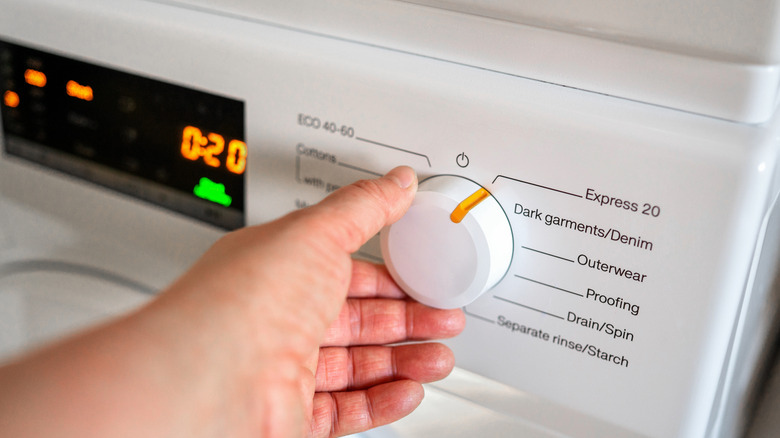
There are few things more annoying than a dryer stopping before your clothes are dry. If this sounds familiar, then Maytag suggests reviewing your cycle selection. Using the wrong settings is one of those things that everyone gets wrong when doing the laundry. Especially with modern Maytag dryers, which use sensors to detect how dry your clothes are. When everything's dry, the machine automatically switches off to protect your clothes from over drying and damage. This means that if you're using "normal" mode, the sensors should do the work for you. However, if you use a quick-dry mode, or air dry (which doesn't use heat) you may find that your clothes aren't dry even when the cycle has run to completion. So, first, check your settings, and if you used, say, a quick-dry setting, consider upping it to "normal" or "heavy duty" to ensure the sensors work their magic.
If that doesn't fix the problem, it could be an overloaded dryer, which will starve your clothes of the space they need to properly dry out. Failing that, it could be a mechanical problem that you need to have fixed professionally. You might have a faulty moisture sensor, for example, or a broken dryer belt, which would pull the machine to a halt. A warped door latch could cause the door to pop open mid-cycle and stop the machine. Likewise, a faulty door switch may fail to tell the machine that the door is properly shut. It could also be that the machine's thermal fuse has broken, which would stop the machine mid-cycle. In this case, it probably won't start up again. As one Redditor, whose machine failed for this very reason, explained, "When mine went out I could not start the dryer at all."
Dry times keep increasing during operation

If, instead of cutting out mid-cycle, your machine seems to keep trucking on and increasing the estimated time to finish, then that can be just as frustrating. Especially if you're in a rush to get out of the door and you need clean clothes! It can happen for a few reasons, although one of the most common is that you selected an automatic cycle. Since these are guided by sensors, times automatically adjust according to load size, the materials, and how quickly things seem to be drying. In other words, it's a part of normal operation.
With that being said, it's important not to take it as read and get on with your day. If dry times constantly increase, then you may need to clean your dryer vents. If these become clogged, they restrict air flow inside your dryer. When that happens, moisture doesn't escape as quickly, which means your clothes stay damp for longer, leading to adjustments in time from the sensors. Luckily, you shouldn't need to guess that it's a vent problem. Clogged vents will often trigger an "AF Error Code" or a "Check Vent" light. If you see either of these, check your lint screen to ensure it's clear, and do the same with your vents. Finally, if that doesn't solve the problem, then you may have a burned-out or failing heating element. If you suspect this, it's best to contact an engineer and have them come out to inspect and repair your appliance.
The dryer makes strange sounds
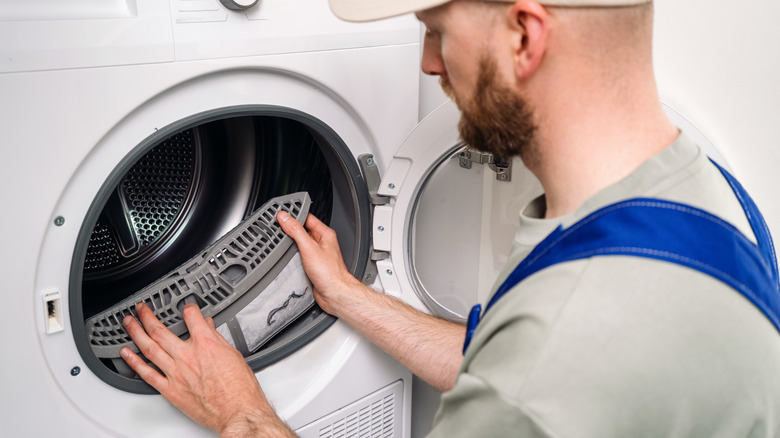
Again, there are a few reasons why your Maytag dryer may be making strange noises when it's trying to dry your clothes. The first and most obvious is that small items, like coins or keys, have made their way out of your pockets and into the drum. They may also end up passing into the lint chute, and when that happens, they can hit the blower wheel as it spins. Other loose items, like zippers and buttons on your clothes, can make rattling noises if not fastened properly before they're loaded. If the noise is more of a "buzz" than a "bang," that's likely down to where you placed it. If it's pushed too close to the wall, for example, or not mounted securely on its pedestal (and leveled), it could vibrate when it's on. In that case, simply pulling out the appliance slightly and adjusting its feet could solve the problem. Similarly, any items placed on top of it may hum and buzz while the machine works, so it's worth pulling those off.
Now, where things start to get a little more complicated is if your machine is starting to squeak or squeal. A squeal from the bottom of your machine could point to poorly leveled feet, which is an easy fix. If it's coming from the front, it could be a loose idler pulley (which keeps the drum's drive belt under tension). Squeals coming from the back could be caused by damaged drum bearings, roller shafts, drive belts, or drum glides. Worn bearings and glides may also lead to a grinding noise. In any case, be it your idler pulley, or one of these squeaky-bottom sounds, the best bet is to call out a professional to inspect and repair your machine.
The dryer springs a leak during steam cycles
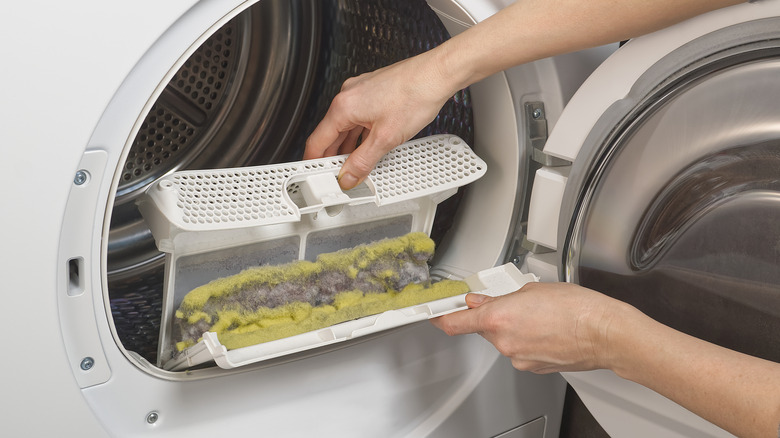
If searching for the source of your home's leak has led you to your dryer, don't worry. It's quite common with Maytag dryers, especially during steam cycles. According to Maytag, steam cycles in its machines are optimized for large, normal, or heavy loads. In other words, the cycle produces enough steam to work its magic on a drum full of clothes. If you use the steam cycle on smaller loads, you may notice build-ups of condensation, and have drips falling from the door when you open it at the end of a cycle. You may still experience leaks during steam cycles with optimally sized loads. This can happen if the water inlet hose isn't secured in place properly, so that's worth checking. A damaged steam nozzle (the part that sprays the steam) can also cause leaks, so inspect it to ensure it's in good shape.
Another common reason for leaks is that the dryer isn't level. Dryers with steam cycles need to be perfectly level in order to accurately sense what Maytag calls "load moisture," so if yours is wonky, it may overcompensate with too much water. Next, if you've ticked the load size, hose-connection, and leveling boxes, check your exhaust vent. If that's clogged (or if your lint trap is full) condensation will build up inside the drum, since it can't escape properly. Not only can this lead to poor drying performance and extended dry times, but it can leave you mopping up drips from the door when you open it at the end of the cycle. Finally, if all else fails, call a technician and have them inspect your dryer for you. The steam generator inside the machine may be faulty or damaged, in which case you'll need to have it replaced.
The washer shows an F0 E2 error code

Moving onto Maytag washing machines, the first problem we'd like to cover is the all-too common "F0 E2" error code. This crops up on washing machines whenever too many suds have been generated, and while it's not ideal, it's not a sign that you need to call an engineer. Instead, if you see it appear during a cycle, and your machine is still running, then let it carry on as usual. In the future, Maytag recommends using only High-Efficiency detergent, which produces fewer suds than regular washing detergents.
Now, if you accidentally overdo it, you may notice that your machine runs for longer than usual as it tries to deal with the suds. It may also run with a lower spin speed for the duration of the cycle, leaving you with a soaking wet load of laundry. Now, hopefully, once it's finished, you should have a wet load that can be run again on a spin cycle to wring out the excess water. But if you start to notice ongoing issues with the F0E2 code, you may need to take further action. The first thing to try, according to EasyBear Appliance Repair, is a cleaning cycle — without anything in the detergent drawer. This should help to clear out any suds or foam still lingering inside your machine. Failing that, you may need to manually drain your washing machine and clean the drain pump filter. This can get messy on front-load washers, so be prepared with some towels, and ideally a bucket to catch the water.
The inside of the washer is starting to smell

There are several reasons why your washing machine smells. In turn, there are several ways to stop it from happening. Starting with the most common culprit, Maytag recommends leaving the door of your washing machine open between cycles to allow the interior to breathe. This helps ensure any remaining moisture evaporates, instead of sitting there and providing the optimal conditions for smelly mold and mildew.
Mold can also grow quite quickly inside the detergent dispenser, which is why Maytag recommends cleaning yours regularly to keep smells at bay. It also suggests running your washing machine's cleaning cycle once per month. Finally, regardless of which machine you have in your laundry room, make sure to take clothes out of the washer as soon as the cycle has finished, to prevent smelly mildew from taking hold. You should also aim to check and clean out the door seals from time to time, as they, too, provide an excellent spot for mold and gunk to build up. Not only that, but as we'll see later, dirty seals can also lead to other common problems with Maytag washers.
Front load washers may experience leaky dispenser drawers
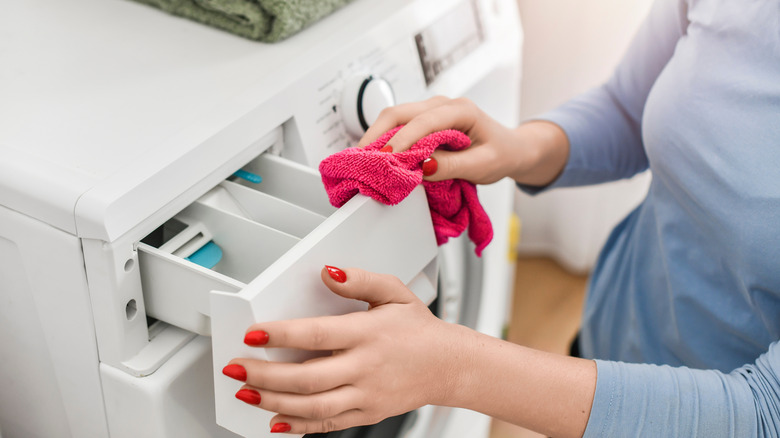
"My washing machine leaks from the water/soap dispenser. This started this week, previously no issues." Does this sound familiar? Quoted from a contributor on Reddit, it highlights a problem with Maytag washers that's common enough to make it to the brand's troubleshooting pages. Fortunately, while it can happen for various reasons, it's typically quite easy to fix.
For example, if you usually use single-dose laundry packets (such as Tide pods) in your drawer, instead of placing them directly in the drum, that can cause leaks. Alternatively, if the drawer isn't fully shut, then leaks can also occur that way. Finally, if there's one part of a washing machine that everyone forgets to clean, it's the dispenser drawer. Over time, this critical component can become clogged with residue from your detergent and fabric conditioner. If you don't inspect your dispenser and clean it regularly enough, you may well notice it start to leak.
The front of the washer is leaking

Another common problem with Maytag front-load washers is that, from time to time, the doors can spring a leak. Again, there are various reasons for this, but one of the most common is that the seals around the door are dirty. Remember what we said about removing the gunk and mold that tends to build up behind them? Well, not only will you prevent those awful smells by periodically cleaning the seals, but you'll also ensure that they work properly and form a tight, waterproof fit.
If your seals are already clean, the next thing to check is whether any items have become stuck in, or under, the seals. This could be lint, coins, little toys, or pieces of balled up tissue that you forgot to remove from your pocket. Again, anything caught up in them could cause a break in the seal, which will then allow water to leak. Likewise, if you overload the drum, small pieces of clothing may become trapped between the door and seal, causing a leak. Finally, if you overdo it with detergent and end up with lots of suds, that can also cause leaks, so it's best to err on the conservative side, or better still, abide by Maytag's recommendation and stick to high-efficiency detergents.
The washer makes banging or thumping noises during operation
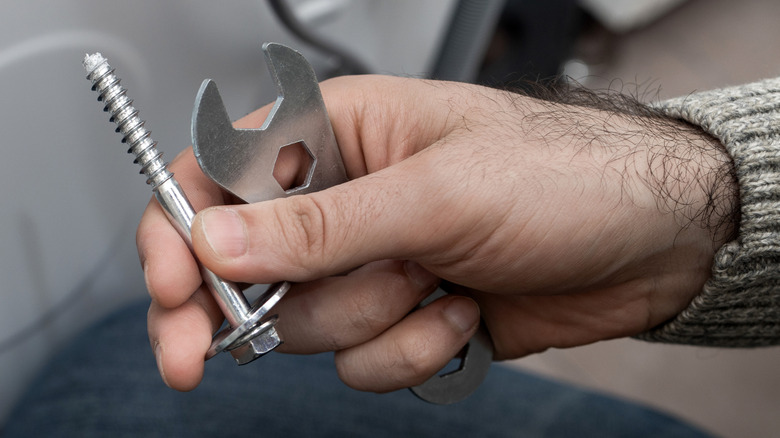
If you've sat bolt upright in bed because it sounds like a rocket is taking off downstairs, don't worry. There's often a very good reason your machine is shaking like crazy and banging around, and it's usually an easy fix. The first thing to double check is that you removed the shipping bolts from your machine before you installed it. These are in place to keep the machine safe in transit. The thing is, even if you had it installed professionally, you should never take it as a guarantee that these bolts were removed. As one Redditor, who experienced this issue, put it, "I assumed the delivery guys would remove them but either it's my job or they forgot." As for what happens if you leave them in place, the first thing is that they can make one heck of a racket. Those bolts can also damage your machine, and unfortunately, if you run your machine with the bolts still in place, they can actually void your warranty. So, take them out!
Next, assuming your shipping bolts have been removed, you'll want to ensure your machine is nice and level. If it's not, it'll rattle around on its little legs when the machine starts to spin. It's also worth taking the time to check that the drain hoses are attached properly to the back, since these, too, can knock against the back when the machine kicks into life. Some Maytag washers are provided with a beaded strap to secure these. Even if yours wasn't, you can simply use wire or cable ties instead.
The washer isn't spinning
There are some common "symptoms" to look out for that can indicate your Maytag washer isn't spinning correctly. You may have noticed some already, like your clothes being soaking wet at the end of a cycle, or heavier loads coming out still dirty. You may simply not see or hear your machine spinning. Unfortunately, it happens, and according to Maytag, there's a raft of potential reasons why.
For example, an overloaded drum may struggle to spin like it should. It will also struggle if the machine isn't properly leveled, or if you overdid it with detergent leading to too many suds in the drum. Another thing to look out for is your machine's cycle history, since some machines "remember" your previous settings. As an example, if you ran a cycle for a "Heavy" load with "No Spin" specified, then later chose "Heavy" for another load, it would still default to the "No Spin" setting. If you want it to spin, you'd have to manually add it back to the settings. Failing all of this, then the problem could be mechanical. In fact, it could be one of several mechanical issues, and unless you're happy taking your machine apart and assessing all of the complex components, it may well be worth calling out an engineer.