

Spraying Your Dining Table With Vinegar: Why The Method Has Stood The Test Of Time

We probably don't need to tell you how vinegar can be a versatile cleaning solution. In fact, you probably have a bottle stashed away in the cupboard already. Its use spans thousands of years, including both food production and cleaning. As a cleaner, it offers a no-fuss way to clean surfaces ranging from windows and ovens to shower screens and even limescale-stained sanitaryware.
It's also commonly used to spray down dining tables, and while there are some arguments against this (which we'll come to later), there are also some very strong arguments in its favor. Vinegar is mildly acidic, which makes it a useful ally when dealing with grease — a common culprit for dirty dining tables. It's also antimicrobial, which, on the dinner table, makes it highly effective against everyday bacteria.
Of course, the same case can be made for commercially available cleaning solutions, which begs the question why modern homemakers choose vinegar over specialized products. Well, while we can't speak for everybody, one factor that helps here is the cost. When a simple bottle of cheap vinegar can theoretically be used to dose the shower head and screen, and then put to work on the dining table, why would you want to buy dedicated cleaners for each room? The answer is that, depending on the surface you're trying to clean — and more specifically, what it's made from — some cleaning products should be used with caution, including vinegar.
How and when to use vinegar to clean your dining room table
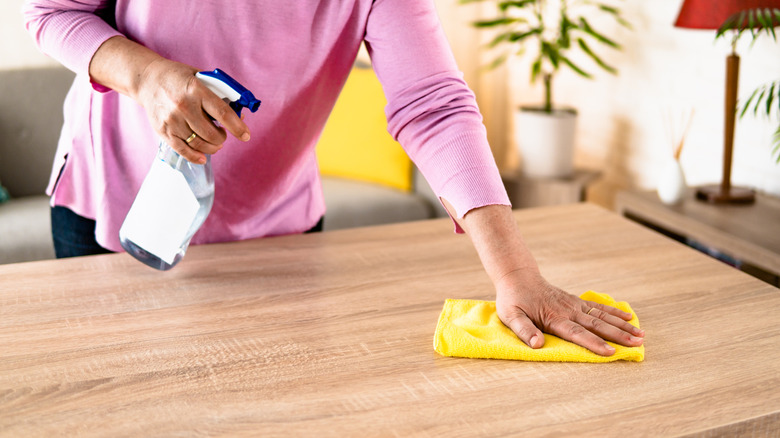
As mentioned, it can be a very good idea to clean your dining table with vinegar. It's cheap, can be used elsewhere in the home, and has precisely the properties you need to get rid of grease and clean away everyday bacteria. But it's important to take some time to prepare your vinegar properly, depending on the surface you're working with. For example, if your table is made of glass, then vinegar diluted with water is a great way to degrease and restore the shine to your surface.
Where things get tricky is if your table is made from surfaces like stone, marble, or wood. Generally speaking, stone and marble are among the things you should never clean with vinegar, since the acidity can actually "etch" them and leave permanent markings. As for wood, the answer is a little more nuanced. For example, does your table have a glossy finish? Has it been oiled? Unfortunately, vinegar risks damaging such finishes, leaving the surface looking dull.
Now, that doesn't strictly mean that you can't use vinegar to clean your wood table. As Marla Mock, president of house-cleaning service provider Molly Maids, explained to The Spruce, "The key is to use vinegar correctly." She advised diluting it and using as little moisture as possible to protect the wood. It's also worth testing your solution on an inconspicuous area first — perhaps a part that's usually covered by a runner or tablecloth. By doing this, you'll ensure any damage is minimal, rather than cleaning the entire surface and leaving the results in the lap of the gods.