

What To Do If Your Dryer Never Stops Running
When you hit the start button on your dryer, you expect fresh, warm clothes ready to fold after about an hour. Walking back into the laundry room two hours later to find the dryer still running can be frustrating, not to mention concerning. A dryer that fails to stop wastes electricity, inflates your utility bill, wears out clothing fabrics prematurely, and is one of the scary dangers that are lurking around your home, as it's a potential fire hazard.
Before you panic and rush out to buy an expensive new dryer, take a step back — a dryer that never stops running is a common issue with clear causes and solutions, and it may be as simple as unclogging the exhaust vent or cleaning the moisture sensor. When you start a cycle, a whole network of mechanical parts, sensors, and electronic controls work together to dry your laundry efficiently without overheating it.
Knowing how these components operate will help you understand which repairs your dryer needs to stop on time again. But first, you need to prioritize your safety. Disconnect the plug from the wall socket, and if your dryer has a heavy-duty 240-volt plug, turn off that circuit breaker in the electrical box. Once you ensure the power is completely off, you can safely begin troubleshooting the never-ending cycles.
Check the quickest dryer fixes first
Start by testing the components that are the easiest to fix, beginning with simple checks that require no tools. Confirm you haven't accidentally selected an extended "wrinkle shield" option or a long timed dry cycle, and make sure that the internal lint filter is completely clean. On older mechanical units, you can also check that the timer knob isn't slipping — if the knob spins freely in your hand without catching, the internal plastic spindle could be cracked, leaving the timer shaft stuck in place.
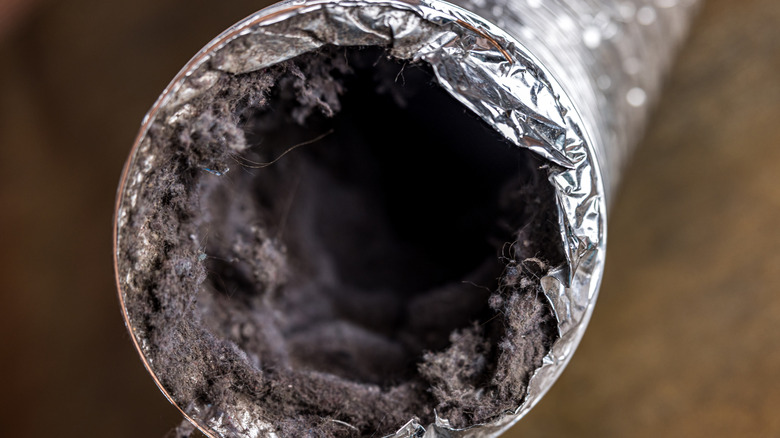
If all of these look good, the next thing to consider is your exhaust vent line. When lint and outdoor debris restrict airflow, the moist air from your wet laundry cannot escape the drum. The moisture sensor will still read high humidity, so the controller will think your load isn't fully dry and won't stop the cycle. To unblock it, remove the flexible vent hose at the back of the dryer. Using a heavy-duty dryer vent brush, scrub inside the ductwork to clear out trapped lint and debris. A vacuum can also help to reach areas you can't access by hand. Use the same technique to clean the exterior vent. Reattach the hose to your machine, then test the dryer to confirm air passes through the vent freely.
Dryers with automatic sensors have metal strips inside the drum that tell them if your clothes are still wet. But unfortunately, fabric softeners and dryer sheets can build up into a thin layer of grime on the strips, confusing the control board into thinking there is still moisture left in the clothes. To clean them, take a microfiber cloth dampened with rubbing alcohol and gently wipe the strips to remove any excess grime.
What to troubleshoot next if your dryer won't stop running

If none of the tool-free fixes work, an internal electrical component is likely at fault. If you are comfortable using a multimeter, you can test and replace several parts yourself. First, test the door switch behind the front panel. If it shows continuity whether the button is pressed or not, the switch has failed shut and needs replacing. Next, check the heating element on electric models. A broken coil can sag and touch the metal housing and stay hot, or burn out entirely and leave the drum spinning without heat. Finally, test the cycling thermostat on the blower housing for continuity to ensure it is accurately monitoring internal temperature by verifying that it maintains a closed circuit at room temperature.
Learning what to check if your dryer is not heating properly helps narrow down these failure points. If the door switch, heating element, and thermostat test normal with a multimeter, the issue is likely a stuck motor relay on the main electronic control board or a failed mechanical timer motor continuously feeding electricity to the drive motor. These repairs can be complicated and require a high level of wiring expertise. It is best to have a professional fix your control board (typically costing $200 to $400) or replace your timer, which can run from $150 to $300. Since basic model dryers start at $300 and some luxury models cost over $2,000, it is generally worth investing in professional repairs, especially if you have a warranty, instead of buying a completely new model.