

He Turns A Bench Grinder Into A Unique Solution For Polishing Metal
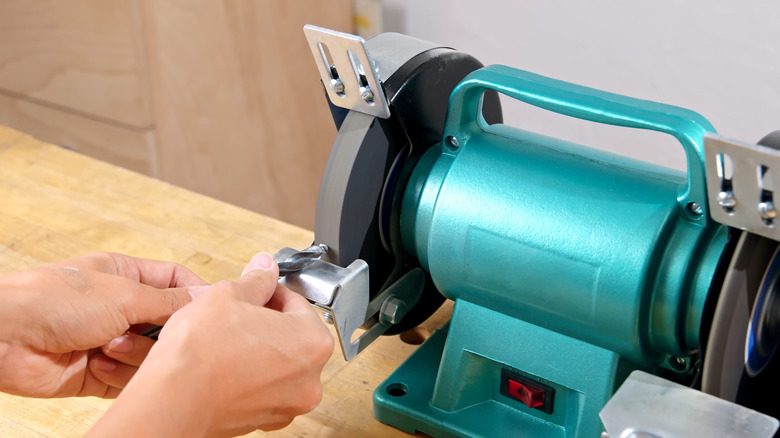
When you need to sharpen your tools and blades, you have a couple of options to consider. To decide what's best for your needs, it's worth comparing a bench grinder or an angle grinder. Some people prefer the angle grinder, because it is handheld and portable, allowing you to use it anywhere for sharpening. The bench grinder is a powerful tool, but it's designed for stationary use in a workshop where you can bolt it in to a workbench for the safest operation.
If you have a bench grinder, you may wonder how else you can use this stationary tool. You could use a conversion technique to change this power tool into a metal polisher. People use metal polishers to give metal items protection against corrosion, to prepare the surface for a coating application, or to improve the look of the item. This tool can also eliminate slight manufacturing flaws or minor damage in a metal part. You might be tempted to buy a metal polisher for $70 or more, but you can save some money with this conversion instead.
YouTube creator Vintage Boulton inherited a 3/4-horsepower bench grinder from family members and decided to try converting it to a metal polisher. This is a process that many DIYers could manage, although it can be a bit of a challenge for those who don't have some experience working with tools. In addition to people who do restoration work, hobbyists who work with metal parts may also want to try this conversion.
Basic steps to convert a bench grinder to a metal polisher
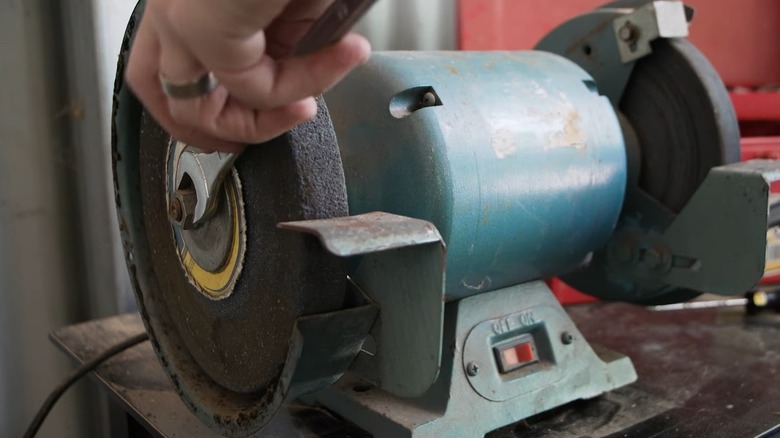
Most bench grinders have guards designed to protect the user from injury when using the abrasive wheels. When converting this tool to a metal polisher, you'll need to remove these guards first. Find the right size of wrench and loosen the bolts and other fasteners that hold the guard in place. After taking off the guards, remove the grinding wheels from the posts; the fasteners you've already removed may be enough to dislodge the grinding wheel.
You'll next have to screw threaded adapters over the bench grinder spindles to hold the polishing wheels in place. You can purchase these adapters at some hardware stores or on Amazon for roughly $10 to $20 for a pair. Measure the spindle's diameter and purchase an adapter that matches and will screw onto it. You'll normally tighten the adapters in place with grub screws (or set screws), which are fasteners that don't have a head so they can sit flush when installed. You'll need a left-threaded adapter for the left side of the tool's spindle and a right-threaded adapter for the other side.
With the adapter in place, you can attach the polishing wheel. Spin the threaded center hole of the polishing wheel onto the adapter. The sizes of both components need to match or the polishing wheel may wobble. You should be able to hand-tighten the polishing wheels to secure them in place, although some units need a nut added over the top.
What to consider before converting a bench grinder
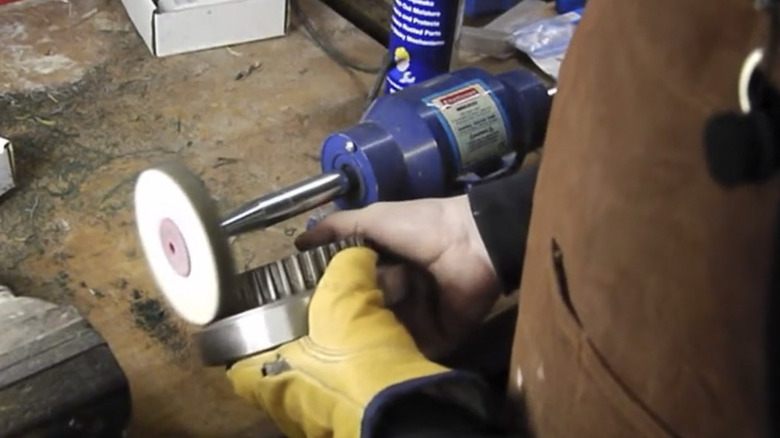
A bench grinder might not be one of the must-buy power tools for first-time homeowners, since most of them probably won't use it daily. However, you might have inherited one, like the YouTube creator did, and you rely on it for occasional jobs. If you're hesitant to convert it to a polisher because you want to continue to have a grinding option, you could keep one grinding wheel in place and only add the polishing wheel to the other side. Just follow the steps for one side of the tool.
When selecting a polishing wheel, pay attention to its diameter. Some will be too large to fit on the bench grinder without contacting the workbench when they spin. Additionally, some polishing wheels may not be made to spin as fast as the bench grinder will attempt to spin. Check the maximum recommended revolutions per minute (RPM) for any polishing wheel you plan to purchase. If it spins too fast, you could leave discolorations on the metal being polished.
It's important to note that bench grinders and metal polishers are potentially dangerous tools. Both types of machines spin their wheels at thousands of RPM, which creates the risk of loose pieces striking you or a bystander. You also could lose your grip on the metal item you're polishing, causing it to fly across the room. Whether you're converting a bench grinder to a metal polisher or using it as originally intended, you should always wear safety goggles or a face shield to guard against injury.