

Solid Wood Vs Plywood: How To Choose Between Them For DIY Projects
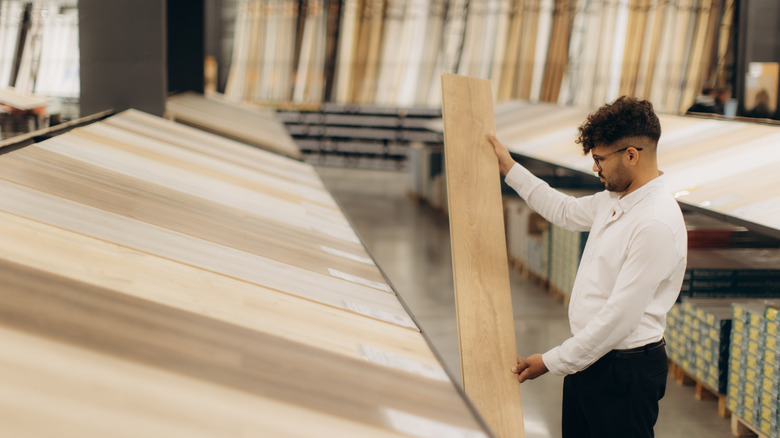
Building your own furniture can be supremely gratifying. But getting it right requires extensive planning. Between dreaming up the ideal design and realizing it, you must make a call on the right materials and tools. One question that routinely comes up during planning is whether you should choose solid wood or plywood. However, this decision isn't straightforward and depends heavily on several factors. These include what you're building, its durability requirements, aesthetic preferences, conditions it must endure in its final location, budget limits, and your DIY skills.
As such, solid wood, which is simply a sturdy piece of lumber cut from trees, is downright gorgeous and unique. Variable across species, it features beautiful knots and patterns in its grain, promising one-of-a-kind furniture that's truly yours. However, wood can warp, twist, cup, shrink, and split, making it unsuitable in humid or wet conditions. You also need to be highly skilled since you must account for wood movement while designing your projects.
Plywood, in contrast, is produced by sticking several wooden veneers with glue into a flat sheet. As plywood is always stacked in an odd number of layers with each grain rotated 90 degrees, it's structurally more stable than wood and can better handle humidity. But it isn't as long-lasting and limits your wood choices. Most woodworkers strike a happy medium by combining both materials: where stability is a non-negotiable, like cabinet boxes, they'll use plywood, with wood on top for finishing and durability.
When to use solid wood for your DIY projects
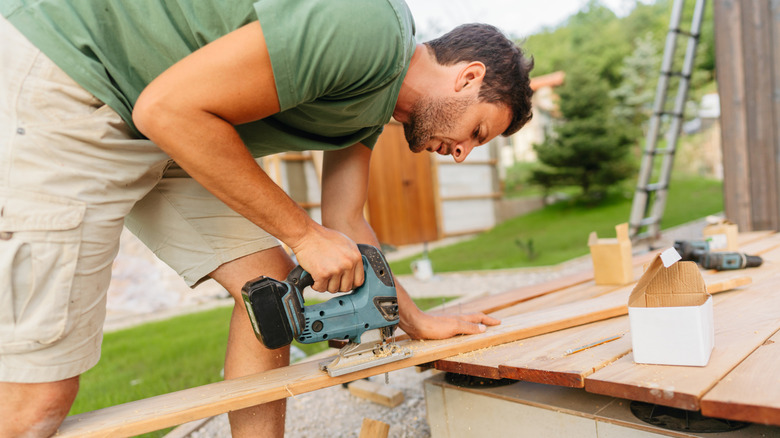
Solid wood is a single, continuous piece whose grain runs in the same direction. This makes it highly reliable and sturdy along its length, making it suitable for concentrated, load-bearing projects requiring a durable structure. Key examples include legs on your furniture, bed rails, structural beams, and tabletops. Solid wood also broadens your aesthetic choices. Since there are plenty of wood species to choose from, including exotic ones, it's your gateway to building a truly unique piece that pairs well with your home style. Any DIY project that requires a pretty top, like cabinet fronts, countertops, or even cutting boards, is mostly done with solid wood. It also helps that it's often food-safe.
On account of durability and maintenance, solid wood fares better than plywood. When you sand or plane plywood frequently, you may eventually hit its core, running out of options to rescue it. Solid wood has far more flexibility and can be refreshed multiple times over its lifetime. So, if you want furniture that lasts and can be passed down to your descendants, pick solid wood. Besides, solid wood has a prettier, uniform edge. This comes in handy to pretty up the separated, ugly corners of plywood projects that will be on display or otherwise, especially for door frames or crown molding. It's also ideal for projects involving traditional, interlocking joints like dovetails, rather than fasteners.
When to choose plywood for your DIY projects
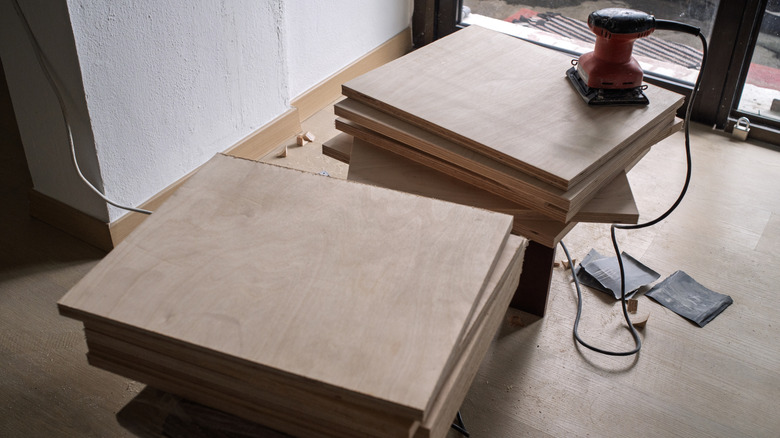
Plywood is a superior choice when your DIY project's final location is in an uninsulated, exposed or wet area. It's also ideal when you require a completely flat surface. Since solid wood has a continuous grain, it can't tolerate major moisture and temperature fluctuations, though dried timber may still have some built-in tolerance. But plywood counterbalances these variations to a certain extent due to its counter-grain production. For this reason, it's more suited to shelves, cabinet carcasses, desktops, or bookshelves where you want the structure to remain square and stable, without noticeable shrinking or warping. You may also put up such furniture around kitchen sinks or bathroom vanities, which tend to stay wet or humid for long.
Plywood projects are also highly beginner-friendly, since you don't have to consider wood movement. Projects requiring wide slabs are also best built from plywood, as they'll be considerably less heavy and budget-friendly. Plus, you can avoid the labor involved in combining the edges, since you can easily find large panels. Because alternating grain distributes load stress equally across the sheet, plywood is less likely to split along the grain lines. This makes it valuable for DIY projects requiring screws and fasteners, like drawer slides. Feeling clearer about your choice between the two materials? Use this secret to choose a good piece of plywood for every project you take on, or check the factors you must consider when choosing wood for your next DIY project.