

The Best Tool To Easily Remove Staples From Walls Or The Ceiling
We may receive a commission on purchases made from links.
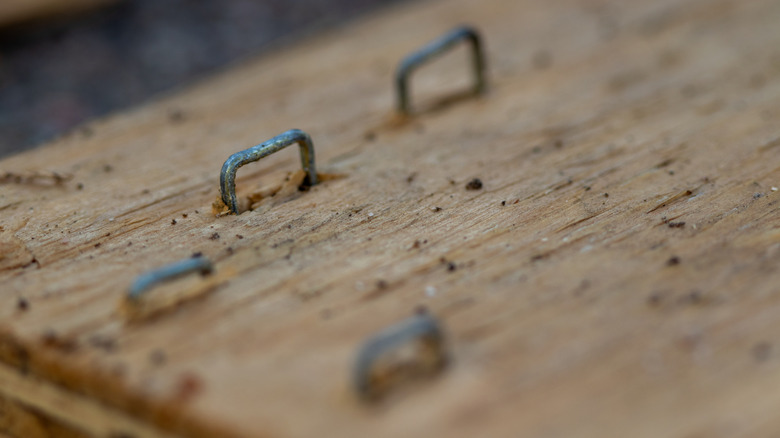
Staples are a simple thing — a U-shaped fastener — with so many niche uses that the term has come to refer to a bunch of very different things. You'll find staples of different levels of robustness used for upholstery, carpet and flooring, fencing, attaching electrical cable, securing landscape fabric, closing skin, and even sealing cardboard cartons. There aren't a lot of reasons to find — and fewer reasons to remove — staples in your walls and ceilings. When you do need to remove them, a staple lifter, like the Husky round-shaft tack puller, is usually the right tool for the job.
Removing staples from walls and ceilings can be a demanding task because staples driven into hard surfaces like wood tend to be pretty insistent about staying there. So you need a robust tool, but you also want to avoid damaging drywall and other softer surfaces. In wall and ceiling construction, staples are sometimes driven into wood when they've been used to attach insulation to studs (such as in the case of insulating a finished garage ceiling), attach siding backer, and attach various roll goods, like house wrap, roof underlayment, and vapor barriers. Those staples tend to stay put, but DIYers might occasionally find themselves removing acoustic tiles or sound-absorbing foam that has been attached directly to wood, particularly in older buildings with solid wood surfaces.
But most of the time, you'll probably be removing staples from drywall, where they're used for tasks like attaching corner bead for easily touching up damaged drywall corners. But sound-dampening tiles get attached to drywall as well, and rumor has it that upholstered walls are making a comeback. These wall and ceiling uses aren't as common as using staples for flooring and fencing, but it does come up from time to time.
How staple lifters work
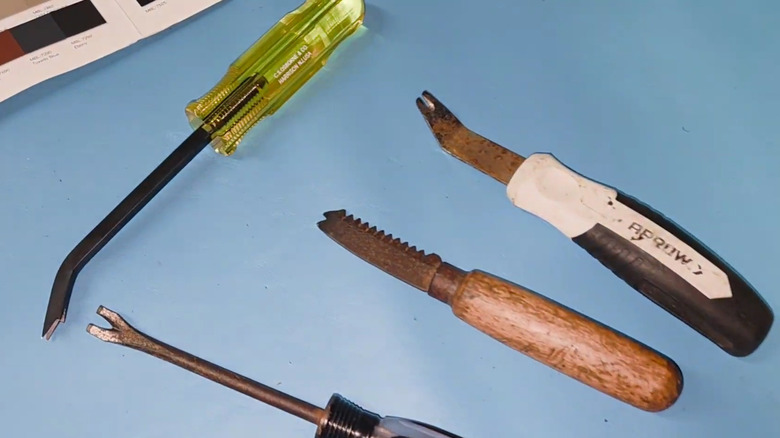
The Husky tack puller evolved from upholstery tools like the CS Osborne 120 staple lifter (also a good general-purpose "staple lifter," as they're sometimes called), and is purpose-built for removing staples from wood without too much destruction. While tools designed to remove staples from skin and paper often have to do the work of straightening the "tines" of the staples they're removing, for construction purposes, you usually only need to pull the thing out. So the design of staple pullers tends to be exceedingly simple. They're mostly defined by a sharpish, somewhat flattened point (or sometimes two, to accommodate small nails). The points vary in sharpness, with some upholstery tools like the Osborne staple lifter (and many other Osborne models) being quite sharp. This makes getting under the staple easier and also makes damaging your workpiece easier. It might reduce the lifter's durability as well.
Lots of people make do with a simple flat-head screwdriver. But dedicated staple-lifting tools add leverage after you've jammed their points under the crown of the staple. This leverage usually comes in the form of a curved shaft that rolls against the stapled surface to increase the distance between the point and the surface ... that is, to pull the staple out.t