

The Attractive Branching Plant That Makes A Stunning Privacy Hedge
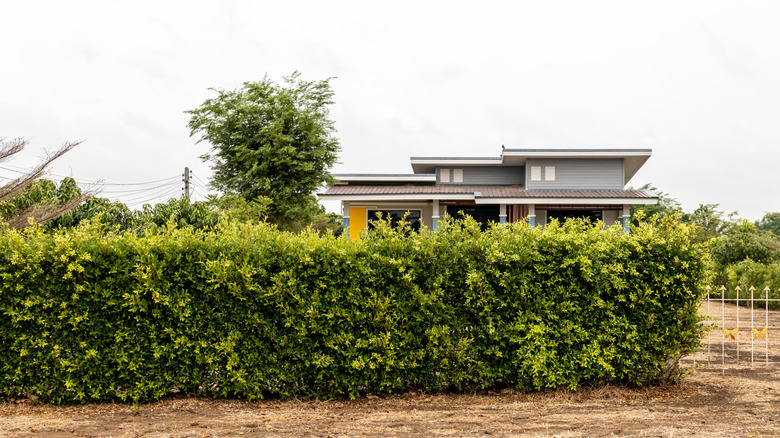
Once the festivities are over, you take down the Christmas tree and pack away the decorations for another year. All of your holly-shaped ornaments and faux greenery are among them, but holly deserves a spotlight for more than a month or two every year. This fast-growing, berry-sporting, and often evergreen plant is underappreciated. It's Nelliet holly (Ilex hybrid 'ROX') that earns special mention here. This hybrid is an improved variety of 'Nellie R. Stevens' holly (Ilex Nellie R. Stevens) that is prized as a privacy hedge. Nelliet holly is the quintessential Christmas holly, too. Its deep green leaves and red berries make it ideal to harvest from your own yard for stunning holiday greenery.
Nelliet holly has all of the commendable features of the 'Nellie R. Stevens' variety, such as dense growth and beautiful branching. Nelliet holly improves on these winning traits by needing minimal pruning to grow into a classic conical shape. It thrives in sunny to part-shady spots in USDA hardiness zones 6 through 9. Nelliet is new enough not to be available for general sale yet, but it will be in 2026.
'Nellie R. Stevens' holly (although self-fruiting) will only produce a limited amount of berries without a male holly growing nearby, and this may be the case for Nelliet holly, as well. A pleasing row of Nelliet holly plants and a small number of compatible male varieties (like a male cultivar of Ilex x meserveae 'Blue Prince') will enclose your yard beautifully. Plus, all types of holly attract plenty of songbirds and other wildlife that benefit from the berries and shelter the shrubs provide.
How to plant and maintain Nelliet holly bushes
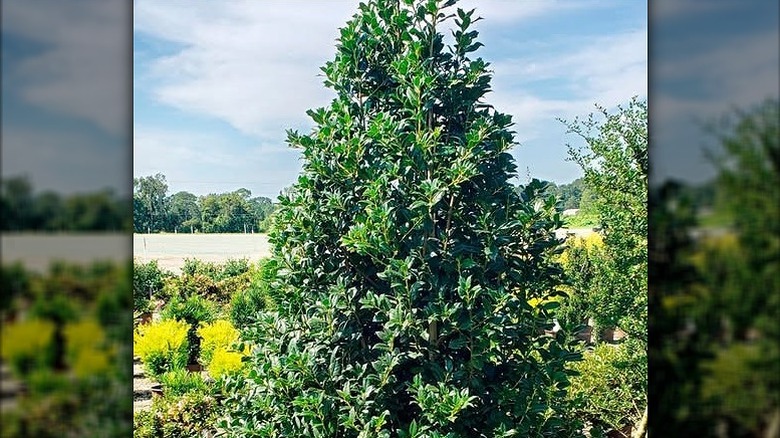
It's not terribly complicated to successfully grow and care for holly bushes. Nelliet holly is pretty low-maintenance once the plants are established. After you've scoped out the area where you'd like your living holly barrier, you'll want to give each plant plenty of room to grow, both out and up. Nelliet hollies can reach heights up to 25 feet and 10 to 15 feet wide. Also, make sure the ground in that area is well-draining. If you're stuck with a soggy spot, try mixing some horticultural sand into the soil to relieve your plants of excess moisture.
Dig a planting hole that's about twice as wide and not quite as deep as the holly's pot. Water the plant well before placing it in the hole. Nelliet holly should sit between 1 and 2 inches above the ground soil. Fill the hole with soil, amending it if necessary. Give the plant another generous watering, and add more soil if needed after the water settles. Protect the plant with 1 to 2 inches of mulch around the trunk, but leave a gap between the stem and the mulch.
For its first two years, give your Nelliet extra water every 7 to 10 days during dry spells to help it become established. You can fertilize your Nelliet every year in spring, but if you want it to grow faster, twice-yearly fertilization with a slow-release organic product is the way to go.