

Say Goodbye To Color Drenching: Color Capping Is The New 2026 Paint Trend

Homeowners looking for a style upgrade may want to pay attention to this paint trend in 2026 — color capping. While color drenching is not going the way of the dinosaurs, it is facing some strong competition. The term "color capping" was coined by Benjamin Moore in 2025 and is gaining popularity. This painting technique is viewed as a nice middle ground between the high impact of color-drenching and the simplicity of a room with a basic white ceiling and colored walls. "Color capping introduces subtle depth by enveloping the room in a tonal gradient that intensifies toward the ceiling," Helen Shaw, director of marketing with Benjamin Moore, told Homes & Gardens. Unlike drenching, which covers the walls and ceiling in the same color, capping begins with one shade at the base of the room. Then, you use a darker or lighter shade from the same color family to paint the ceiling, giving it that "capped" look. For a few ideas, these are the best paint choices when using this color capping trend.
To enhance the gradient look, choose a similar hue for accents at the base of the wall and above it, blending more than two colors. What's also fantastic about this trend is that it doesn't matter whether you want your room in laid-back neutrals or an abundance of brightness; color capping works with it all. Jessie Brooks, a product manager at Davincified, told Martha Stewart that, "It creates visual interest without overwhelming a space. When done right, it can make rooms feel taller and more polished."
Try color capping in your home
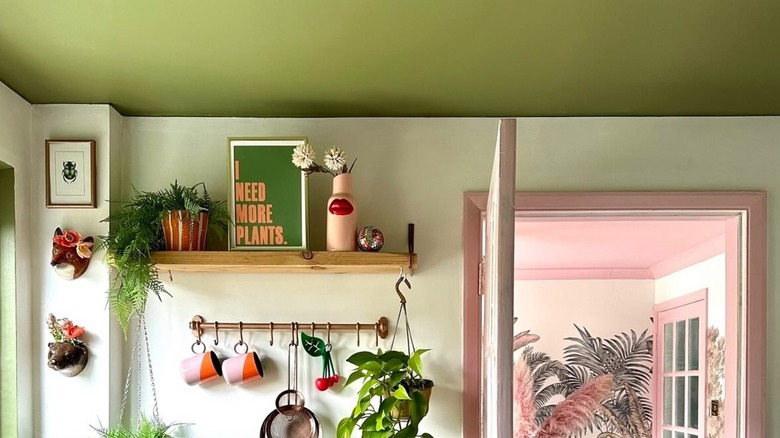
To implement this paint trend, look for colors that have some depth; ones that really make you feel something. While you can certainly stick with neutral tones, choose those that add some complexity and mood to the room. Just keep in mind that a boring color in multiple hues can still be dull. When picking shades within the same color family, avoid jumping too far from light to dark or vice versa; stick to two or three shades in between. The main idea is to cover the ceiling with the darker shade. However, some people may prefer to go the other way. It's your space after all.
Smaller rooms may benefit from lighter colors, while larger rooms can handle darker hues without making the space feel confined. Keep in mind that sometimes dark colors can make a small room feel larger. If your room has mostly flat walls, you can still use gradient color changes along the walls, but you'll need to define your own separation point and may need to experiment to get the look just right. If the room has crown molding or other features that stand out from basic flat walls, this gives you a great place to switch up shades. Gradient color patterns allow you to create a cohesive color palette for your home. If done correctly, color capping can make slender spaces, like hallways, feel wider, and shorter rooms feel taller.