

11 Ways Joanna Gaines Adds Privacy To A Home Without Sacrificing Style

We may receive a commission on purchases made from links.
As the certified queen of farmhouse style, Joanna Gaines has taught her devotees how to best style open shelving, the secret to successfully meshing antique finds with more modern pieces, and the value of a shiplap accent wall. But those aren't the only lessons fans can yield from the HGTV darling.
While the Magnolia founder undoubtedly loves the flow an open-concept floor plan provides, she knows how to create defined zones and separate spaces when clients are seeking enhanced privacy. Take the loft she and husband Chip Gaines created for "Fixer Upper: The Lakehouse." Rather than leave the upstairs landing fully open, they removed the existing pony wall in favor of a set of custom-built wood screens that help the place feel enclosed, yet still bright and airy. Then there's her predilection for reeded glass — a clear winner when you want to create a little solitude without sacrificing any natural light. Those are just a few of Gaines' tricks for adding privacy without marring a desired aesthetic.
Farmhouse-style barn doors can stylishly separate spaces
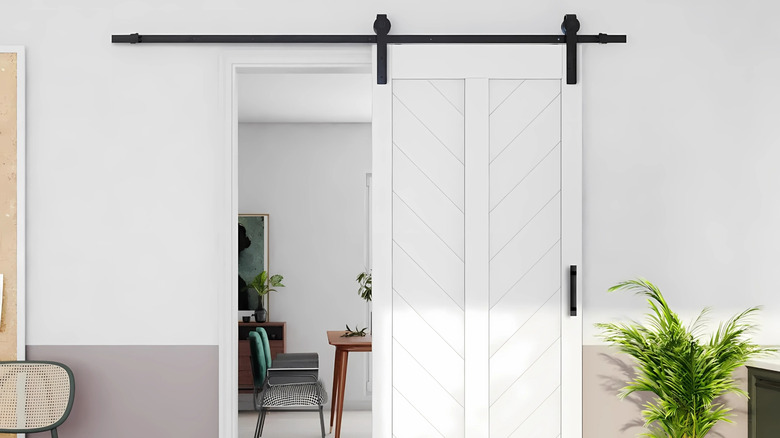
You can, uh, bet the farm that this is a winning choice for anyone looking to close off a more open floor plan without installing drywall. In a Season 2 episode of "Fixer Upper," Gaines erected one of her go-to pieces, a set of sliding barn doors, "in the foyer leading into our client's office," she detailed on her Magnolia blog. The move helped create "both character in the foyer," she said, "and privacy for the office."
Since this type of door slides open and closed, it can be squeezed into the smallest of nooks. It's a great solution to temporarily separate rooms — for instance, your dining area from the rest of the kitchen. That's just one of the best places in your home for barn doors. They can also be installed in your entryway, to close off a bedroom closet, as a pantry, or to hide a laundry area.
Using an antique door provides separation without sacrificing your aesthetic
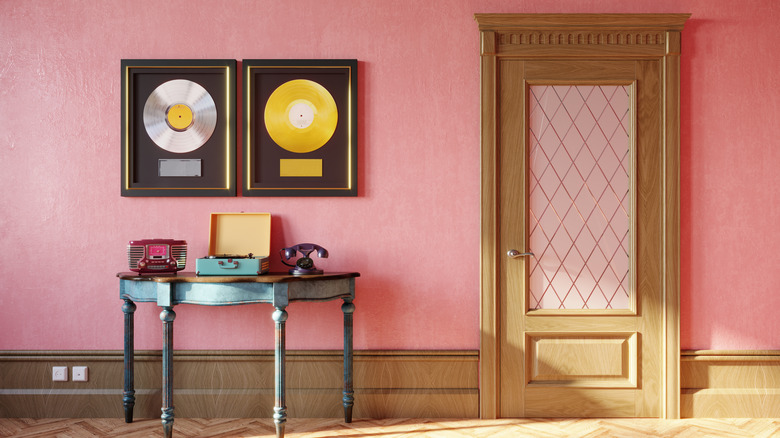
Even when breaking up an open floor plan, Gaines doesn't want to close the door to style. So the Magnolia Network owner is quite thoughtful about the types of doors she uses. In a Season 3 episode of "Fixer Upper," Gaines tasked a local cabinetmaker with crafting an attractive wood piece to separate the office from the rest of the living space. Made of solid wood, "it serves as a striking feature that ties into the main style of the great room," she wrote on her blog, "while being functional and adding privacy." She made similar moves years later when tasked with renovating her friend and "Today" show alum Hoda Kotb's New York City office space, installing antique doors from Portugal to divide the hallway into three separate small offices.
And you don't need to have a family heirloom to add a little something vintage into your home. Thanks in part to Gaines, reclaimed wood pieces are quite popular, meaning you are likely to find something in your neck of the woods by searching eBay, Craigslist, or Facebook Marketplace. You can also scour antique shops and second-hand stores for unique finds. One aspect to consider is that older doors may not be an exact fit for a modern doorframe, so you may need to cut them down by a size or two.
Stylish partitions can help an area feel private without closing it off
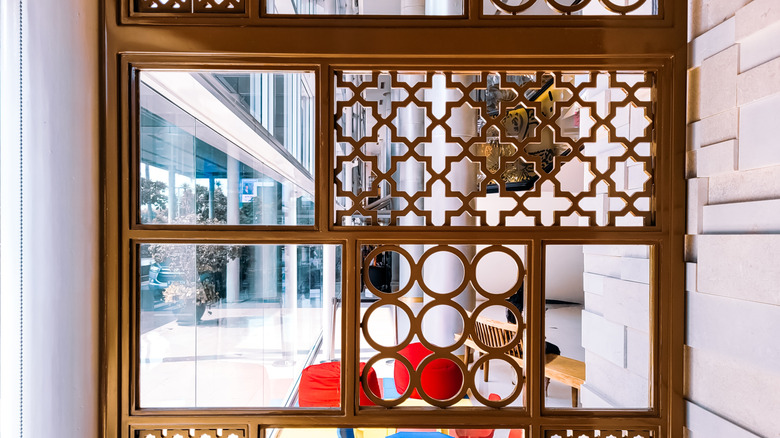
Gaines had some lofty goals when renovating a 5,100-square-foot Spanish revival on "Fixer Upper: The Lakehouse." Namely, she wanted to keep the airy feel of the second-floor landing while still giving it a cozy, nook-like vibe. So, she commissioned a set of custom wooden screens — featuring a tight grid pattern that gives off midcentury modern feels — and hung them from floor to ceiling. "I love these so much," Gaines raved of the finished product. "I love these screens, how simple they are — but, detailed, very detailed."
You can score something akin to her creation, such as Wayfair's $380 Decorative Lattice Trellis Panel set or AllModern's similarly priced Poul 72-inch-by-72-inch Solid Wood Single Panel Room Divider. Or, if you're particularly handy, you can DIY a wood privacy screen that's much more budget-friendly. Simply combine a few wooden planks, a jigsaw, a nail gun, and a bit of carpentry know-how, and you can truly, uh, nail the look for roughly $30.
Reeded glass provides privacy, while still letting the light in

It's easy to see why Gaines so frequently reaches for panes of reeded glass. Not only is the fluted look an attractive one, but it gently distorts the images on either side, creating a sense of privacy between spaces without blocking out natural light. Which is why she relied on the glass panels — placed inside custom sliding cherry wood doors — when renovating the library inside the five-bedroom waterfront spread on "Fixer Upper: The Lakehouse." "The Lakehouse project taught me so much," Gaines recounted on Facebook. "There's just something so good and intentional about 1960s design."
So, no surprise that the art deco glass design trend is making a big comeback. It's a look that elevates any space and plays well with all sorts of materials. The one downside of reeded glass, however, is that it can be trickier to clean. While the ridges resist fingertips better than smooth glass, you'll need to be sure to really scrub the grooves with a mild or homemade glass cleaner, as they can trap dirt and soap scum.
Or, skip the reeded glass in favor of a stick-on film that mimics the look
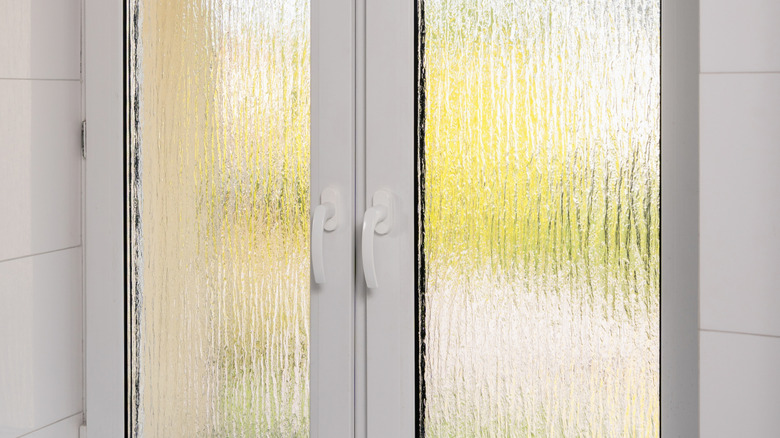
Yes, Gaines could have fully replaced the bathroom window when updating a 100-year-old home on an episode of her "Mini Reni" series. But she found a more affordable hack instead. Keeping her goal in mind — "creative updates in smaller spaces that make a big impact," as she detailed on her Magnolia blog — Gaines stuck the landing with this smart hack. "Instead of replacing the whole window," she wrote, "we painted the existing trim and added a stick-on film to the pane to mimic reeded glass for privacy."
To replicate the reeded glass look on a budget, you'll want to purchase an option like Velimax's Reeded Glass Privacy Film. Be sure to measure carefully before ordering, keeping in mind that it's easier to cut down a too-big piece than to work with a swath that's too small. To apply, make sure the surface is fully dirt-free, then spray with water to moisten the panes before flattening the film. Smooth out any bumps using a squeegee or a plastic card. Because it's reusable, if you're struggling to remove the air bumps, you can peel off and start over.
Roman shades are a classic window treatment option that won't go out of style
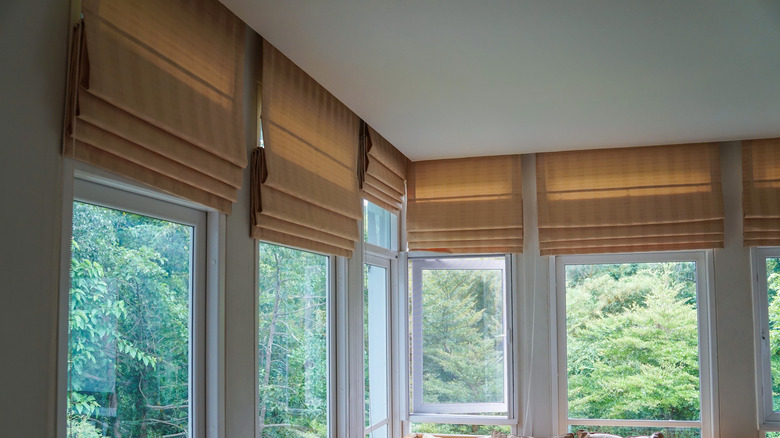
Though standard vinyl blinds and curtains tend to be the standard for window treatments, Gaines prefers to do as the Romans do. The design pro is a fan of Roman shades — elegant fabric window coverings that fold into horizontal pleats — as a statement piece that's as practical as it is pretty. Working on the same "Mini Reni" project, she installed natural-hued Roman shades in the foyer with a texture that paired "well with other woven elements throughout the space."
Roman shades are certainly trendy, but they won't work for every home. For starters, their price tag is on the higher end. And since they can wear easily, you may need to replace them every few years. Those who prefer a sleek, minimalist look may find they're not for them, as they don't disappear when rolled up, giving a bulkier look.
Plantation shutters offer the right amount of privacy in a bathroom
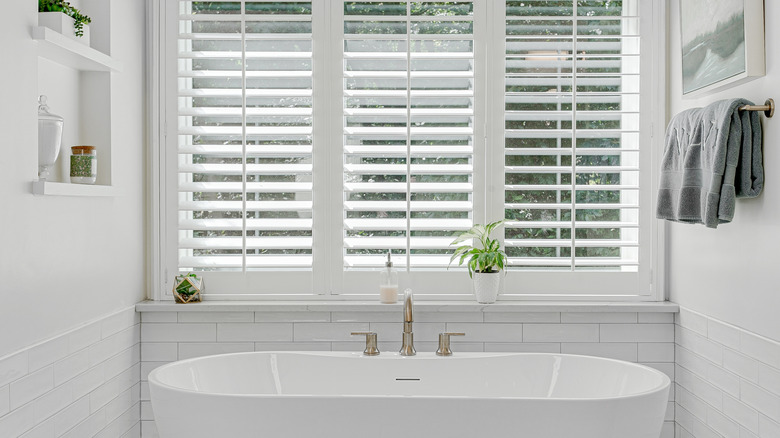
Another savvy way to, uh, shut out any prying eyes is to opt for one of Gaines' other go-to window coverings. "In order to keep this space private," she wrote in her 2018 book, "Homebody," of her bathroom strategy, "consider a window treatment like plantation shutters for a styled look."
Also called interior or estate shutters, the timeless window treatments complement many home decor trends. You'll just want to be careful not to make this mistake when cleaning plantation shutters. Since excessive moisture can cause wood to warp, swell, or — worst case scenario — rot, you'll want to use a neutral pH wood cleaner. After a thorough dusting, spray on a small amount and gently wipe down each slat, then buff with a clean, dry cloth.
Bifold shutters allow you to close out the world easily
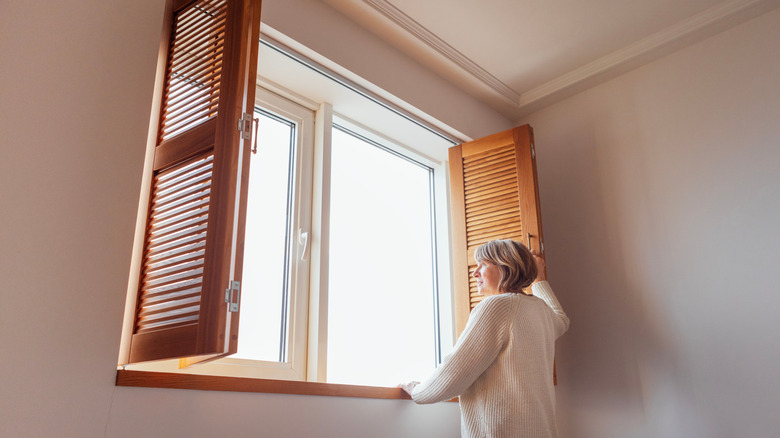
Elevate your standard blinds or curtains with a set of bi-fold wood shutters. Gaines built a set for a kitchen renovation on a Season 5 episode of "Fixer Upper." While entirely charming (Gaines had her cabinet maker craft them from the same wood they used for the vent hood for a cohesive look), the structural element offers flexibility, allowing homeowners to let the sun stream in throughout the day, then close things up at night. "Blinds or curtains are the typical go-to, but using these bi-fold shutters added an extra layer of character that is harder to achieve with classic window coverings," Gaines explained on her blog. "They're also fully functional — easy to open during the day to let in natural light and then close at night for privacy."
And while it may seem like a big job, you can try this DIY wood shutter project for inside or outside your home. Using wooden planks of your preferred size — a good rule of thumb is to have the shutters be half the width of the window or a little less — sand down each plank and then attach them using mortise-and-tenon joints and strong wood glue. The finishing touch: use an extra plank to glue on a horizontal cross piece.
Glass partitions create space without sacrificing natural light
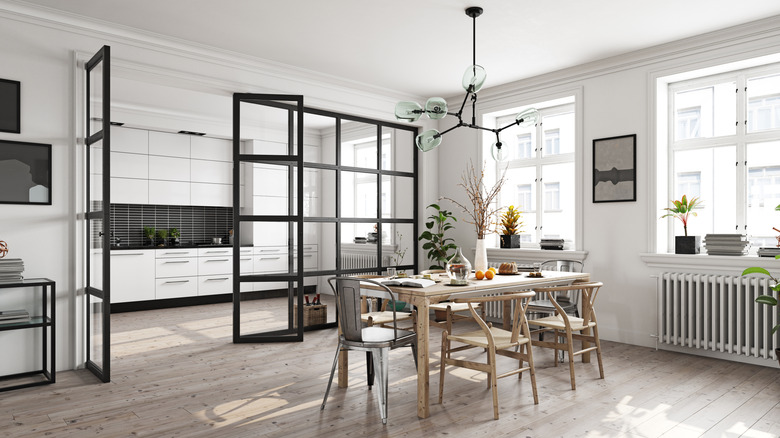
The upside of adding a window wall inside your home is fairly clear. Not only is it an eye-catching architectural detail, but it can create a sense of privacy between individual spaces and help cut down on noise without blocking any natural light. It's a strategy Gaines employed in Season 1, Episode 4 of "Fixer Upper: Welcome Home" when working on an emergency shelter room for girls, installing a window with bold, black framing.
While a window wall offers a stunning look, the glass-half-empty way of looking at it is that it can be somewhat time-intensive to clean. So, if you feel that having to scrub each pane might break you just a bit, there are endless decorative room divider ideas to separate your space in style. You can even DIY a budget-friendly room divider that doubles as a sleek storage solution by transforming an old bookshelf into a piece that's part shelving unit, part room separator.
Architectural features can create the look of separate spaces
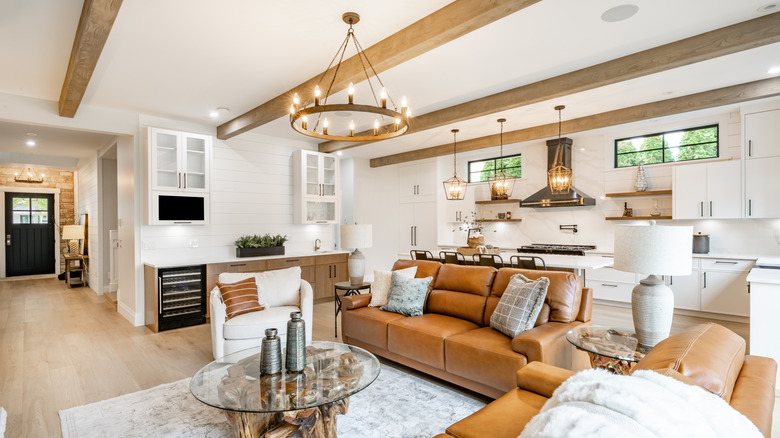
When it comes to creating zones in a more open floor plan, Gaines has a few, er, bright ideas. One highlight is to use lighting fixtures to help visually delineate two separate spaces within one wide-open room. Whether you opt for an oversized chandelier in one area or a series of pendant lights or bistro lighting, it tricks the eye into seeing two distinct spots. As Gaines explained to Homes & Gardens, "When you walk into [a] space, you have two defined areas."
To choose the right light fixture that will boost your living room, consider adding multiple sources. While overhead lighting alone can create a harsh vibe, a mix of that with table lamps, sconces, and strip lighting can create the warm glow that you're after. You also want to consider the scale of the fixture and your space. A bold, dramatic piece might make a statement, but it can also overwhelm a smaller room, while smaller pendant lights might get lost in a vast space.
Adding a film to windows is easier than a full-on renovation
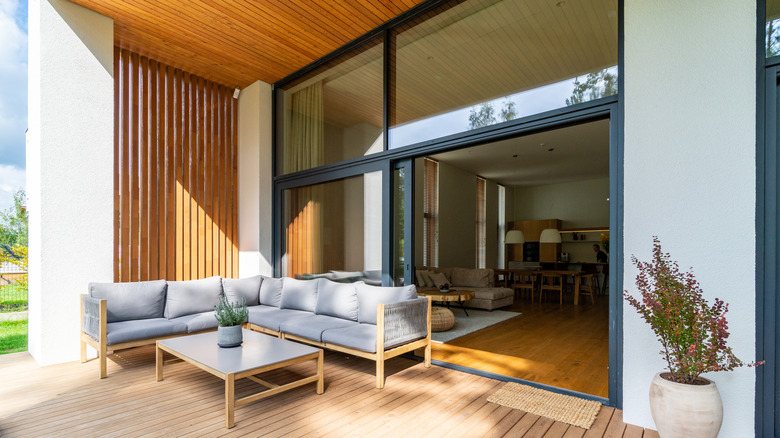
Sometimes the simplest solution is truly the best. Such was the case when Gaines took on a renovation at her parents' home, transitioning an outdoor porch into a space that's half greenhouse for her plant-savvy dad Jerry, half sunroom for her hostess mom Nan, in an episode of "Mini Reni." To preserve the waterfront views, she chose not to put any blinds on the windows "to get maximum sunlight in here because it is a greenhouse," Gaines explained. But in an effort to make the room feel like its own private space, a film was added to the original exterior windows — a much cheaper move than removing them entirely.
For those looking to turn their existing outdoor porch into an indoor entertaining area, there are several porch enclosure systems to consider. A sunroom with a roofed structure and glassed walls completely protects you from the elements, while a screened enclosure offers a more budget-friendly solution. Or you can go fully open air by adding a roof and outdoor curtains.