

The Stunning Woodwork Feature To Look For In Historic Houses

When we go house hunting to find somewhere new to live, we often focus on factors like location and room sizes that can cause us to overlook certain features. Architectural trends and designs come and go, with many historical homes containing elements from different eras and styles, making it difficult to know what to look out for. However, one brilliant woodworking feature found in many historical homes is the egg and dart wood pattern. Rich in history and usually a sign of quality craftsmanship, the egg and dart pattern often appears in types of wall molding and woodwork in high-end interiors and neoclassical architecture. As the name suggests, this motif consists of a repeating pattern of egg-shaped ovals and narrow, dart-like points.
Although this feature appears in buildings across the U.S., its origin is far from these shores. First developed by the Ancient Greeks, the egg and dart pattern was also used by the Ancient Romans, with the motif appearing on the Temple of Athena Polias in Athens. When the neoclassical decor and architecture revival occurred in the 18th and early 19th centuries, the egg and dart motif came back into fashion and was incorporated in buildings across Europe and then the U.S.
The egg and dart pattern indicates craftsmanship
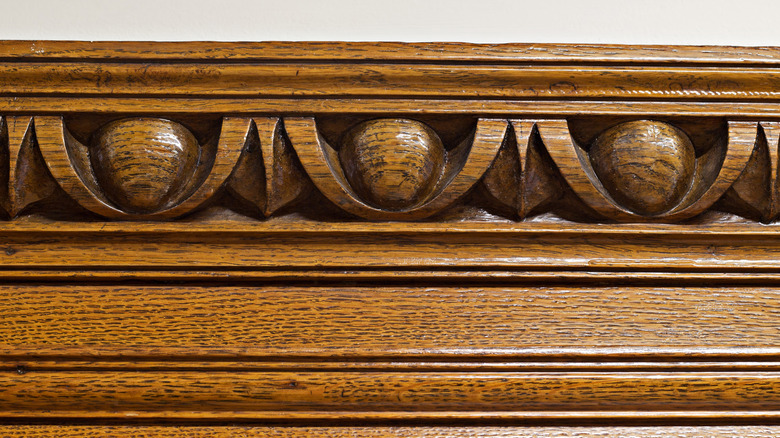
The egg-and-dart motif has appeared in homes throughout history, especially when architects began taking inspiration from Greek and Roman buildings. Having one in your home brings an element of class and elegance into your space while paying homage to architectural styles of the past. It is a subtle hint at grandeur and suggests that the home was built to impress. It can also help to indicate the time when the house was built. As the egg-and-dart design became popular during the Greek revival in neoclassical architecture, homes displaying the pattern can usually be dated to the 18th and 19th centuries. However, as this design is still popular today, people are installing crown molding and other types of molding featuring the egg-and-dart pattern into their homes or using it when restoring old buildings, and therefore, the appearance of the motif doesn't automatically represent historical work.
As egg-and-dart woodworking is more labor-intensive to add to a home than your standard trim due to the necessary carving work, seeing it in a house reveals a certain level of craftsmanship and skill. This craftsmanship may appear throughout the home, reflecting a high standard of architectural design and creation. As the pattern is versatile, it allows you to redecorate and change things up in the home without needing to remove or alter the woodwork. The simplicity of the egg and dart motif blends seamlessly with other interior design elements, meaning you can make the house your home while leaving history intact.