

15 Foolproof Ways To Keep Your DIY Supplies Organized
We may receive a commission on purchases made from links.
There are DIY supply closets up and down the country that are proverbially (and sometimes literally) fit to burst. If this sounds familiar, then it should also reassure you that you are not alone. DIY supplies often include a variety of tools and other items that can only be described as "bits," which makes them very difficult to organize. The problem is that if you don't keep some form of order, these "bits" can quickly start to resemble a jumbled pile in which it's hard to find anything other than shame. This can lead to several problems, the first and most annoying being your own frustration. But it can also lead to wasted materials, and if you're not careful, even broken or damaged tools.
Fortunately, there are lots of budget-friendly ways to keep your home organized, and this includes your DIY stash. It doesn't need to be overcomplicated, either. All you really need is a little time (maybe a lot, depending on the state of your supplies) and some creative thinking.
To help you get on top of your DIY cupboard and restore order to your garage, we've gathered some of the most effective tips for sorting your supplies. Some, like installing a pegboard or hanging magnetic hooks, provide a physical solution to keep your gear organized. Others, like adopting a "one-in, one-out" approach, help you discipline yourself and avoid overcrowding your closet in the future. What they all have in common is that they'll help restore order to your supplies and allow you to find the items you need whenever there's a DIY crisis.
Add heaps of vertical storage with a pegboard
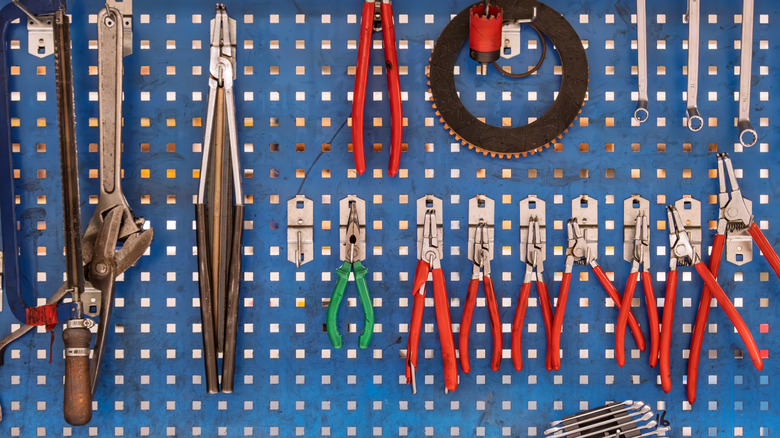
If your DIY supplies have finally outgrown the cozy cupboard that they were originally assigned — and you don't have floor space for more units — consider hanging a pegboard. Instead of gobbling up floor space, a pegboard makes the most of the unused vertical space on your walls. This solution is also highly versatile; you can customize a pegboard with hooks, shelves, and even baskets, making it perfect for organizing different DIY supplies.
The trick to hanging a pegboard is to use one that's large enough to accommodate all of your supplies. You should also ensure that it's hung on a wall that can support the weight of your tools and other items. Tick these boxes, and you'll find that it's incredibly easy to organize your pegboard. Reserve a section for all of your wrenches, portion part of the board for your different screw drivers, and add a row of hooks for your pliers. However you arrange your tools, once they're organized on a pegboard, it'll become infinitely easier to keep them that way. They'll also be far less likely to get damaged, and you'll be less likely to injure yourself by reaching into a pile of miscellaneous (and potentially sharp) tools.
Use clear storage bins to store small DIY supplies without losing them

Often used for organizing toys and craft supplies, transparent plastic bins are especially useful for storing DIY tools and materials. By allowing you to spot what's inside them, this organizational set up can save your fingers from the risky business of rooting through sharp screws and other pointy pieces of hardware. And if you use stackable bins, like these 4-inch Stacking Tilt Bins from Harbor Freight, it's possible to arrange your DIY area while taking up the lowest amount of counter space possible.
The beauty of bins like these is that, not only can they be placed on your counter or fixed to the wall, they are also modular. In other words, they slot together, meaning you can create a storage system for keeping all of your hardware pieces organized, including screws, nails, nuts, and bolts. You could also use them to store various power tool bits, like attachments for your drills and power saws.
Use rolling carts for portable storage while increasing your countertop workspace
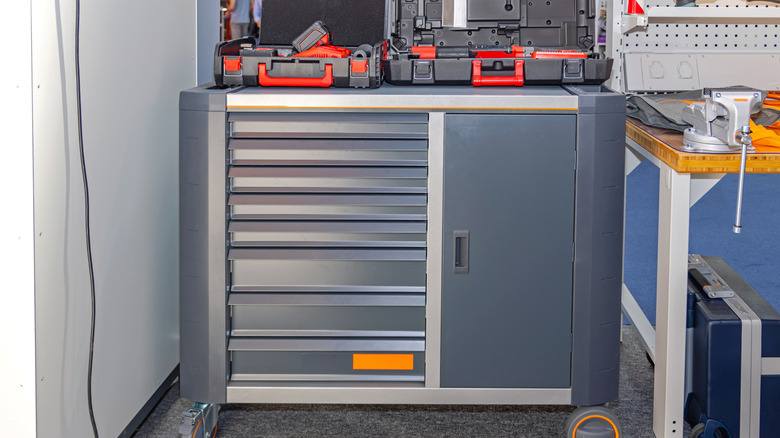
Sometimes, you don't need to be especially creative in order to store your DIY supplies. After all, products like Yukon's 9-drawer mobile storage cabinet are literally designed for the job. Of course, products like these come at a slightly higher cost than some of the other ideas in this guide. However, in the case of this top-rated Harbor Freight storage find, it also offers the bonus of portability.
In other words, you can bring your tools and supplies wherever they're needed the most. Many units like this also have a handy workbench on top. Not only does this provide a surface where you can perform various DIY tasks, but it also gives you somewhere to place items, like paint cans or dusty tools, that may dirty up your other surfaces.
Use labels to transform chaos into calm
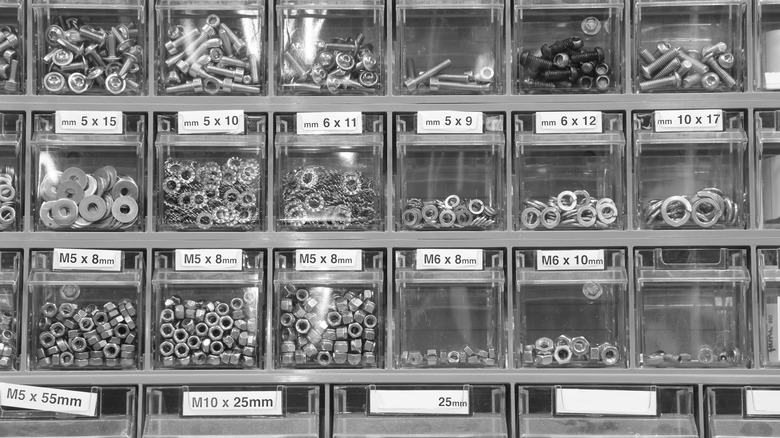
Your tools and supplies don't need to be piled in a heap to feel disorganized. Even if you have shelves, drawers, and storage bins in place, your stash can still feel chaotic if you don't actually know for certain where each tool can be found. This is why labeling things is so important.
You don't need physical labels to pull off this idea — you can simply annotate your storage boxes and drawers with a Sharpie. But, if you're looking for ways to put your label maker to good use, then you may well find that physical labels are better in the long term. Especially if you're prone to re-organizing from time to time — you'll find it's much easier to peel off a label than to scrub (or sand) away a Sharpie mark. Labels can also be bought in various colors, allowing you to color code your DIY storage and make it even easier to find what you're looking for.
Hang over-door organizers to store various DIY supplies
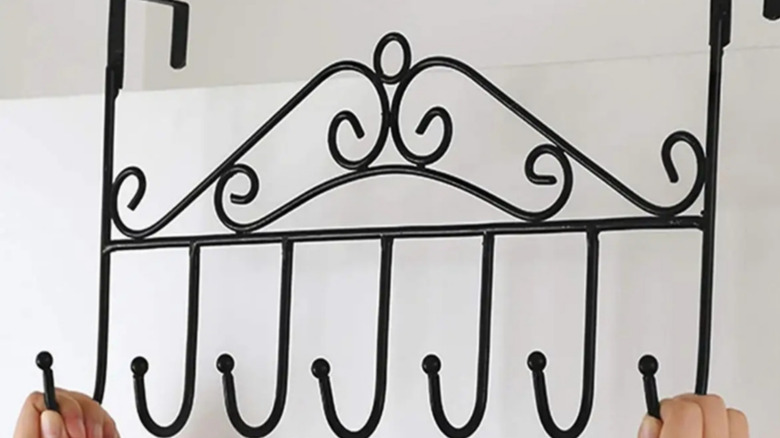
Like a pegboard, over-the-door organizers allow you to turn an otherwise unused surface into an invaluable source of storage. They're designed to hang over your doorways, and they usually feature various pockets. They're a useful way to store shoes, and they're equally handy for storing miscellaneous tools, like handheld garden tools, paintbrushes, and protective gloves, keeping supplies both visible and clear of the floor.
You can also find over-the-door hangers with hooks — similar to a coat rack — and there are also other products with storage pockets that are more like shelves. This five-tier over-the-door organizer by Amazon Basics, for example, features five shelves that are perfect for storing slightly larger items, like small paint cans. The mesh at the bottom of each tier allows you to see through the fabric and identify what's inside, making access to your supplies even easier.
Upcycle household items like mason jars to store small items
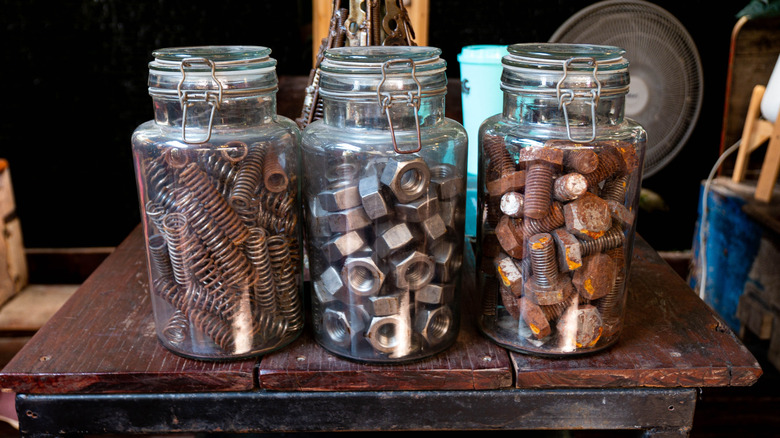
If you or your kids have a penchant for preserves, then instead of recycling those used jars, pop a few aside to help organize your DIY cupboard. Old jars and mason jars are perfect for keeping smaller items that could otherwise easily get lost. Since they're see-through, you'll always know what's inside the jars and can access the items you need.
To level up this organization trick, use your jars in tandem with your go-to label maker. Reserve a jar for your nuts and bolts (and label it accordingly), and use another to hold those various spare screws and hinges you have leftover from IKEA. Pop them on a shelf where you can see them, and try to avoid just throwing any old small item into your jars — this will just cause them to get disorganized again. And don't forget, there's nothing to stop you using a larger jar as a "bin" for miscellaneous bits that don't fit elsewhere.
Use a lazy Susan to keep the things that you need within easy reach
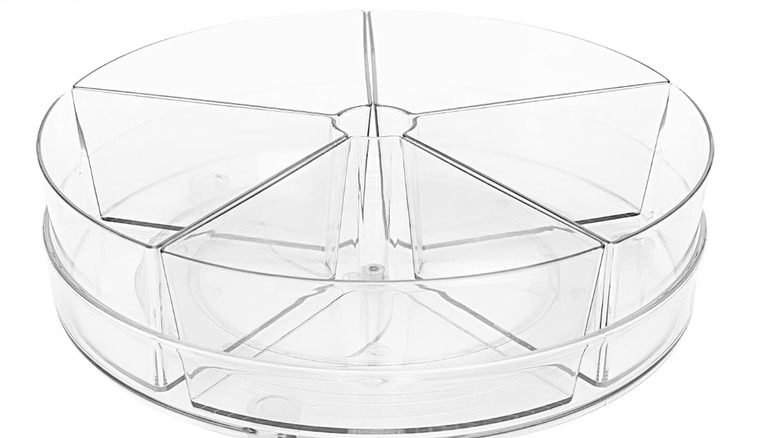
Instead of letting it gather dust at the back of your kitchen cupboard, why not repurpose your lazy Susan and use it to organize your DIY supplies? These classic kitchen cupboard staples are excellent for keeping a variety of DIY supplies tidy, organized, and handy. What's more, if you have a few spare glass jars, then you can easily pair them with your lazy Susan to create an accessible storage display. Think paints, small tools, and easily-lost items like screws, nails, nuts, bolts, and beads.
Alternatively, you could opt to buy a dedicated product with organization trays built in, like this lazy Susan organizer with removable bins by Roninkier. Each of the five built-in bins is see-through, offering the same benefits as glass jars. However, since they're part of the product, they slot neatly onto the Susan and won't run the risk of toppling. Sure, it's designed for herbs, spices, and baking ingredients, but why should that stop you from getting creative?
Use drawer dividers to level up your existing storage
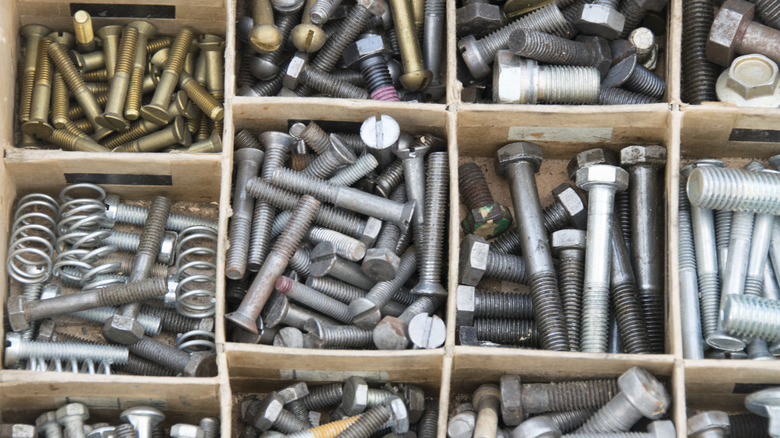
The first thing to state here is that drawers alone aren't always enough to organize DIY supplies. If you have a collection of mismatched hand tools and an unwieldy hardware hoard of loose screws, nuts, and bolts, then a drawer can easily become a DIYer's deepest source of shame. That is, unless the drawers are fitted with something to organize them.
That's where drawer dividers come in. This idea is one of the simplest in this guide, and yet it's perhaps one of the most effective. It can revolutionize your drawer storage, helping to separate different types of items and keep them tidy while preventing smaller items from spilling into the corners and getting jumbled together. You can buy dividers in varying sizes, too, like these expandable bamboo drawer dividers from SpaceAid. These can help to create different-sized sections within your drawers, including smaller areas for keeping those dreaded miscellaneous "bits" in check.
Alternatively, if it's just tools you need to organize, then why not grab yourself a cutlery drawer insert and use that? These inserts are like ready-made storage solutions for items like screw drivers, but they're also excellent for storing drill bits and saw blades. They're inexpensive, too, especially if you manage to snag one from your local thrift store.
Use bookcases or cube storage units to organize DIY supplies by category
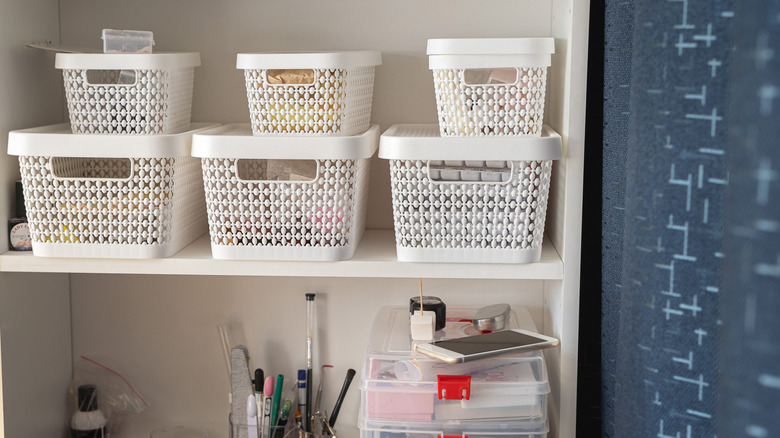
If you have space in your garage or DIY supply closet, bookcases or cube storage units can be a useful way to create flexible, expandable storage. You can use them to house various bins, trays, and stacked supplies. The key to making this storage solution foolproof is making it scalable, ensuring that it can continue to accommodate your growing inventory of supplies. In order to do that, you should install more storage than you actually need, at least to begin with.
Once installed, each "cell" in your cube storage unit can be dedicated to different items. For example, you can dedicate entire cells to housing larger items, like power tools. For smaller knick-knacks, use baskets or hard-wearing totes and fill them with hardware, like screws, nuts, bolts, hinges, and so on. Like drawers, cube storage is only as organized as you are, so it pays to take the time to separate your supplies, categorize them into individual boxes, and label them accordingly for easy access.
Install vertical wall shelving to minimize workspace and floor clutter
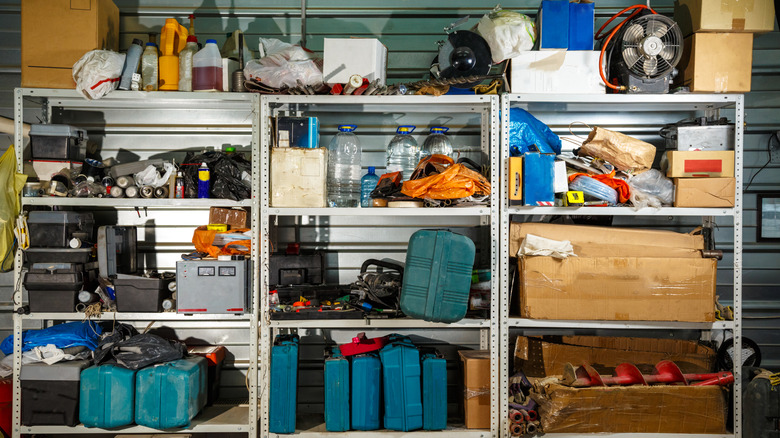
If you've yet to do this in your shed, garage, or supply closet, you may well be chastising yourself for missing such an obvious solution. The reason it works so well is simple: it amplifies the amount of storage you have available while taking up precisely zero floor space. More than that, it makes use of a space that is otherwise wasted — the vertical area of your wall.
Shelves can be used to house power tools, tins of paint, toolboxes — you name it. The key is to ensure that your shelves, and the wall behind them, are up to the task of bearing the weight you intend to load them with. As for how to organize your tools, keep things you only use occasionally higher up, and reserve the lower levels of your new storage system for items that you use all the time.
Create a French cleat wall system to hold and rearrange DIY tools on demand
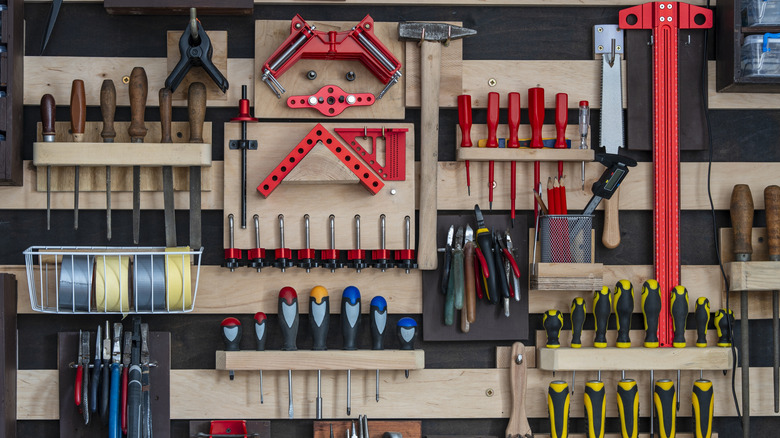
Made from two interlocking, angled strips of wood or metal to create strong and versatile tool storage, French cleat hanging systems are well worth the time and expense of installation. Their modular nature means you can customize and reconfigure your storage to accommodate a growing or changing inventory of tools, and they're widely used in workshops where versatile, heavy-duty storage is required.
Now, while it is entirely possible to build your own French cleat hanging system, it does require certain tools and skills. It is quite an involved process that requires precision to ensure that the cleats interlock securely. Instead of doing this, you can buy dedicated French cleat hanging systems, like this heavy-duty 30-inch aluminum French cleat hanger from Simfelice. This can be used to create a strong tool rack in your DIY storage room, or you could use it to create a sturdy base for shelves.
Consider slatwall storage systems for heavy-duty tool storage
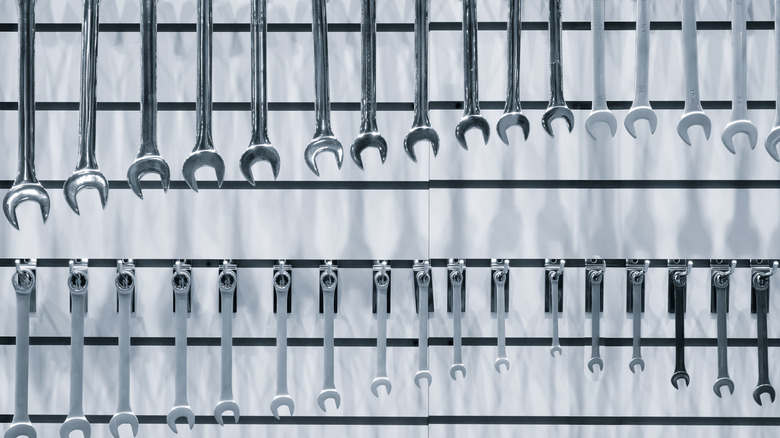
Another way to maximize your shop or garage's vertical storage is to install a slatwall storage system. Similar to French cleats, slatwalls are incredibly versatile and customizable, and can be easily tweaked to accommodate your various tools as you grow and update your collection. They use modular panels with horizontal grooves (or slats), which are securely fastened to the studs of your wall.
Because of this, slatwall systems are usually very sturdy. In fact, if installed correctly, they should be capable of supporting even your heaviest tools. There's a reason they're often used in commercial settings. To ensure yours is up to the task of bearing your tools' weight, you may need to spring for the cost of a contractor. Then again, if you're the sort of DIYer whose tool collection necessitates such a heavy-duty solution, then you may well be capable of installing it yourself.
Use magnetic strips and hooks for quick and easy metal-tool storage
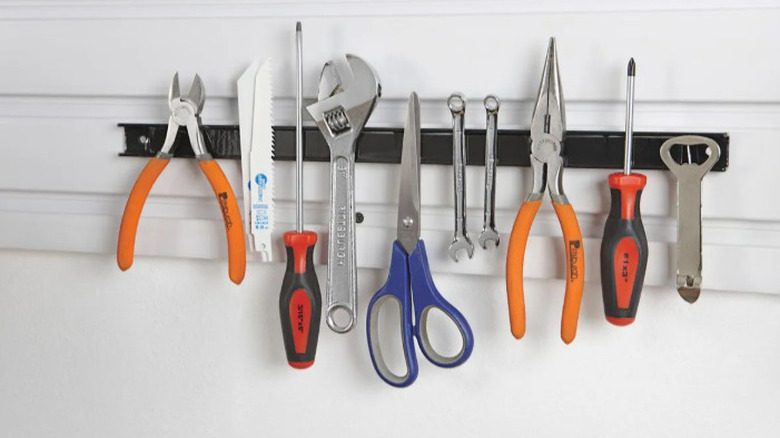
This has to be one of the easiest ways to keep your metal hand tools clear of your counters and prevent them from cluttering up your drawers and toolbox. All you need to do is mount a magnetic strip to the wall, and voila — you have an easy, highly visible way to keep your tools handy, from scissors and metal rules to screw drivers and more. You can make your magnetic strip even more versatile by attaching magnetic hooks. This allows you to store "hangable" items that aren't, themselves, magnetic, like power tool cords.
As for which strip to buy, it's up to you. This multipurpose wall-mounted 18-inch magnetic tool holder from U.S. General comes highly recommended. The important thing is to check the load-bearing capacity and installation requirements of your chosen product, and compare those against the tools you need to store.
Adopt a one-in, one-out rule to keep your storage system sustainable
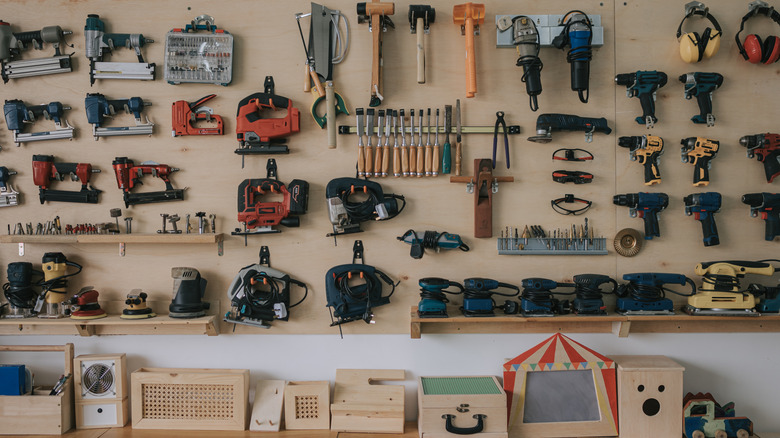
The one-in, one-out rule has to be one of the easiest ways to make your home more organized. When you decide to buy a new tool, a new box of screws, or a new bag of hinges, first rummage through your DIY supplies and look for items that you no longer need. The point is to "free up" a gap in your supplies to fill with the new product, instead of piling it on top of your collection. It can be a good idea to have the rummage first, especially if your supply pile isn't organized, as you may just stumble upon the kinds of screws or hinges that you need without having to spend more money.
Even if you don't, you may find some spare screws or dowels from previous IKEA purchases that you no longer need. Or, if you're buying a new screwdriver — perhaps one with a demolition grip to help with heavy-duty DIY tasks — look and see if you have another screwdriver of the same size. If you do, and it doesn't have any features that your new one is missing, remove it from your stash.
Use magazine files to store flat DIY materials

Magazine files offer a handy, space-saving way of storing flat DIY supplies. Things like sandpaper sheets, spare tiles, wood, felt, and foam insulation can easily clutter up your space if not properly organized, yet they fit beautifully into magazine files.
Stored vertically, these also take up less space on your floor or countertops, and since they can be kept on a shelf or surface out of harm's way, they're less likely to warp or become accidentally damaged. Keeping your DIY materials organized and stored this way also makes them more visible and less likely to be forgotten about. This means that you're more likely to use them, instead of accidentally buying more of the same, adding to your garage clutter problem.