

The Simple Upgrade That'll Make Your Steep Driveway More Functional
Some people see driveways as a major factor in curb appeal that can increase the resale value of their home, but not everyone agrees that you'll get your money back when you make an investment in your driveway. One thing most can agree on, however, is that driveways that are serviceable add value to your home by making it easy and safe to come and go during all types of weather. When it comes to steep driveways, practicality matters even more, and it can be challenging to find ways to make steep driveways more functional. However, in the past decade, resin driveways have become an elegant solution for many homeowners, providing a simple upgrade to sloped approaches that can last for years.
Homeowners with steep driveways are turning to resin-bound gravel driveways, which are made by combining natural aggregates with UV-resistant polyurethane resin. This material combination is troweled into a smooth finish, providing a permeable surface that does more than simply provide a clever driveway layout that boosts curb appeal. For homeowners with steep driveways who are struggling with sharp elevation changes, resin-bound gravel surfaces offer several functional advantages. Although they're not as popular as other driveway materials, resin driveways have been around since the 1950s, and with proven reliability in the United Kingdom, resin driveway installers in the U.S. are now offering 20-year installation warranties.
Discover the advantages of resin bound gravel driveways for steep slopes
When ice and rain turn your driveway into a literal slippery slope and you've tried everything from grading to adding more rock and using a gravel grid system to make it safer and easier to use, a resin driveway can sometimes be the only good solution. Resin driveways offer superior traction, which is good for both drivers and pedestrians. Whether your driveway is wet or dry, a resin surface gives you better grip. They are also durable, as the resin creates a strong bond with the gravel. This means less maintenance is required, leading to lower costs over time. And resin driveways offer exceptional design advantages with the variety of colors and textures that are available.
Resin driveways offer another important advantage that's especially meaningful for homeowners with sloped driveways: erosion control. Resin driveways are permeable, so water is able to drain into the soil. Compared to concrete driveways, this makes resin a better choice for reducing the serious risks related to erosion, which can include anything from water going towards your home's foundation to weakened support for your driveway, patios, and sidewalks.
The permeability of resin driveways means less chance of water pooling, offering more advantages since this means less ice and fewer problems with freeze and thaw cycles. And with a smooth surface, if you ever have to shovel snow, it will be much easier and tidier with a resin driveway than a plain gravel one.
Explore costs and DIY opportunities for resin driveways
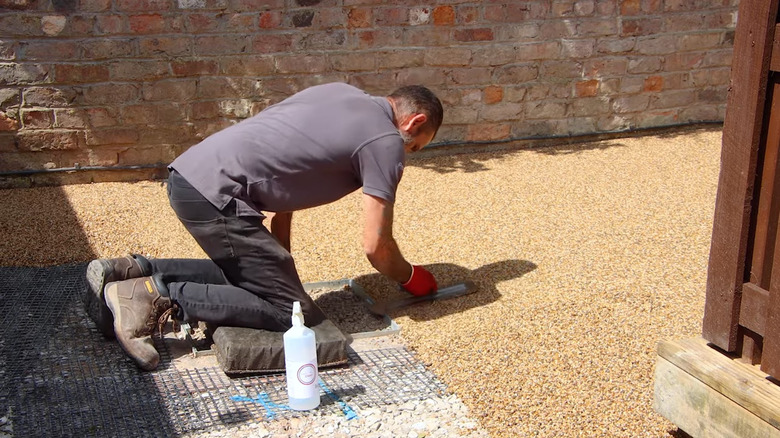
According to Angi, the cost of a resin driveway is about $5 per square foot just for the materials. If you pay for professional installation, those numbers can double, but since many of the advantages of resin driveways hinge on a properly prepared and installed surface—and because this is a challenging DIY project— contractor installation is often the better option. Crafty and ambitious homeowners and DIYers who are just learning about resin driveways and want to give it a try may have more success with small projects.
Resin driveways are one of the most overlooked driveway ideas for making a good first impression, especially on properties with a steep incline. When it comes to designing resin driveways on properties with steep slopes, homeowners often find inspiration in natural stone textures, multi-color designs, geometric patterns, and border accents. Together, these design opportunities can be used to match your home's exterior and elevate your property's appearance. However, the really important design features of resin driveways lie at the base of the installation. From subgrades to geotextile fabrics, all resin driveways need a good base that supports drainage and stabilization. When deciding if a resin driveway is a good way to make your steep driveway more functional, this is a good place to start.