

How To Use Mulch To Make Tree Stump Removal Even Easier
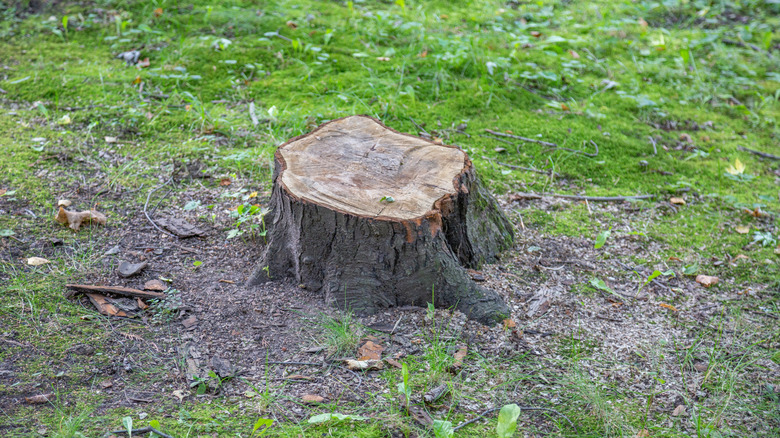
It is sad to see a tree go. Nonetheless, even if it once brought you shade, fruits, or if it was instrumental in increasing the curb appeal of your home, you probably don't want your property covered with tree stumps. That's when you realize that removing the tree stump can be a chore in itself. There are several tricks and tips you can use to make removing an old tree stump easier. But using a natural method, such as applying mulch, is an especially convenient way to rid yourself of them. Simply add a layer of wooden mulch to the stump, cover it to create ripe conditions for fungal growth, and wait for the stump to rot.
Mulch can stimulate the natural decomposition process of a tree stump by providing a suitable medium for the growth of fungi. Fungi are one of the primary decomposers in the environment. Without fungi acting on dead matter, most ecosystems would find themselves littered with lifeless twigs and branches. Mulch, being primarily composed of wood chips, straw, and bark, provides food for the fungi to proliferate. Mulch can also lock in moisture, humidity, and air, which further provide ideal conditions for the growth of fungi and accelerate the decay of the stump. This is why adding mulch on top of other DIY or chemical solutions (like rock salt) further ensures that the stump rots faster, and uprooting becomes easier.
Step-by-step procedure for using mulch to remove tree stumps
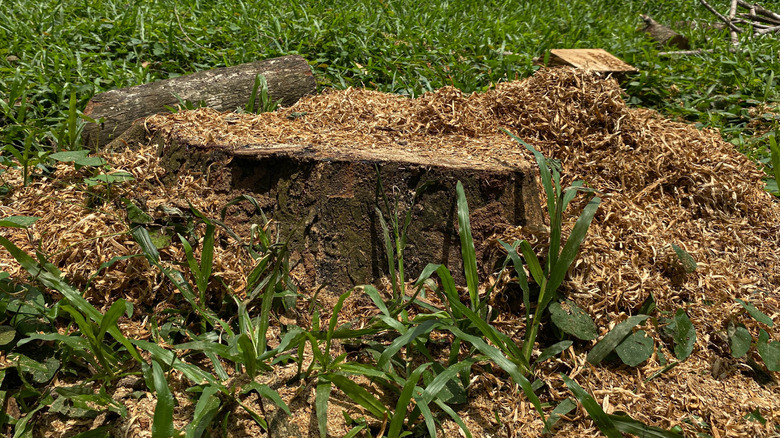
Removing a tree stump using mulch (alongside dirt or grass) is both convenient and easy. To begin the process, trim away all the accessory branches from the stump. Next, add mulch and dirt to the stump and the immediate area surrounding it. Choosing the best type of mulch for this process is crucial. Wood chips are great since they are excellent at stimulating fungi growth. Make sure you slap as much mulch and dirt as possible on the entire stump to create the best conditions for decay. Then find something to cover the stump so that heat and moisture are trapped underneath. For this, you can use anything from a large bucket to a tarp. Add some dead leaves under the covering to further support fungal growth. Once you're done, all you need is some patience.
This process can take some time — a year or two to be precise. Considering that, without creating the right conditions, it can even take decades for some tree stumps to rot, this time frame is a bargain. Check your stump in about 12 months to see if the roots have weakened. You can do this by trying to push the covering to see if the stump budges. If it still feels sturdy, give it one more year. By this time, the stump should hopefully topple over without much effort, or at least be loose enough to uproot. Nonetheless, keep in mind that the time it takes for the stump to completely disappear may still depend on factors such as size, structure, and insect activity in the region.