

11 Privacy Fence And Screen Ideas From HGTV Stars
We may receive a commission on purchases made from links.
Privacy in urban and suburban outdoor spaces can be hard to come by, so you may need to get creative. Some of our favorite HGTV stars use things like fences, screens, and even greenery to add more privacy to exterior areas. Some solutions are complete, as in nobody is going to see anything happening on the other side of the barrier. However, other options are designed to be a little more open. That way, you don't feel like you're out in the open like a sitting duck, but you're not totally cut off, either.
No matter the amount of privacy you want or the budget you're working with, there is a creative solution from an HGTV star that's already been tried and tested. The best part? Most of these are easy enough to DIY, so you won't need to hire a professional team to make your space cozier. Instead, you'll just need a few things from the local hardware store or plant nursery (and a free afternoon) to make it happen.
The Property Brothers think privacy fences can be functional, too
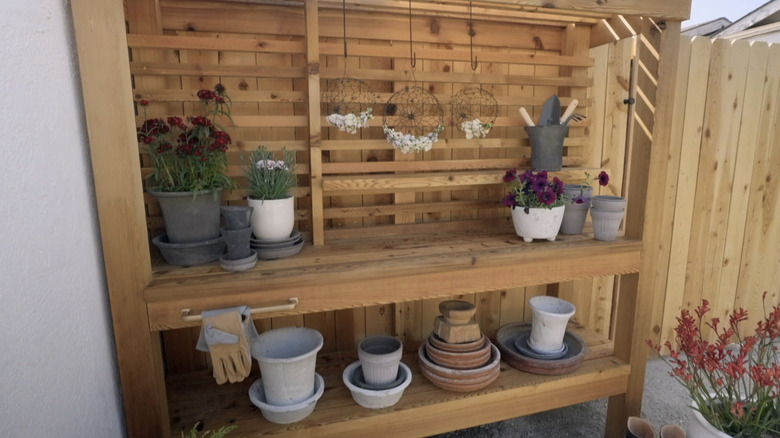
The great thing about privacy fences is that they can serve more than one purpose. In Season 6, Episode 7 of "Celebrity IOU," the Property Brothers elevated an outdoor fence for a better backyard look by completely finishing both sides of it. Before, the finished side of the fence was facing the adjoining property. As part of the renovation, both sides were covered, offering a second layer of privacy, as nosy neighbors won't be able to peer through the slats. "We finished your fence properly on the inside, so now you have the beautiful side to look at," Jonathan said, per HGTV.
Yet due to some creative thinking, this wasn't the only benefit of the new fence. In addition to the doubling up on slats, the brothers created a potting station for the homeowner, tucked into the corner of the yard. The gardening post had two sturdy shelves for working, plus a slatted fence on the second level to help organize tools. The genius of having the potting station set up against a double-slatted fence is two-fold. First, the homeowner can work in the sunshine in a designated area, instead of dirtying the table on the patio. Second, they will never have to make accidental eye contact with anyone through the fence, even though they're right up against the property line.
Dave and Jenny Marrs Fence off even the smallest of patios
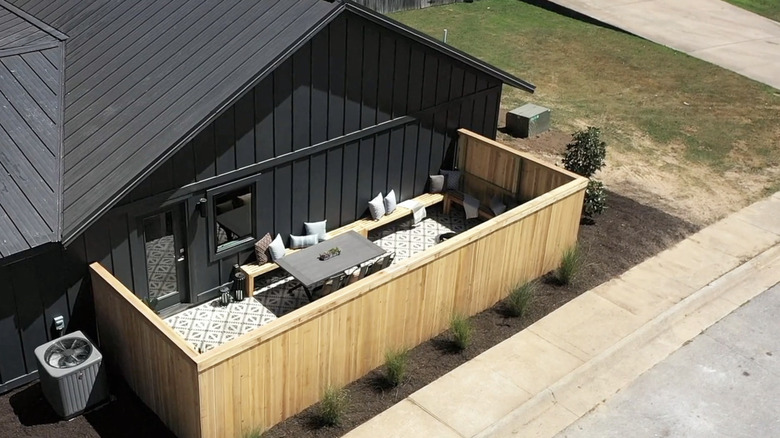
If you have a tiny backyard or porch, you might worry that enclosing it for privacy will make things feel a bit claustrophobic or that it's not worth it to redesign such a small area. Yet on "Fixer to Fabulous" Season 2, Episode 6, Dave and Jenny Marrs proved that even the smallest of spaces can be both functional and private. "Alright, so for this little patio, we're going to create a private little oasis back here," Jenny said, per HBO. "We're going to put a new concrete pad down, and then we'll also give you some sort of privacy with a fence."
The key to defining this space started with the concrete slab. This is especially important for creating a private space that's also usable. Then, when you put up the fence, you can enjoy every inch of your new patio. If you are worried about things feeling a little tight with a tall fence around a small area, you can choose a slatted design to create the illusion of more room. However, if you prefer for things to be completely closed in, look for ways to draw the eye up and create visual space, like hanging planters along the top of the fence, or choosing climbing potted plants.
Jasmine Roth suggests retractable fences for flexibility
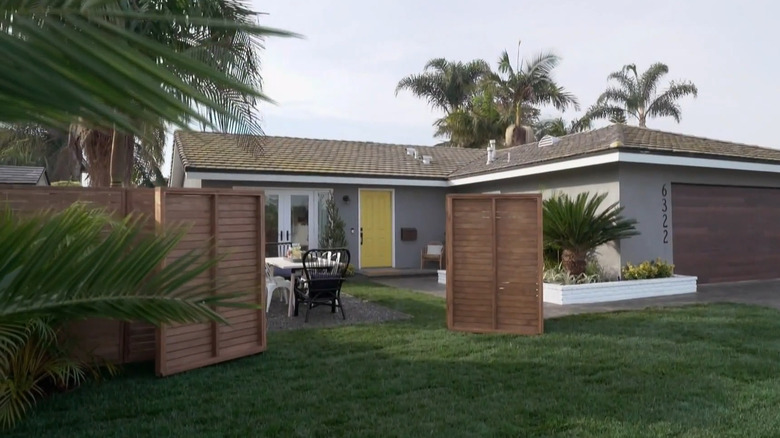
Sometimes you don't need your yard to be 100% closed in all of the time. However, when playing outside with your children, or maybe sunbathing, you would prefer a touch more privacy. In Season 1, Episode 10 of "Hidden Potential," Jasmine Roth offers up the perfect solution for this. Her clients would like to make use of their large front yard, but a permanent privacy fence has the potential to make a bad first impression. So, in a creative way to increase the home's curb appeal, Roth builds a fence that gives them the best of both worlds. "The cool thing about this fence is that when you're ready to have some privacy, it closes right up," she said, per YouTube.
This custom-built fence is anchored by two stationary panels on either end. However, in the middle, there are two panels that can be folded in and out, depending on the level of privacy the homeowner wants at the time. As a DIY, it can be recreated with plywood and hinges, or something pre-built, like the No Dig Enclo Concord Cedar Wood Privacy Screen. If you do go the custom-built route, be sure to protect the wood and seal it with something like Seal-Once Marine so it can stand up to the weather.
Nate Berkus has used trees to add privacy around retaining walls for years
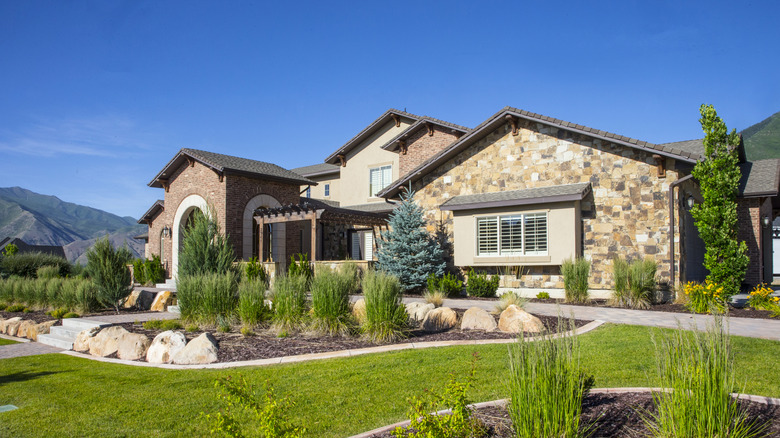
In 2006, Berkus worked with Oprah to create a dream outdoor room for clients. His concepts of using greenery to cover both unattractive outdoor features and provide privacy at the same time still checks out today. The client's backyard was heavily sloped, so Berkus and his team added a retaining wall about halfway down to create usable space, but it wasn't the greatest thing to look at. They added bushes to offset this, but combined a trellis and trees as well to provide privacy to the previously unused outdoor space.
Some of the best trees to plant for privacy if you have a smaller backyard include Pagoda dogwoods, which can be 15 to 25 feet tall and 20 to 30 feet wide when fully mature. Degroot's Spire arborvitae is also a good option, as it can reach heights of up to 30 feet! Trees can take a long time to grow to the size you need them to be. However, you can purchase more mature trees from local tree nurseries to gain more instant access to the privacy that you need. The types of large trees available to you will likely vary greatly depending on your location and USDA zone.
Dave and Jenny Marrs think fences turn open spaces into courtyards
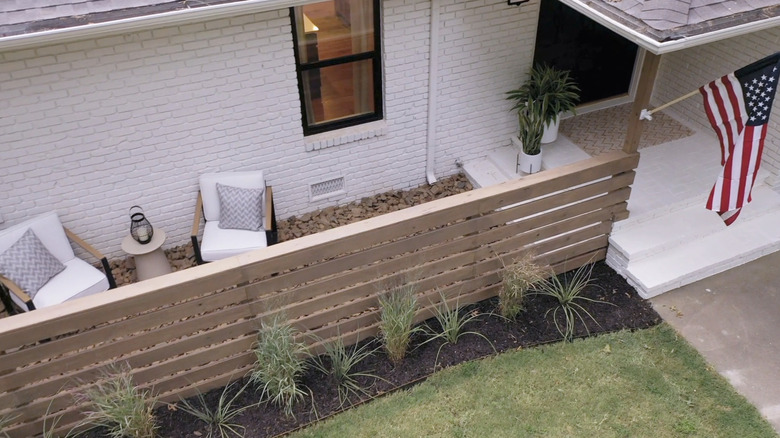
In Fixer to Fabulous: Season 2, Episode 7, Dave and Jenny Marrs create an outdoor oasis for their client using a slatted fence across the front of the property. Instead of leaving things more open and exposed, the fencing, although shorter, still creates a cozier space. No matter the height, slatted fencing creates privacy with flexibility. Light and movement are still visible from both sides, but there is still a tangible, physical barrier present to promote separation. "It also provides privacy," Jenny said, per Homes & Gardens. "They can enjoy this space, and it could feel like a little enclosed courtyard."
Before the renovation, the patio space was simply an unused alcove running along the front of the house. If you have a similar niche on your property you'd also like to transform into a courtyard, it's an easy DIY. The slatted fence can be built with plywood. Pre-made options, like Enclo's Sierra Privacy Screen, are also available. To further define the space, the Marrs laid down stones like the Fantian Store's River Rocks for Landscaping to create a floor-like space for the new patio, before adding a pair of chairs to finish things off.
Jonathan Scott adds hedging to the fence to increase privacy
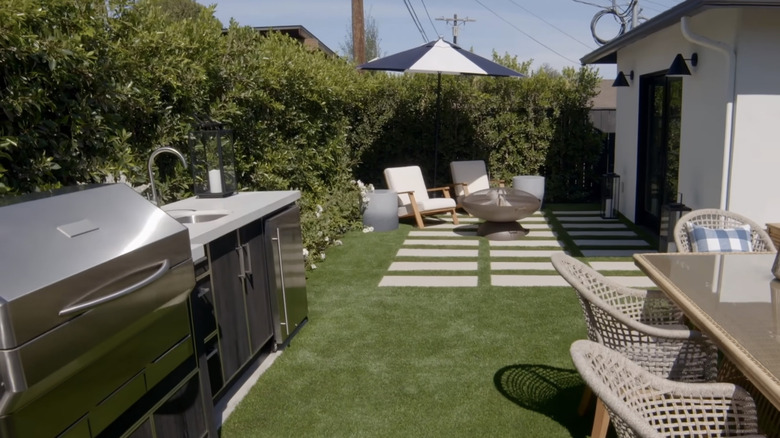
Sometimes you'll find that a fence alone just doesn't bring you the level of privacy that you want. You may have HOA restrictions on how tall it can be, slats that you can still see through, or nosy neighbors that you want to be as separate from as possible. So, sometimes you just need to double up and combine fencing and foliage. Jonathan Scott gave a great example of how to do just that in the "Brother Vs. Brother" Season 6 finale. "In the back, I'll continue the modern theme with a black cedar fence, lush hedging to add privacy, and low-maintenance artificial turf and stone pavers," he said, per YouTube. "This backyard will be a true retreat and have buyers dreaming about the life they could have here."
Spacing is the main thing to consider when planting a hedge along your fence. You don't want to crowd out the plant by placing it right next to the wood. Instead, plant it about 18 to 24 inches from the structure, so it has plenty of room to stretch out and grow. It might take two to three years before you have the lush hedge that you're hoping for, if you start from scratch. However, there are also companies that sell fully grown plants, if you prefer to have more privacy from day one.
Emily Henderson suggests a mobile privacy screen
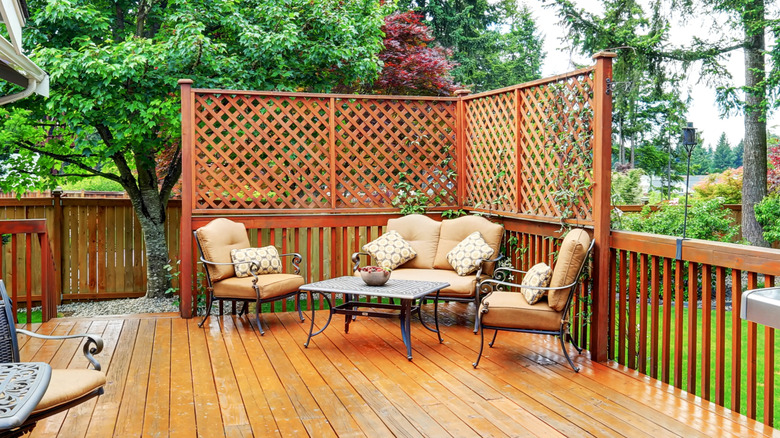
You might not always need privacy in the same spot. You might also only want it at certain times of day, like when your neighbor is also on their back porch. As a solution for this, try a movable privacy screen. "I decided that I wanted to try to make the overall privacy structure a mobile aspect of the deck for a few reasons," Jess Bunge writes for Henderson's blog, Style by Emily Henderson. "In case I want to reposition it, in case I want to remove it from the deck entirely (during very windy/inclement weather, for example), and so that I can easily carry it and store it away whenever necessary."
To build the wall, they used four 2-by-2 boards (to make the sides and center) and 2-by-4s (to make the slats). The boards were held together with simple screws. Then, they used hardware, like Everbilt's Zinc-Plated Steel U-bolts, to attach it to the deck. They also stained the wood to match the deck. However, this project is customizable. The slats can be swapped for lattice, or the screen can be painted a contrasting color for a more dynamic look.
Dan Faires suggests using planters to create a botanical wall
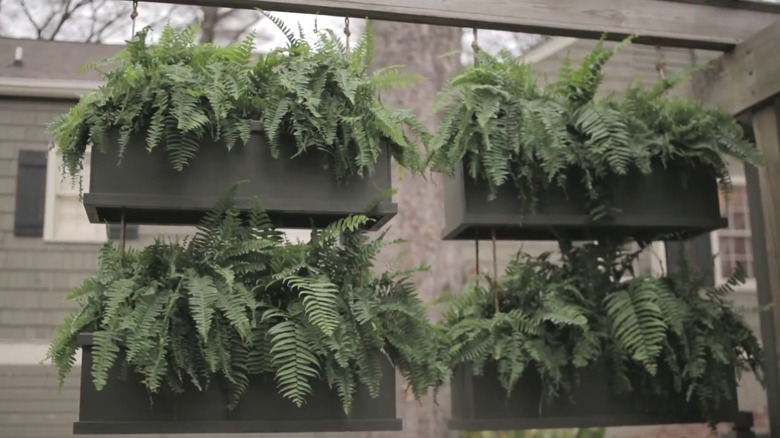
Dan Faires is a carpenter and designer who works with HGTV. If you want to use greenery as a privacy screen, but only need the protection around a porch or deck, use his idea to hang planters to DIY a living wall. "[It's] a totally original way to create a lush wall of greenery without sacrificing coveted space on the deck," he said, per YouTube. This saves you the hassle of crowding the floor with plant pots, but it also allows you more flexibility if your needs change in the future. Taking down a few planters is much easier than removing a fully grown hedge if you want to open things up again.
The key to success here is that the planters you choose should be lightweight because they will be hanging. You don't want to risk collapse, so the CHUKEMAOYI Window Box Planter is a good choice for this. Next, consider the plants you will use. Faires recommends shade-tolerant options like ferns, which work well because you'll be stacking the boxes. This will impact the amount of light each plant will receive. As a final tip, he recommends covering the bottom of the planters in crushed plastic water bottles instead of pebbles for drainage — just to keep things light so the planters have less risk of falling. This is one of the many ways you can reuse plastic water bottles in your garden.
Martha Stewart says Green Mountain boxwoods will create a dense, attractive screening hedge once mature
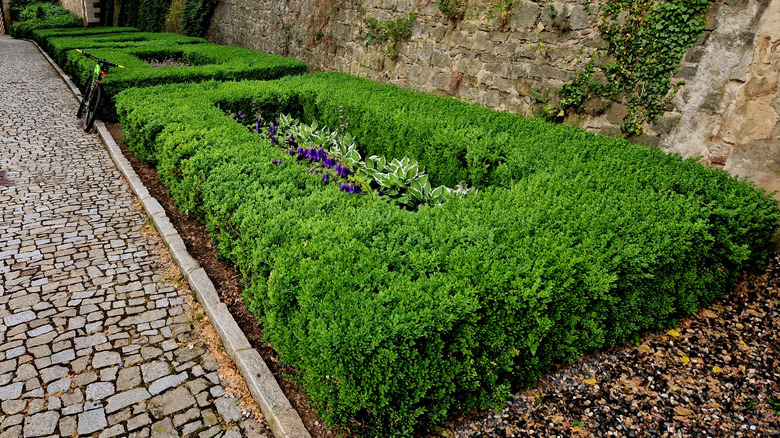
Knowing Martha Stewart's plant recommendation for a lush privacy hedge can help streamline the process as you pick one out. "When fully mature, 'Green Mountain' boxwood can grow to be three to seven feet tall and two to three feet wide," she wrote for The Martha Blog. "Eventually, the boxwood will create a handsome hedge." These plants tend to grow slowly, but do well in most types of soil, as long as there is proper drainage.
This particular plant does best in USDA Growing Zones five through eight and is considered to be an evergreen. This quality is important when selecting a privacy hedge, as you don't want it to drop its leaves for the winter, leaving your space totally exposed. When planting, Stewart recommends the time-saving hack of digging a trench, instead of inserting each plant into its own hole. "Digging a trench is not only faster when planting a number of specimens in a row compared to individual holes, but it also allows more break up of the soil for new roots to grow and for better circulation of oxygen and water," she shared on her blog. To keep your hedge looking its best, you should also understand the telltale signs of boxwood blight and know what to do about it.
Brian Patrick Flynn uses planters as support posts for privacy screens
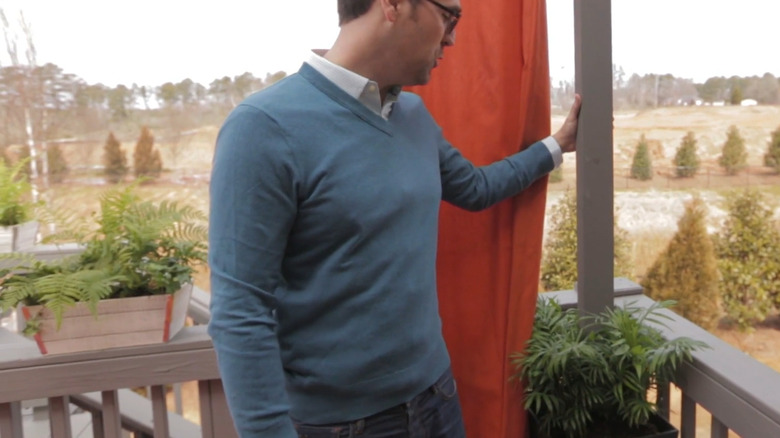
If the back of your patio or deck is too exposed, Brian Patrick Flynn, an interior designer who often works with HGTV, has a solution. Use planter boxes to house the support posts for curtains. "Here's an excellent idea for any homeowner who has an outdoor space in which they wanna add a movie screen, or some privacy with drapes, but they don't necessarily have the wallspace to add the hardware which is needed to hold those things," he told HGTV.
He used large containers, like the Veradek V-Resin Indoor/Outdoor Taper Planter, placed a small galvanized metal bucket inside, and poured concrete into the bucket. He then inserted a 2-by-4 board into the wet concrete and let the mixture set before covering the opening with plants. When paired with another post across from it, it's easy to install a line across them to hang some privacy curtains, like the Town & Country Basics Cabana Outdoor Curtains.
If you don't have a deck and are just adding these to the edge of a concrete patio, you'll have a bit more flexibility on the color of choice for the post, as you won't have to match the deck. However, never leave the boards untreated, as they will be more vulnerable to the elements.
The Property Brothers explain how lattices give privacy to outdoor rooms
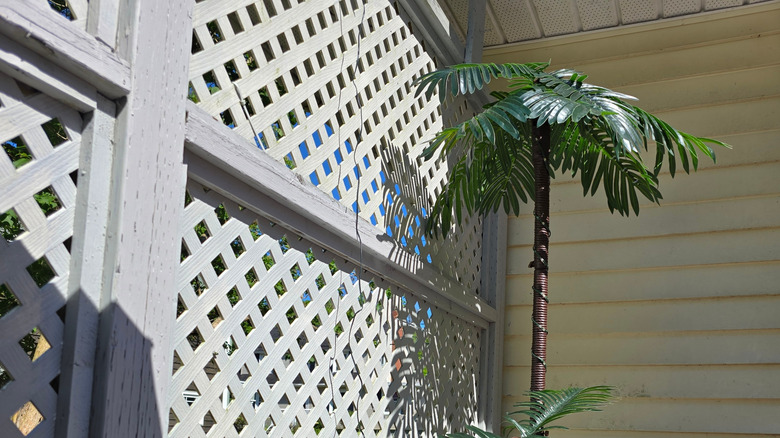
The Property Brothers know a thing or two about making your living spaces much more, well, livable. In a piece for She Knows, the Scotts revealed that the secret to creating a usable outdoor area is to marry function and privacy. You can create both of these with some careful design, including installing lattice. "Often the house will serve as a wall for the outdoor room, which can be further defined with elements such as latticework, low stone or brick walls, trunk-style benches (a good place to stash cushions), or an arbor structure," they said. "Latticework can provide shade and privacy."
To make latticework actually work for your space, think about scale and placement before anything else. Install lattice panels along the sides that face neighbors or busy streets to create privacy where you need it most, without closing off the entire area. Opt for taller panels if you want screening, or wider spacing if airflow and light are priorities. You can also soften the look by training climbing plants like jasmine or ivy to grow through the lattice.