

Straight Or Staggered: How To Choose The Best Tile Layout For Your Space
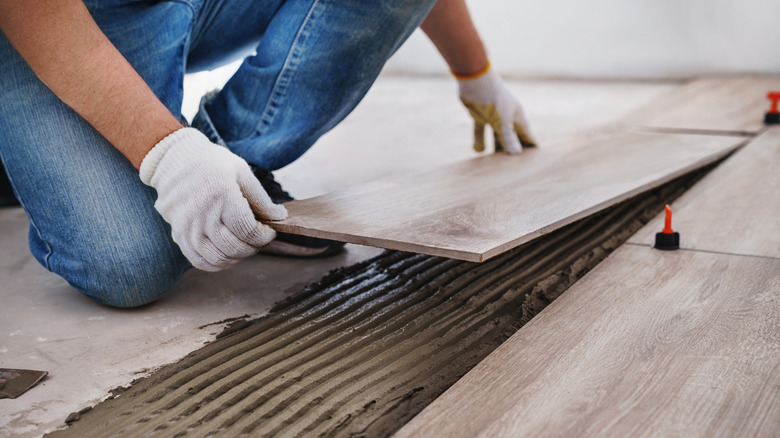
Once you have chosen from the various tile shapes and styles for your next project (whether it is replacing the shower backsplash or a full kitchen reno), choosing the right layout is one of the key drivers that determines how your space is going to look. A lot of elements can influence this choice — from the aesthetic you're aspiring towards, the size of the tiles, as well as the budget constraints. Primarily, you have two options: a straight layout or a staggered layout, with variations to both types. Choosing one over the other can impact functionality, appearance, durability, as well as costs down the line. While straight layouts give you a more modern look with easy, cost-effective installations, staggered layouts give you a more traditional aesthetic, but can be both difficult to install and heavier on your pocket.
In a straight layout, tiles are arranged in a way in which the edge of each tile is perfectly aligned with edges of tiles above and below it. On the other hand, in a staggered layout, also known as offset layout, the edge of a tile aligns with the center of the tiles above and below it. In some staggered layouts, the tiles are offset by a third of the length instead of half. Like all design elements, choosing between the types depends as much on your personal goals as on the functionality and form the layouts offer. While there are pros and cons to both, if you're unsure about which way to go, you can test both layouts in a small space and see what fits better.
When to choose a straight tile layout
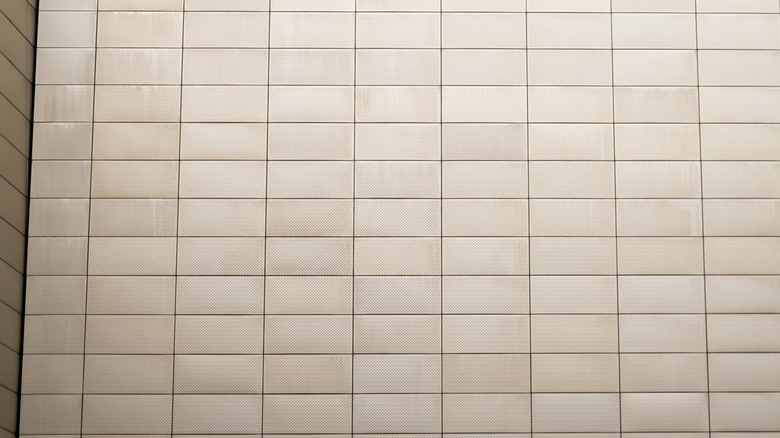
A straight tile layout gives you a simple, grid-like, modern aesthetic. It is easy to install and leads to less wastage, when compared to the staggered layout. Nonetheless, a straight layout can look plain, especially if you don't give it some variation with color or texture. This layout can also be less visually dynamic than the staggered type. When it comes to aesthetics, a straight (or stacked) layout offers symmetrical, straight lines that can give a modern, contemporary look. Therefore, you may like this layout more if you're a fan of incorporating low-effort minimalist trends in your decor. The modern look also makes them great for commercial spaces. Moreover, straight stack layouts can add the illusion of space to confined spaces, like small powder rooms.
Furthermore, you also get more customization with straight layouts — you can stack the tiles both horizontally as well as vertically with ease. In the case of staggered layouts, vertical installation can be more rare to find. The tile size can also determine your best layout options. If you're working with large tile types, stacking the tiles is more preferable. A staggered layout with bigger tiles can be susceptible to unevenness.
Finally, straight layout installation is also more eco-friendly. Less waste is generated during the installation process. If sustainability is one of your concerns, you should definitely go for this approach. If your criteria for choosing the right layout is ease of installation or cost-efficiency, the straight layout is, again, the right option.
When to choose a staggered tile layout
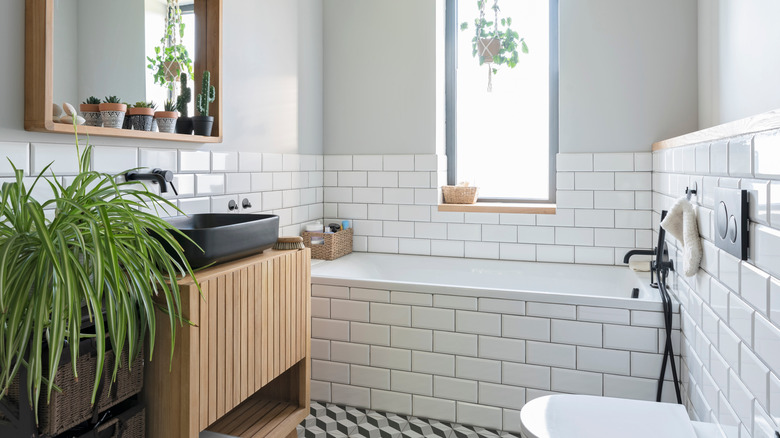
Staggered tile layouts can give your space a timeless feel. This type of layout has been used for centuries, notably gaining attention when designers George C. Heins and Christopher Grant used the subway tile backsplash in New York subways back in 1904. Taking cue from brick floor installations, which use a similar pattern, the offset tile layout has passed the test of time because of its functionality as well as aesthetics. This layout can be used in a diverse range of settings, but it is especially popular in bathrooms and showers. A staggered layout is also helpful in hiding inconsistencies in the tiles, as well as any imperfections in the walls or floor. This layout allows a better weight distribution on the walls, and reduces the chances of cracks appearing in the tiles.
If you're looking for a more rustic, vintage feel, the staggered layout is definitely the way to go. Aesthetically, the offset pattern is also great for creating more dynamic interest in a space and adding depth to walls. The staggered tile layout is also a great option for adding movement to large areas, such as hallways or open kitchens, and breaking the linearity in these regions.
Having said all that, installing this layout is more complicated and can take more time. Offset installations can also lead to significantly more wastage – far more than the usual 20% waste common with normal installations. A lot of the tiles that are cut during installation can not be used elsewhere either. Furthermore, there are higher possibilities of uneven edges or "lippage" appearing while installing staggered tiles, especially if you're working with porcelain tiles. While these issues can be fixed with leveling systems, they add to the overall cost.