

How To DIY A No-Cost, Spiral Plant Trellis From Yard Scraps
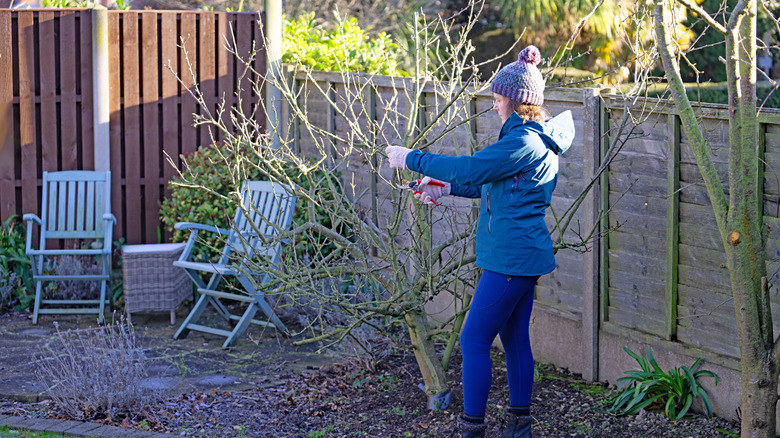
As you gather up the twigs after pruning your trees or shrubs, pause before tossing them onto the brush pile. How pliable are these mini branches? Test a few for flexibility, and if they bend without snapping, save them to make graceful, natural plant supports. With just these simple materials, you can twist together a sculptural trellis that's a downright magical addition to a garden, indoor or out.
Transform scrap wood into useful garden pieces for your plants using only tree trimmings, a knife, and a drill. One thicker and sturdy branch acts as a base, and one or more long, flexible twigs are coiled around and anchored into holes drilled in the thick branch.
Nearly any year-old shrub or tree shoots are good candidates for bending, but you may need to soak your twigs for a while to give them maximum pliability. Many twig-crafters prefer working with branches from willow (Salix), dogwood (Cornus), common hazel (Corylus Avellana), and mock orange (Philadelphus lewisii). However, experiment with what you already have before foraging elsewhere or purchasing additional branches.
Create a bent twig plant support
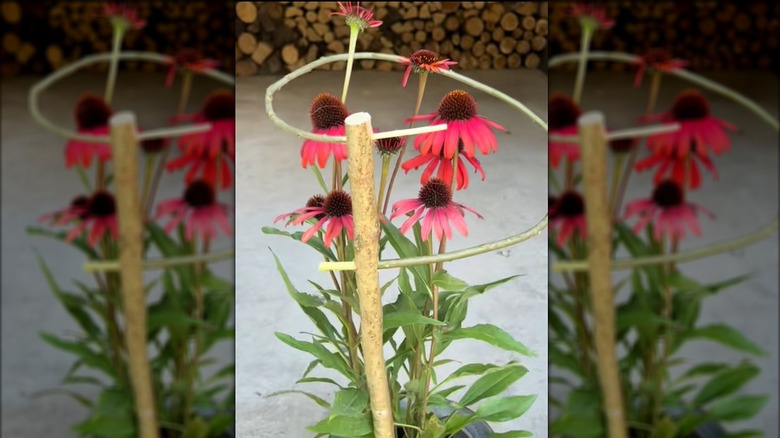
Take some time to find the right pieces for this project. The base stick should be considerably thicker than the one you'll be bending, since you'll be drilling holes in it as wide as the bent one. Both sticks should still be pretty green. Letting the thinner stick soak in water for a few hours can help improve its pliability if necessary.
To help determine where you should drill the holes on the larger stick, bend the thinner twig into shape and position it against the larger stick to mark anchor points. Make small marks on the larger stick to remind you where to drill. Each bent twig will need two holes in the larger stick, one for each cut end.
Lay the thicker stick on a work surface, and drill small pilot holes at the spots you marked; these will be helpful guides for the bit while drilling the larger holes. Use a drill bit roughly the same diameter as the bending twig, center it on the stick so that it will penetrate the thickest section, and drill all the way through the stick at each point. Insert the twig ends into the drilled holes, trimming them slightly with a knife if needed for a snug fit. Try to send the bent stick ends fully through the holes in the larger stick. Once the ends are secure, set it up in your garden or around a house plant as a clever way to decorate with nature in your home.