

Are Towel Warmers A Fire Hazard? What To Know Before Installing One In Your Bathroom
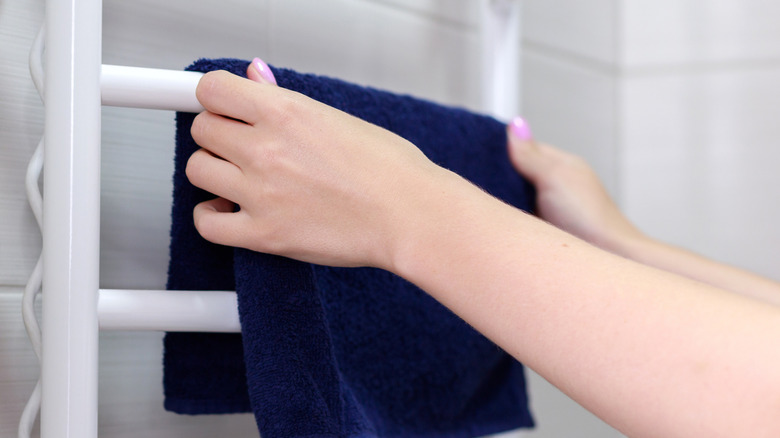
Installing a towel warmer is a great way to make your bathroom feel more warm and cozy. However, these appliances generate a significant amount of heat in order to warm you up and dry your damp towels. But is that enough to start an electrical fire? "Generally not," licensed electrician Carl Murawski explains in an exclusive interview with House Digest. "However," he adds, "there are exceptions and conditions that must be met to be sure."
According to Murawski, the list begins with installation. He tells us: "Firstly, the towel warmer must be fitted as recommended by the manufacturer and all safety features [should be] engaged." If you find this process to be too complicated, you may want to hire a professional for the job. "Generally," Murawski continues, "the temperature of the elements on the modern towel warmer are much lower than that of an electric space heater or any other appliance that uses large quantities of electricity." This means that, unless they malfunction, there's less risk of them starting an electrical fire. Moreover, he explains: "Most towel warmers are also fitted with thermostats and thermal cut outs that should the heater element fail in some way the element is disabled very quickly to prevent any chance of fire occurring." In a nutshell? "It is the method of installation, condition of the electrical wiring, and the intended use of the appliance that determines whether it is a fire hazard or not."
Towel warmer safety features

Speaking exclusively with House Digest, Carl Murawski details some of the reasons why he feels towel warmers are relatively safe to use in a home. "Most decent quality towel warmers are UL-listed or ETL-certified," he says, "which means they have been certified as safe as far as electrical testing is concerned." So, when looking for the best towel warmers to give your bathroom a luxurious upgrade, always ensure they carry the proper certifications to avoid accidents later. He adds: "Hardwired towel warmers are almost always installed on a GFCI-protected circuit in the bathroom, which is a further safety measure." Such models feature a built-in timer that turns them off automatically to prevent them from getting overheated.
Murawski also says that towel warmers shouldn't draw too much power from your home. "While a towel warmer does use a huge amount of electricity," he explains, "when compared to something like a hair dryer or iron, a decent quality towel warmer is relatively low-wattage, and when installed correctly will not overload the electrical system of a home." Proper installation is key here, because, Murawski cautions, "problems arise with ... improper wiring of the element, or failure to have GFCI protection ... There is also a possibility that the unit could have been damaged in some way, not always visible to the naked eye." He advises that you should have an expert check the device periodically to highlight any concerns with the unit or its installation. Timely discovery and remediation of issues will minimize the likelihood of a fire.
Should an electrician install your towel warmer, or can you DIY?
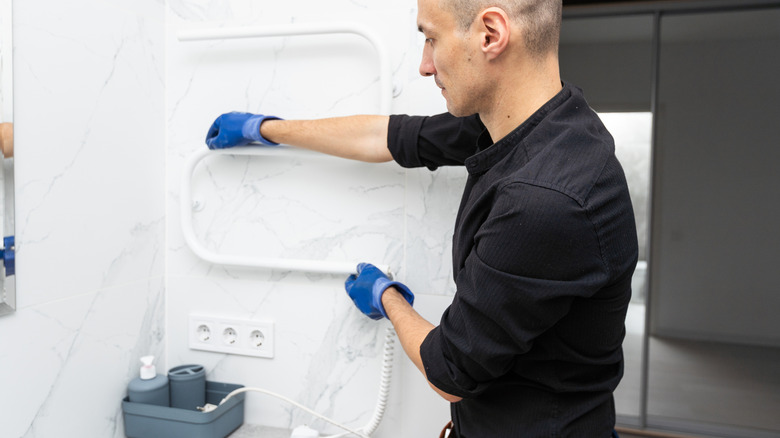
Whether or not you should contract a professional to install a towel warmer depends on the kind of device you purchase. "If it's a plug-in type towel warmer, most homeowners will find this to be very easy to install," Carl Murawski shares in his exclusive chat with House Digest. That being said, there are some caveats you should keep in mind. Murawski says that, "as long as you can locate a nearby outlet, preferably a GFCI outlet, the installation should be relatively easy to complete."
With hardwired towel warmers, he recommends hiring a licensed electrician and letting them handle the installation. "There are certain scenarios in which it's in the best interest of everyone for someone more qualified to do the work," he says, "and this is one of them. Bathrooms are classified as wet locations within the National Electric Code." And this is an important thing to consider because, as Murawski explains, "the National Electric Code says that conductive paths in wet locations are more likely to become the path of least resistance than they would in drier locations."
So, to prevent your bathing area turning into a hazardous zone, Murawski insists that the wiring be done properly. This will ensure your hardwired model is connected to the right circuit and won't cause issues later. Additionally, he says: "The connections must also be snug and to code specifications and all of the wiring should also be contained within an appropriate device to ensure the towel warmer does not create an electrical hazard."
Mistakes to avoid when using a towel warmer
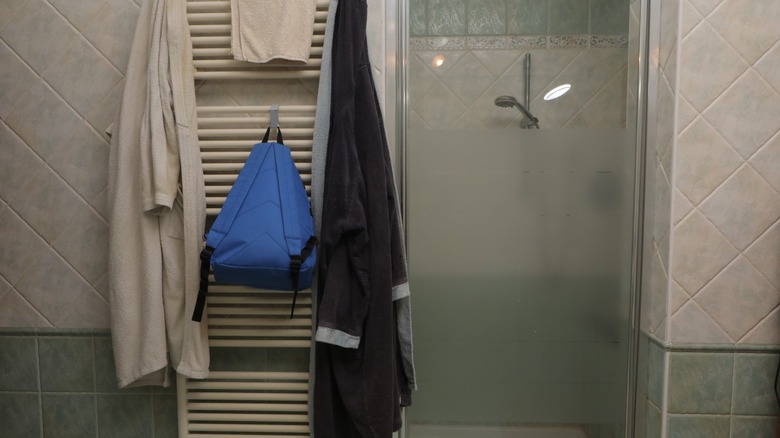
While conducting due diligence before hiring someone to set up a hardwired towel warmer is necessary, the right installation alone won't negate all chances of an electrical fire. You must also exercise caution when employing the device. Listing the things you shouldn't do when using a towel warmer, Carl Murawski exclusively tells House Digest: "Do not overload with too many towels or excess weight as specified by [the] dryer manufacturer ... Do not attempt to dry articles of clothing or materials not designed to be heat dried." To illustrate, Murawski suggests you keep "fabrics with feathers, rubber, or other foreign materials attached" away from your towel warming unit.
Beyond this, he says: "Do not attempt to dry any items containing flammable substances such as fabric air fresheners, cleaning solutions, dyes, paint, adhesives, perfume, cosmetics or combustible dusts." Nor, he adds, should you "operate a plug-in dryer with an extension cord in a bathroom." Why? "Unusual heating of cord, overheating of the dryer, constant tripping of circuit breakers, burning odors or exposed wiring means that dryer and cord should not be used and should be examined by an authorized repair center," he tells us. To be on the safe side, always check a plug-in towel warmer's cord length before purchasing a unit.