

It Was Popular For Centuries — The Historical Pattern Making A Comeback In Home Design
We may receive a commission on purchases made from links.
Specific pattern trends come and go, but regardless of the time period, there are a few repeated motifs that seem to have a foothold in design. Stripes, for one, are an interior design pattern that remains timeless, while plaid is a classic that will never go out of style. Florals are another one of those prints that we just can't shake. Whether they're abstracted and modern, fun and bubbly, or subtle and classy, florals are everywhere. The problem with this, however, is that over-saturation has made many tire of these nature-inspired prints, and the patterns that once made a statement are starting to fall flat. Luckily, florals' more illustrative and historically rooted cousin is here to pick up the slack.
"Within the botanicals, we're also seeing subtle, story-driven nods to nature such as birds, rabbits, horses, and even figures of people woven into the pattern," Jennifer Beget, owner and principal designer of J Beget Designs, shared in an interview with Apartment Therapy. These prints, more commonly referred to as chinoiserie, first popped up in the mid 1600s in Europe. Designers and illustrators were inspired by Chinese art and design and began imitating it — often without the direct experience necessary to do so accurately — and the result was a whimsical, fantastical art style that commonly featured motifs like blossoming trees, pagodas, flowers, and even people. In many ways, it creates the same free-flowing, organic, and classic look as a traditional floral print, but the addition of other elements within the pattern helps to break things up and provide more interest, sometimes even going so far as to tell a story. Where florals tend to fade into the background, chinoiserie makes a statement, making it a great way to add personality to your decorating scheme.
How to incorporate chinoiserie into your design
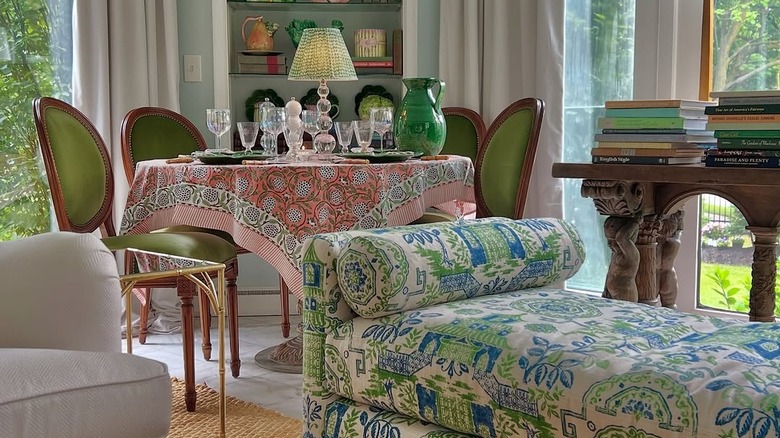
If you're bold enough to embrace chinoiserie in your space, there are many different paths you can take. This pattern is most commonly seen on wallpaper, so of course, covering your walls with a print like the NuWallpaper x Scalamandre Self-Adhesive Wallpaper will immediately transform your design into something that feels both classic and playful. There are plenty of other innovative ways to use wallpaper in any room, however — for a more subtle accent, consider covering the backing of a bookshelf or creating an accent wall. Many chinoiserie-inspired wallpapers also utilize large-scale designs that feel more like a mural than a repeated pattern, so these are great picks for spaces where you want an interesting accent that doesn't come across as busy.
Unless you want to fully embrace the traditional feel of chinoiserie, it's also important to provide some contrast. "When integrating the old with the new, it's all about balance and scale," designer Kendall Wilkinson shared with House Beautiful. "Juxtaposing chinoiserie with more modern elements like shiny lacquered walls in a bright and unexpected color, contemporary furniture, and lighting reinvents the traditional into a modern and fresh aesthetic." If it feels like wallpaper will overwhelm the room and make it difficult to achieve this balance, consider incorporating the pattern in the form of smaller pieces throughout the space. Curtains, accent furniture, and tablecloths can help you achieve this task, but something as subtle as a vase or lampshade can still make a big impact in a smaller room, especially if the rest of the design leans more modern or minimalistic.