

Neither A Closed Nor Open Floor Plan: The Modernist Solution To Create Flow In A Home
We may receive a commission on purchases made from links.
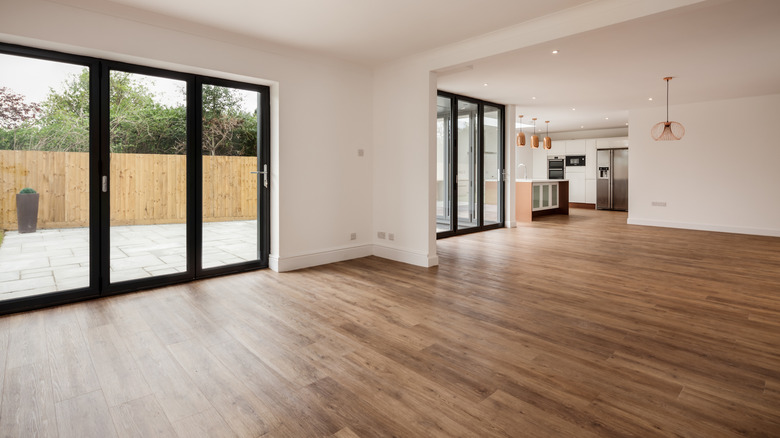
Although open floor plans have existed in some fashion since the turn of the 20th century, they saw a real surge in popularity in the 1990s and 2000s, when cable TV, DVD players, video game consoles, and other forms of entertainment became widespread, but devices were still shared by the whole family. It didn't take long before open floor plans became the modern standard; prospective buyers insisted on them in newly built homes, and residents even knocked down walls in their existing spaces. But they soon realized a problem. Open floor plans have the potential to feel a little too open, exposed, and distant, and now, some might even say that open-concept floor plans are going out of style. As trends have changed, people want that sense of coziness back, but that doesn't mean they want to divide up every room with drywall. Enter: the broken floor plan. The broken concept space is divided by a clear structural element — one that is often literally transparent, as in the case of folding glass walls.
"A compromise that is quite popular nowadays is a hybrid between open and traditional floor plans, otherwise known as a broken plan," explained interior decorator and content creator Reynard Lowell on YouTube. "Indoor windows and glass partitions are some of my favorites, as it allows you to see through and borrow light from another room while giving enough separation and privacy." If you want the best of both worlds, a folding glass wall is even better, offering a wide open room when you want it and separation for calm and focus when needed. With the inclusion of this smart element to define spaces in an open concept floor plan, you can easily reduce noise, create privacy, and control household traffic. Even in more traditional "closed" floor plans, this concept works well.
Folding glass partitions adapt to your changing needs
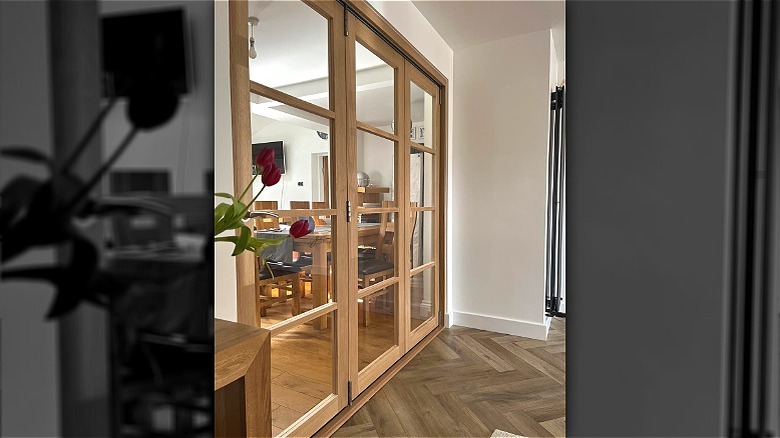
If you want your open floor plan to feel a little more closed, a folding glass wall is the ideal solution to divide an open concept home for a more stylish, peaceful layout. And if you already have a more traditional floor plan, folding glass partitions can be a smart way to create visual flow between two or more rooms. You can either demolish a wall and replace it with a partition, or simply ditch your solid doors and put accordion-style glass doors in their place. "Windows and glass partitions are a more permanent way to transform an open plan into a broken plan," Lowell explained on YouTube. "They look great, allows you to borrow light from another room, blocks out a good amount of noise, but can be quite expensive to get it done right."
Indeed, unless you're a whiz at wall renovations, a folding glass partition will probably need to be installed by a professional — and maybe even custom-built for the perfect fit. Though individual projects may vary, you might expect to pay between $200 and $800 per linear foot for a folding or sliding glass divider. These partitions are usually made of thick glass with steel, aluminum, or wood frames, which can make them quite heavy, so properly reinforcing the walls and framing is also a must.
If all of that seems unfeasible, Lowell said, "An easier and less permanent solution is to add a screen." Screens like this Svimi Acrylic Room Divider will still allow light to pass through the panels to avoid blocking off the room entirely. Experimenting with a temporary room divider might also help you decide if investing in a built-in glass partition will be a good investment for your lifestyle.