

Erin Napier Is Bringing Back A '90s Home Trend We Never Stopped Loving

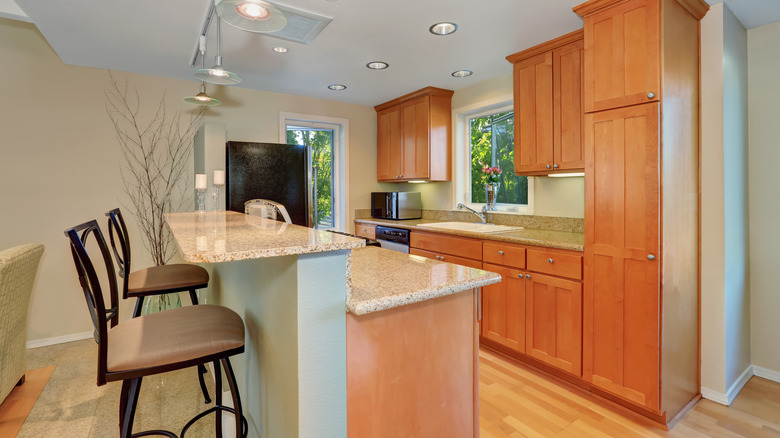
The 1990s: a time of wicker furniture, intricate wallpaper, and clashing patterns. While we may not necessarily miss many of the popular trends from that specific decade, there is one home design element that can be both uniquely practical and visually appealing in the right space, even today: a double-tiered kitchen island. Popular HGTV home renovator, Erin Napier, seems to agree.
The double-tiered kitchen island is a common find in homes that were renovated in the '90s and early 2000s. Today, many of them have since been removed in favor of sleeker, single-level surfaces. However, the two-tiered kitchen island effectively separates eating or socializing areas from prep areas, making it a practical addition for kitchens where both tend to go on at once. Erin Napier appears to be a supporter of bringing the double-layered design back. As shown in her Instagram post featuring Season 9 Episode 11's episode of "Home Town", she opted to incorporate a kitchen island with two different heights into her design.
However, she didn't just copy an out-of-date version of the double-tiered island in old 90's primary colors. Instead, she modernized this 90s kitchen trend by using a natural wood material for the lower tier and a sleek, white surface for the upper one. The higher white surface does a great job of reflecting light from the nearby windows, thus helping to brighten the whole space. Meanwhile, the wooden lower section feels calm and grounded as a result of the organic material, which ties into the chairs pulled up alongside it. Let's have a look at how else Erin Napier has updated this classic 90s trend and how you can do the same.
Modernizing the double-tiered kitchen island
By looking at the room which Erin Napier designed on "Home Town", we can see how she has utilized a few careful design tricks to modernize the double-tiered kitchen island. First, she keeps the color palette and visual textures simple. In contrast to the busy, bright color schemes of the 90s, she instead sticks to light neutrals and wood tones. The wood on the lower tier of the island is reflected in the same light brown color as the open shelving and hardwood floors. The white upper tier of the island, on the other hand, is echoed in the room's trim. This is a great example of how to create a cohesive color palette for your home while incorporating a two-tiered kitchen island.
One of the drawbacks that has been noted regarding double-tiered islands is that they can make an already small kitchen feel even smaller by dominating the visual space. However, Erin Napier tackles this through careful decoration. She tops the upper tier with a large vase filled with tall, narrow greenery. This draws the eye upward towards the ceiling — rather than downward towards the darker floor — helping to make the space feel brighter and more open.
In addition, by choosing to decorate with greenery, she connects the kitchen to the larger outdoor space visible through the windows. So, if you are interested in getting your own double-tiered island, consider using subdued tones repeated throughout the space, and topping it with a statement piece of greenery to help the island feel design-worthy and fitting for your home.