

Make High-End Storage Baskets Out Of Old Bedsheets And Towels
We may receive a commission on purchases made from links.
Your sheets are ripped, your towels are frayed, and you're mentally screaming, "Why can't we have nice things?!" You can, by reusing the aforementioned ragged textiles. That probably sounds counterintuitive, but with the right steps, your old and worn-out bath towels and sheets combined with a cardboard box become surprisingly luxe-look storage while also staying out of the waste stream. These three unwanted items join forces to become a simple fabric-covered cardboard box with terry cloth detailing and rope handles. A TikTok from hometalk shows how a sheet, a towel, and a large corrugated cardboard box morph into an oversized storage basket — and a stylish one, at that.
Gather up a sad sheet and towel, a sizable corrugated cardboard box, and some 1-inch thick white nautical-style rope. Also set aside scissors, a tape measure, a fabric marker, and a glue gun with fabric glue sticks. Make sure the sheet has its hems intact, since this will save some steps. The creation shared by hometalk was made with an appealing pink towel and sheet. In the likelihood that you don't have a matching sheet and towel, and/or your tired linens are discolored and unpleasant to look at, choose a fabric dye in a color you like. (This works best for white or light-colored fabrics.)
While hometalk's results are cute, we're doing one better by making this project more durable: let's swap ornamental handles for usable ones, and we'll keep the towel trim from fraying with Aleene's Stop Fraying Fray Repairing Adhesive. A roll of packing tape will go a long way in helping the box hold up, too.
Preparing the materials for a cloth-covered box
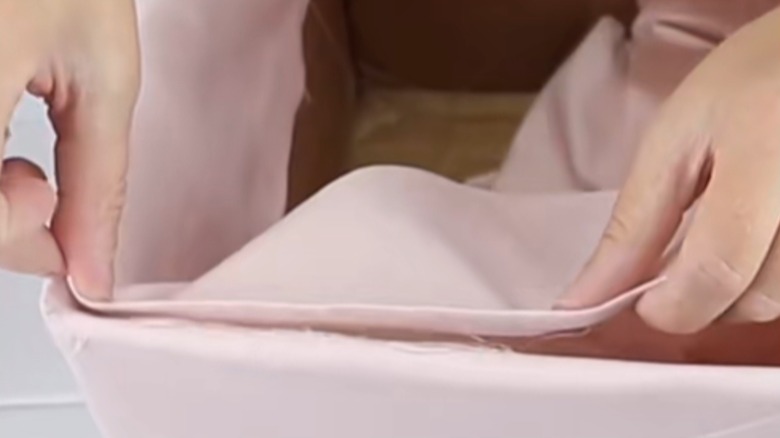
If applicable, dye your linens while you prepare the cardboard box. You don't even need to purchase dye when you can use this coffee-ground hack instead. Cut off the top flaps, and tape the two largest ones together into one liner piece for the box. Reinforce all of the box's edges, corners, and its base — both inside and out — with packing tape. On both width ends of the box, measure, mark, and poke two small holes (about 5 inches apart) for your rope handles. Cover the holes with tape on both the inside and outside of the box.
For each piece you cut, add several inches to each side for overlap. Spread out a corner of the sheet to reuse the hems on two sides for the first cut. Measure the circumference of the box. Mark that amount plus 2 inches along one of the sheet's edges, which will be the length of the wraparound piece. Then, measure the box's height and add 10 inches. Mark this amount as the other side of the wraparound piece, and cut it out.
Along a hemmed edge of the sheet, cut a piece of fabric for a lining that's the same length as the wraparound piece. Measure the box's depth, and add two inches; mark this measurement as the width edge of your liner piece, and cut it out. Place the taped box flaps that will be the box's liner on top of a raw-edged section of sheet, and cut the fabric so that there's a 2-inch margin of excess to fold over the cardboard liner.
Covering and finishing the fabric box
Grab some Vaseline before starting. This is the secret to a better hot glue gun experience; dipping your glue gun's tip in petroleum jelly will help prevent a stringy mess. Take the largest piece of fabric you cut, and glue the narrow raw edge perpendicularly to one side of the box. Leave 4 inches of fabric to fold over the opening. Wrap the cloth around the box, and glue the hemmed edge on top of the raw edge. Fold and glue the fabric's edges over the box's opening. Like wrapping a present, fold and glue the remaining excess fabric over the base of the box.
Use scissors to poke through the layers of fabric and tape where you made the initial holes for the rope handles. Cut two 12-inch pieces of rope, and loop one through the holes on each end, tying solid knots on the outside of the box. Glue the hemmed edge of your large liner piece around the inner edge of the box, covering both the raw edge of the overlapped fabric and the ropes' exit points, and secure the rest of the fabric to the bottom of the box. Glue the edges of the smaller liner piece over the cardboard flap liner, and slide it inside the box.
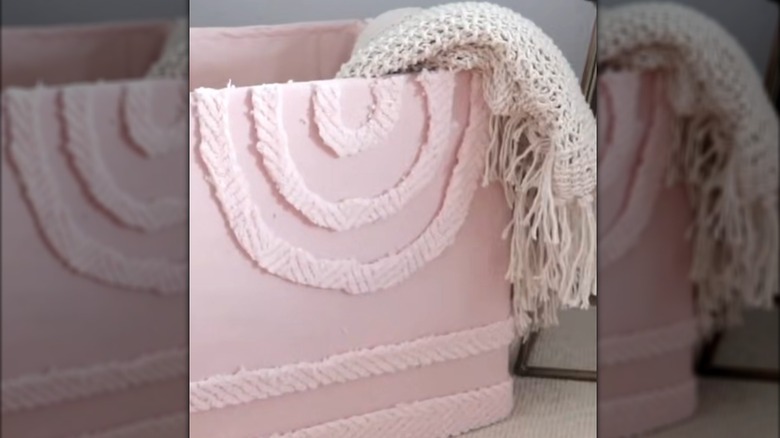
Cut the towel into 1- to 1½-inch strips, and edge them with Aleene's Fray Stop. These strips will be a chenille-like detailing for the exterior of your box. You can glue them on in concentric half-circle patterns, like in the hometalk video, or take inspiration from an image search of vintage chenille bedspreads.