

Why DIY Enthusiasts Should Give This Stunning Paint Design A Chance In 2026

If you're ready to color outside the lines, brush up on an emerging paint trend. We're talking about a new twist on color drenching, which is an interior design trend that drenches a space in color by painting each surface — walls, ceiling, trims, potentially even furniture — in one single shade. (Double drenching does the same with two or more related colors). The new variant of this trend is the gradient paint fad, which incorporates various tones of the same hue — for example, an ombré-style feature wall with a ceiling in white, cornice in light pink, walls in a medium rose hue, and baseboards in deep mauve.
"Color drenching is most often used to make spaces look bigger and calmer by not highlighting any trim or architectural features," Joa Studholme, color curator at U.K.-based paint brand Farrow & Ball, explained to Real Simple. "The gradient approach to decorating is used to draw attention to every aspect of your space, creating a greater sense of dimension." The goal of the technique is to up the hygge factor in your home, with similar hues cultivating a calming effect. As Studholme noted, "Using varying tones from the same color family creates a seamless scheme that feels cocooning and safe but still makes a design statement."
How to try the gradient paint trend in your home
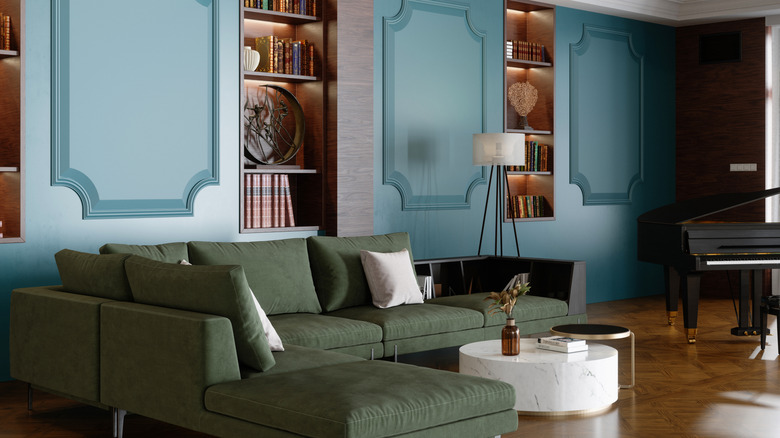
Using the gradient paint trend is a great way to turn a boring wall into a work of art. And the key to nailing the look is to lighten up. "A gradient of color is much enhanced when the strongest color is used at the bottom to ground the room and add depth and nuance," explained Studholme, "with lighter colors above to open up the space." She recommends choosing at least three shades with the boldest hue on your baseboards, a mid-tone on the walls, and the lightest on the ceiling. If you have a larger space, you can squeeze in a couple more. But to really be on top of the trend and make it feel intentional, "it is essential to include the ceiling in your gradient of colors," Studholme stressed. "So many people default to white for the ceiling, but it is very much the fifth wall in any scheme."
Beyond that, you can truly play around with color. Different tints of the same shade can create a cohesive color palette for your home. So, a research trip to your local paint or hardware store to check out some paint chips may be a good place to start. Then, if you're uncertain about where to start, Architectural Digest recommends trying a monochromatic look out in a small bedroom or bathroom. Because your walls will be largely different tones of one color palette, be sure to add some pops of color and texture variationin your furnishings. A fuzzy pillow, a boucle chair, or a shag area rug can make all the difference in providing depth to your design.