

13 Mistakes People Make When Organizing Their Countertops
We may receive a commission on purchases made from links.
When you clean or reorganize your kitchen, your countertops look pristine. You have everything organized in its place and lots of clear workspace. But slowly, a peculiar kitchen phenomenon happens where, before you know it, the worktops are all full, and you've barely got room to slice an onion. It doesn't happen all at once though; it's insidious. Somebody leaves a bottle of cordial out on the side and suddenly a bottle of pop joins it. Someone gets the popcorn maker out of the cupboard where you had it stashed, and now suddenly it lives on the worktop. Then, so do the bowls to put the popcorn in.
Very quickly, your counter space gets filled with whatever happens to land on it. It's often not a lack of storage space that's causing the issue. It's just life and any one of a number of common mistakes that people often make when organizing their kitchen countertops. Not keeping things in sensible groups, ignoring your vertical space, keeping stuff piled on the counter that would do better on the walls or in a cupboard, and letting random stuff collect all over the place are all common mistakes that make your kitchen feel cluttered and not comfortable to use. Some organization mistakes, like keeping flammable items near the range, can even be dangerous. Others can reduce the lifespan of ingredients and fresh produce.
Keeping appliances out that you don't use every day
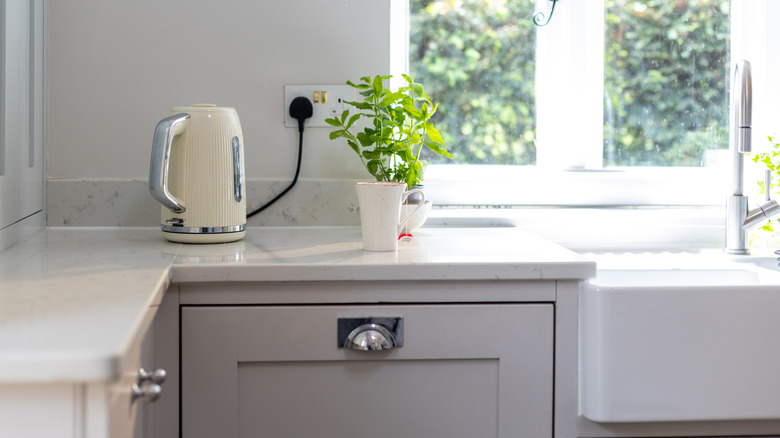
There are lots of kitchen appliance storage ideas to try. But the key rule is only appliances that you reach for every day should have a permanent spot on the countertop. Your coffee maker, the toaster, or an electric kettle, for example. These are all things that you probably use daily, or close to daily. The bread maker, on the other hand, probably only comes out at weekends at most, and that's only if you're a conscientious bread baker. The blender might only see use once a week when you're feeling like you should have a healthy fruity breakfast. How about the waffle iron that you bought, thinking it would be used every single Saturday morning, when in fact it only sees some action four times a year? All of these appliances still have their place, but they don't belong on the kitchen countertop.
Most people have at least three appliances on their kitchen counters that aren't used every day or at least every other day. Instead, these appliances are mainly expensive clutter that you have to wipe around. To fix this, start by taking a hard look at everything on your counter and separating it into three categories. What gets used daily or at least every other day, what gets used weekly, and what only gets used occasionally. Be honest with yourself, and don't let aspirational appliances (we're looking at you, NutriBullet) eat up countertop real estate if you truly aren't using them on the daily.
Daily-use or alternate-daily appliances get to stay on the counters. Weekly-use appliances can live in an easy-to-access cupboard or a low shelf where they're accessible but not taking up prime surface space. Occasional-use appliances, like that waffle iron or your big KitchenAid stand mixer that only gets used once a month, can be tucked further away, either on a high shelf or at the back of a large cupboard. Yes, they are slightly less convenient to access, but if you're only using them once a month, that's not really a problem.
Ignoring all that usable space above the counter
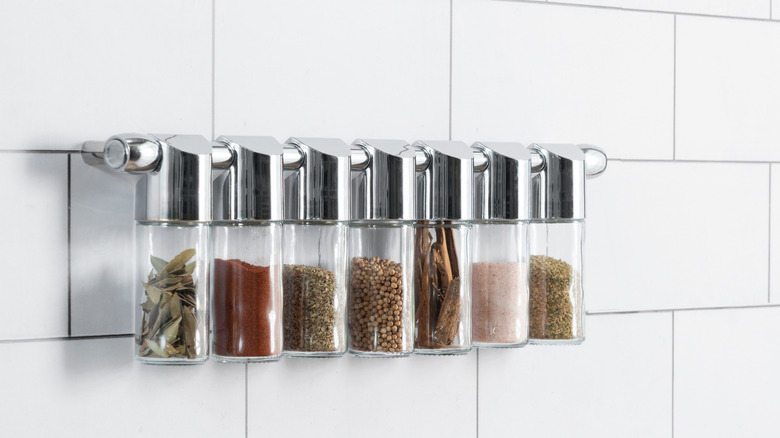
Most people organize their kitchen counters in two dimensions because that's how you work, and that's mostly where your eyes are drawn. They forget that their kitchen counter has a whole vertical plane above it, sitting right there unused. The gap between the counter surface and the underside of the overhead cabinets is typically around 18 inches and it can hold a surprising amount of everyday storage without getting in your way.
Tiered shelf risers are brilliant to make use of this area while keeping the space at the front of the counters clear for prep work. A tiered shelf riser can turn into a well-organized spice rack, for example, keeping your surface clear and your spices and herbs beautifully organized and accessible. You could also install a wall-mounted rail with S hooks to hold utensils, add a paper towel holder, and small items that you use a lot, like a colander. Under-cabinet hanging baskets are also an interesting idea. They simply clip onto the underside of cabinet shelves and can hold things like dish soap, sponges, scrubbing brushes, and other items that otherwise normally crowd the sink area. You can also use them above countertops to hold things like cloves of garlic and other small items that you like to keep close to hand. These adjustable ones from AmonHouseware have a mesh design, which can be a little more user-friendly than the typical wire rack style.
Mixing cooking items with cleaning supplies
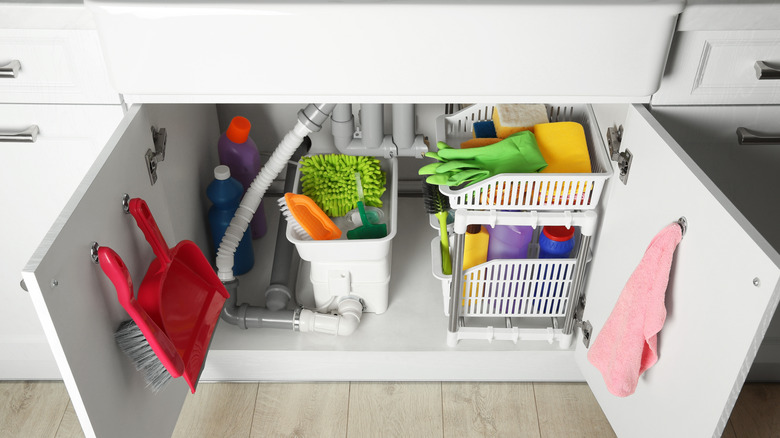
For the sake of hygiene if nothing else, food preparation items and cleaning products do not belong mingled together on the same surface. Keep your olive oil, garlic, cooking vinegars, and herbs in a cooking zone near the stove (but not so close that the heat can ruin their flavor). Dish soap, your sponges, and scrubbing tools belong near the sink. Harsher chemicals, such as surface disinfectants, belong underneath the sink in their own safe space, preferably with a child lock if you have small children. Once these items start to get thrown together on the kitchen counter, the area becomes harder to work in and more difficult to clean around. Plus it looks messy, untidy, and disorganized no matter what you do.
Rather than lumping everything together, keep those two domains separate. Establish a clear physical boundary, for example, with something as simple as a tray for cooking items and a wire basket for kitchen sponges and detergents. Keep your cleaning products near the sink, where they are most needed, and keep your cooking items closer to the stove or the oven, depending on where you do most of your food prep. Keeping items grouped sensibly and in one small area rather than having them sprawling everywhere helps make your kitchen look and feel more organized.
Using a knife block when a magnetic strip would serve you better
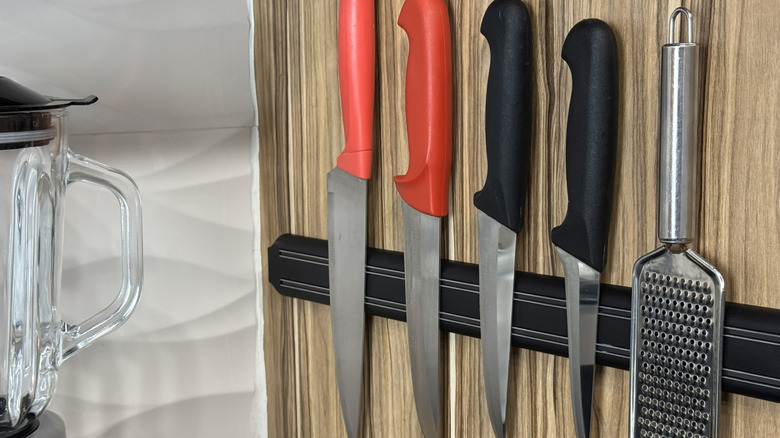
A bulky knife block often seems like a good idea at the time. It feels like it helps make your kitchen look serious, like a real chef lives there, but actually, big old knife blocks do take up a lot of space on the kitchen counter. Most people only use a handful of the knives in a knife block. Maybe the bread knife, the big carving knife, and one or two of the smaller paring or vegetable knives. The slots also tend to trap moisture, which can lead to mold, bacteria, and rusting of the knife blades. Even the dishwasher-safe knife blocks are not easy to clean. Plus, every time you insert or pull out one of the knives, the blade makes contact with the wood or plastic, which slowly but steadily wears down the edge.
There's no need to waste counter space on a knife block when a wall-mounted magnetic strip does a better job. It eliminates the bulky block that sits on the countertop, prevents dulling from repeated drawing against wood or plastic, and is easy to keep clean. Installing a wall-mounted magnetic strip lets you move the knives to the backsplash or a bare patch of wall near your prep area so that they're easily accessible but take up zero counter space. Every blade is visible at a glance, too, so you can easily see which knife you need for which job. You can get strips that are stainless steel, modern-looking, and very easy to clean — or a variety of wooden finishes if that is your preference (case in point, this sleek Hoshanho Acacia Wood Knife Holder). If you don't want your knives on display, you can even install a magnetic strip inside the door of a kitchen cabinet. A good quality, corrosion-resistant magnetic strip is generally also considerably cheaper than even a modestly priced knife block.
Letting a permanent dish drying rack colonize the sink area
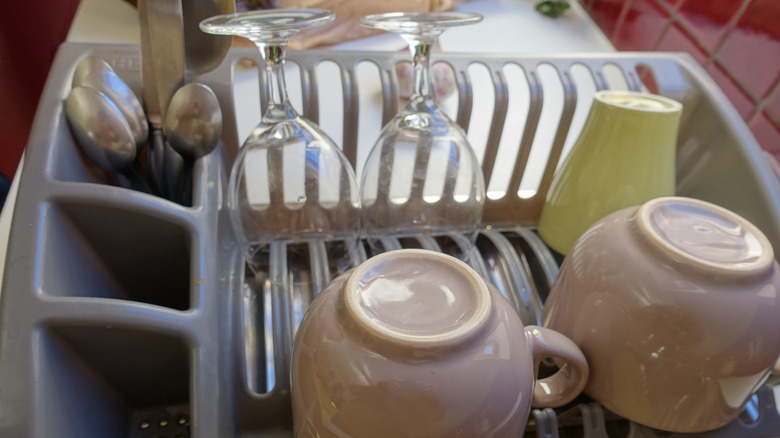
It's a common pain point. The draining board beside your kitchen sink just doesn't hold enough stuff. You add a dish drying rack over the draining board so you've got multiple layers or racks to let you air-dry more dishes. But having it sitting there gives you less incentive to put the dishes away after you've washed them. The cups, plates, dishes, and cutlery all sit neatly in the rack on the draining board, so it's tempting just to leave them there. This ends up looking untidy, and they get in the way and block your new set of dishes that need washing.
Declutter your countertop by removing this eyesore by your sink and opt for a smarter solution. You can get collapsible racks that fold flat when the dishes are done and that tuck into a drawer or a cabinet. You can also get over-the-sink racks that, as the name implies, sit above the sink basin and drain directly into the sink. These are a great option if you have a very small draining board area — and you are less likely to leave them full of dishes because you'll want to access the sink freely. You can also get space-saving wall-mounted, fold-down drip shelves that offer the same functionality but don't really take up any counter space, like the Tqvai Over Sink Dish Drainer.
Storing flammable items near the stove
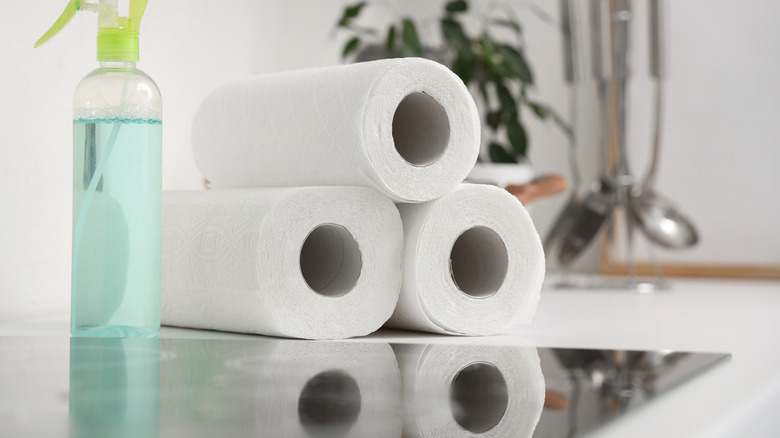
Things like paper towels, dish towels, oven mitts, cookbooks, and wooden utensil crocks stored on the counter near the stove are all potential fire hazards. The stove obviously produces heat, and if you have a gas range, there is also an open flame. Keeping anything flammable at least 3 feet away from the stove is an essential basic safety standard. You want these items far enough away that they're not a danger, but close enough that they are still easily accessible from the stove.
You can keep kitchen towels organized with a simple in-cabinet storage solution. Or, use a wall-mounted or under-cabinet-mounted holder to keep your paper towels out of the immediate vicinity of the stove but still easy to access in case of a spill. If you have a wooden utensil crock, that too is flammable, so you need to keep it at least an arm's length away from the stove, which is still close enough to grab whatever utensil you need. Oven mitts and pot holders can be stored on hooks within easy reach of the stove, but out of the danger zone.
Keeping cooking oils right next to the stove
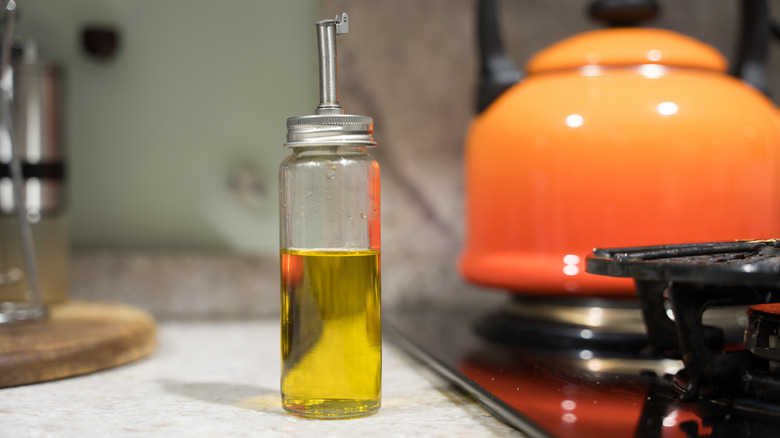
It's pretty common for people to keep things that they use very frequently while cooking right next to the stove. Cooking oils, particularly, live by the range, which makes sense because you grab them every time you cook. The issue is that oils, when exposed to oxygen, light, and heat, can quickly become rancid. The counter space zone by your stove delivers plenty of all three of those things. The rancidity gets worse over time and, although it isn't noticeable at first, will eventually start to taste awful.
Aerosol cooking sprays are even more concerning as they can be dangerous. The propellants in aerosols are flammable, and aerosol cooking oil products can explode if exposed to too much heat or an ignition source. Make sure you store oils and aerosols in a cabinet or pantry well away from the stove and only bring out what you need for a given dish.
Grouping all your produce together in one bowl
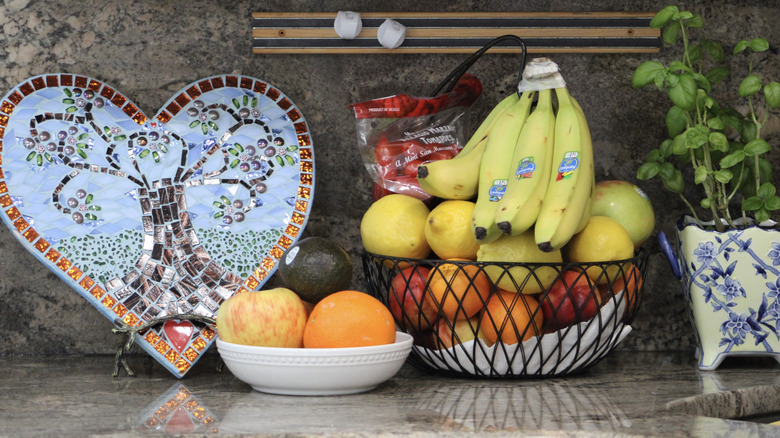
A gloriously heaped fruit bowl looks healthy, hospitable, and inviting, but is actually, sadly, a spoilage accelerator for much of the contents. Some fruits and vegetables produce ethylene gas, which is a ripening signal that tells other fruit and vegetables to hurry up and get ripe. High ethylene producers include apples, bananas, avocados, and pears. They can significantly shorten the useful life of themselves and ethylene-sensitive produce that's sitting in the same bowl. Things like leafy greens, kiwi fruits, eggplant, and delicate veggies are all particularly sensitive to ethylene and can degrade noticeably faster when stored next to any of these high ethylene producers.
Keep anything that produces lots of ethylene, like bananas and avocados, separate from the rest of the fruit bowl. It's also a good idea to move delicate ethylene-sensitive produce to the fridge crisper rather than leaving it at room temperature. A half-full fruit bowl with bananas hung from a banana hook or in a banana hammock looks much more healthy and hospitable than an overly full bowl of overripe, mushy fruit.
Wasting the corner counter space
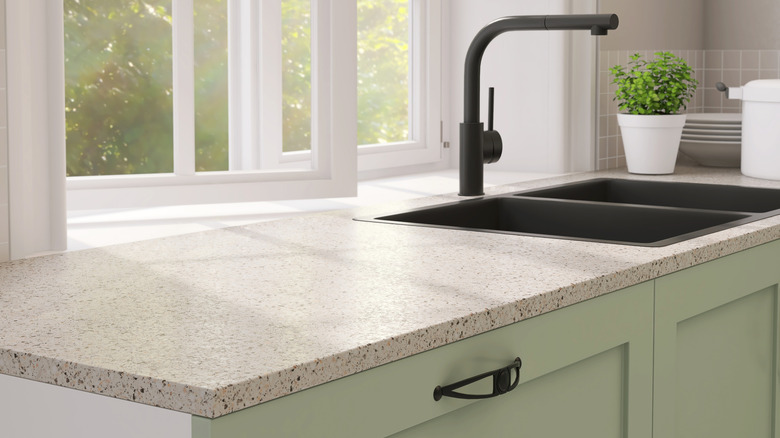
The corners of your kitchen counters tend to become dead zones because they're awkward to reach into, nothing quite fits, and it's not practical prep space. However, the corners typically have more depth than other parts of the counter surface and can act as valuable storage space if used correctly. The corner zones are good for placing larger appliances that are in use, like an air fryer or slow cooker, as they're still easily accessible, but they don't displace anything from a more useful stretch of the countertop, and they don't take up valuable prep space.
A lazy Susan can be a kitchen's best friend, especially for filling up a corner, as it brings whatever is at the back forward when you rotate it. You could even go with a multi-tiered lazy Susan to store smaller bits and bobs and make use of not just the corner counter space but also the vertical space above it. The same applies to things like rotating spice racks or tiered corner shelves. Figuring out ways to turn kitchen counter corners into actually valuable space stops them from becoming cluttered junk magnets.
Letting mail, keys, and paperwork claim a permanent foothold
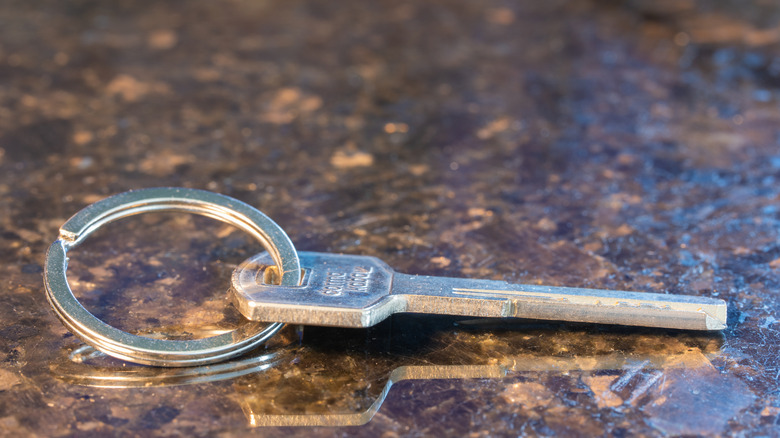
Because kitchen counters tend to be some of the only clear surfaces in your home, and because they tend to be near an entryway, they seem to magnetically attract paper, keys, mail, and the general detritus of daily life. Very quickly, the counters that you just cleared and straightened can become home to receipts, miscellaneous objects, the random stuff from your jacket pocket or whatever thing you're carrying that needs to go on a flat surface. Then, in the blink of an eye, you end up with a messy, cluttered space with no prep area because it's been filled with junk.
What you need is a landing zone for all of this ephemera. In an ideal world, you would move this zone out of the kitchen, but in reality, if everyone's habit in your home is to use the kitchen as their dumping ground, then you need to create the zone within the kitchen. Set up a dedicated space and give it boundaries. You could use a small tray or a bowl in the corner space, or in a dedicated zone behind the kettle. Here, people can dump their keys, incoming mail, and other stuff they're not quite sure what to do with. Having a receptacle keeps the clutter confined and means that you're likely to sort it out faster, because the bowl will get full.
Letting appliance cords tangle across the surface
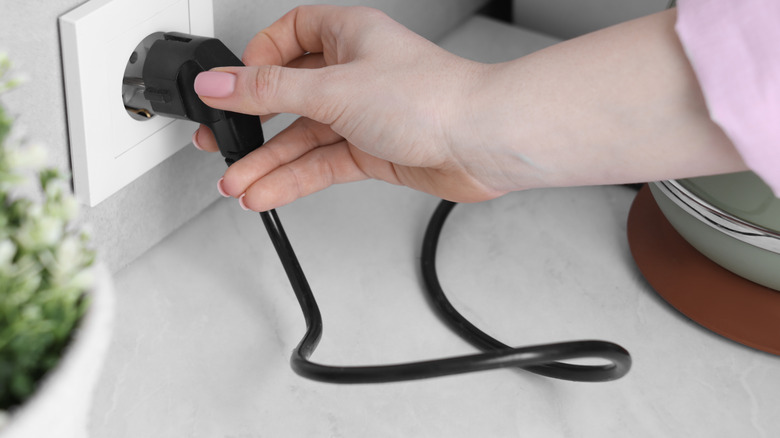
As you move through the week, you use more and more appliances. You drag them out of their cupboards or pull them forward or across the countertops. Your air fryer, the espresso machine, toaster, and blender all get moved around, and when their cords are left to drape freely across the counter, your prep space becomes visually chaotic — and it's also functionally hazardous. A cord trailing across a surface near the sink, for example, is an electrical risk. A cord hanging over the edge of a counter that's attached to a heavy appliance is a pull hazard, especially if you have children or pets.
If your appliances don't have built-in cord management, get Velcro cord ties to keep them tidy and contained when the appliance isn't in use. You can also get adhesive cord management clips that route cords along the back wall, under the upper cabinet, or even under the lip of the counter. These all stop cords trailing across a work surface. You can also install under-cabinet power strips to eliminate the need to run cords across the counter to reach a wall outlet.
Treating the counter area near the fridge as a permanent home for appliances or items
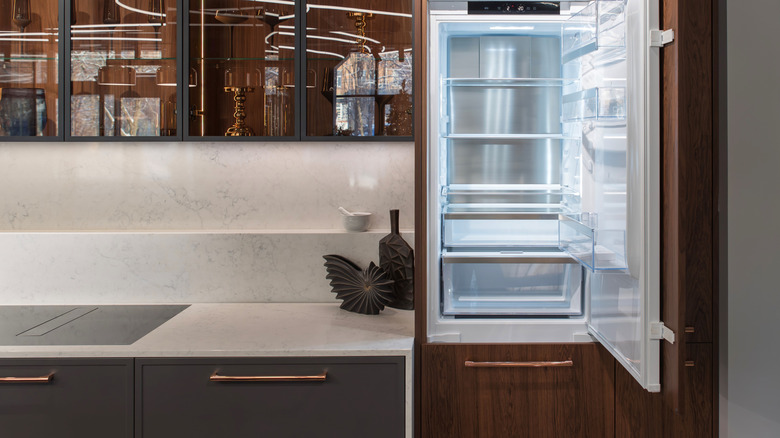
When organizing your countertops, that bare zone next to the fridge can be a tempting spot to populate with lots of decor and cookbooks. It might even look like the perfect place to position an appliance that lives on the countertop, like a toaster, coffee maker, etc. But hear us out, you need this empty stretch of counterspace, even if it's not a key prep zone.
Why? Because having a clear surface where you can pop your grocery bags down and sort items into the refrigerator and cupboards is key. If a big 'ol air fryer is hogging this space, or there's tons of bottles, baskets, knick-knacks, and other small items residing there — you'll probably be forced to unpack your groceries on the other side of the kitchen. And a clear landing zone next to your refrigerator isn't just useful for unpacking groceries. Even if you're simply reorganizing your fridge shelves, or taking a few ingredients out at a time, you need an adjacent surface to place them on. The National Kitchen and Bathroom Association recommends at least 15 inches of counterspace next to a refrigerator, specifically designated as a landing area.