

How Often Do I Need To Aerate Soil In Potted Planters?
We may receive a commission on purchases made from links.
Potted plants, like houseplants or patio plants, typically thrive with regular watering. However, over time, the soil around your plants' roots can become compacted. It's almost inevitable in container gardening. Once it happens, it limits the amount of moisture and oxygen deep in the soil. The soil in your garden beds is aerated naturally by critters, like the good worms that help your garden. Potted plants, which are contained inside hard-walled planters big or small, don't have that advantage. Instead of relying on worms to plow tiny tunnels that help water and oxygen flow freely, you need to manually aerate the soil in your plant pots at least once a month.
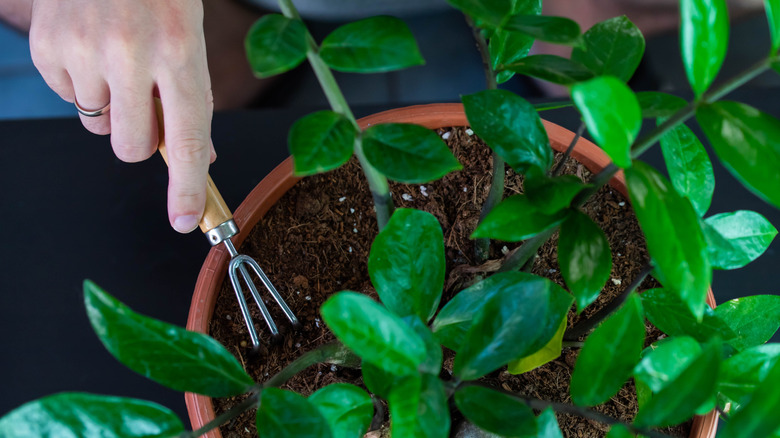
Another way to look at it is to aerate after every two or so watering sessions. It's best to aerate the soil in a pot just before you water the plant. To do so, use a thin, long object to poke holes in the soil, moving the tool in a slow, circular motion as you drive it into the dirt. Items like chopsticks, forks, craft sticks, and wooden or metal skewers work well for aerating houseplant or potted plant soil. You can also use a purpose-made tool, such as this 16-inch Hibumfx Root Aerator and Plant Water Monitor or the rake in this three-piece Zoklu Mini Garden Tools Set. Once you've created some holes in the soil and broken up any crusty, dry areas, water your plant thoroughly. Aeration helps the soil absorb water more evenly, allowing it to reach the roots more effectively.
Aerate your potted plants to break up dry, compacted soil
There are some telltale signs that let you know when it's time to aerate the soil in your potted plants — whether they live indoors on your windowsill or outdoors on a large terrace. The soil is likely compacted when your plant starts to wilt, a gap appears between the soil and the planter walls, or the soil surface is cracked and dry. You might also notice that when you water your plant, the water sits on the soil surface instead of soaking in. Breaking up the compacted soil will give water a path towards the roots and allow it to drain slowly out of the bottom of the pot. Too much water can also be a problem. Common signs that you are overwatering your indoor plants and causing damage — such as the plant's younger leaves turning yellow — are an indicator that water isn't draining effectively. Aeration may help here, too.
Aeration is just one strategy to ease soil compaction in potted plants. In some cases, though, it might not be enough. You may need to replace the soil in your potted planters completely. When you repot a plant, you remove all that tightly packed dirt and switch it out with fresh, healthy, airy potting mix, like EasyGo Products Farm Ocean Light Aerated Texture Potting Soil for containers. It gives you the chance to incorporate soil additives that improve the structure. Depending on what type of plant you have in your planters, that could be bark, peat, perlite, sand, pumice, vermiculite, coco coir, or even biochar. These additives create air pockets in your potting mix, keeping the soil aerated longer. While you likely won't be able to retire that aeration tool, you hopefully won't need it as often.