

Ditch These Old-School Tools For Their High-Tech Replacements
We may receive a commission on purchases made from links.
How many obsolete, old-school tools do you have in your toolbox? Is there a brace and bit somewhere in the chest that your grandfather gave to you? Perhaps your garage is housing a secondhand push-reel mower that you bought to safely teach the kids to mow the lawn. Sure, when a storm blows through, you might appreciate having kept hold of a certain few tools from the metaphorical dark ages. But for the rest of the time, when power isn't a problem, do you really see yourself using them?
In this guide, we're going to cover 12 high-tech replacements for the old-school tools that you've yet to let go of. Some will help you make better decisions when it comes to ensuring a green and lustrous lawn. Others will take the legwork out of lawn mowing altogether. Some, while unnecessary for day-to-day DIY, are essential for larger home-improvement projects, and some will allow you to quickly decorate your home like a professional. From specialized equipment to DIY tools that every homeowner should have in their toolbox, if technology intrigues you, then this 21st-century tool guide is most certainly for you.
Be as precise as possible by switching a spirit level for a laser model
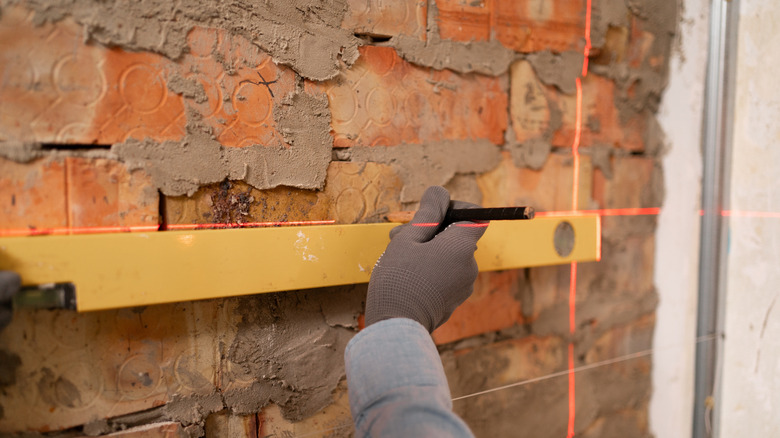
If you're just hanging a couple of shelves, chances are a good old-fashioned spirit level will do the trick to keep things nice and straight. However, if you're working to achieve an even keel on longer edges, then using a single spirit level makes misalignment more likely. It's known as a "chaining error" — where you make a series of minor mistakes by trying to level a long line with a single, shorter spirit level. Avoiding such errors is one of the main benefits of using a laser level for home improvement.
For example, let's say that you're hoping to DIY the perfect deck and thus save costs on hiring a contractor. While a laser level is undoubtedly an extra cost versus the spirit level you already own, the former will make it much easier to ensure your footings are level. These high-tech tool upgrades can set a level line in seconds, and allow for hands-free operation. Some can also provide a "cross line," allowing you to achieve perfectly level and plumb lines for DIY upgrades like new bathroom tiles. Those lines will have zero accidental inaccuracies, leaving you with a professional-grade finish in places where it really counts. Laser levels used to be pretty pricey, but you can now get cheap models on Amazon for under $30, such as this Nikotek Laser Level with Tripod.
A robot lawn mower can (literally) put lawn cutting on autopilot
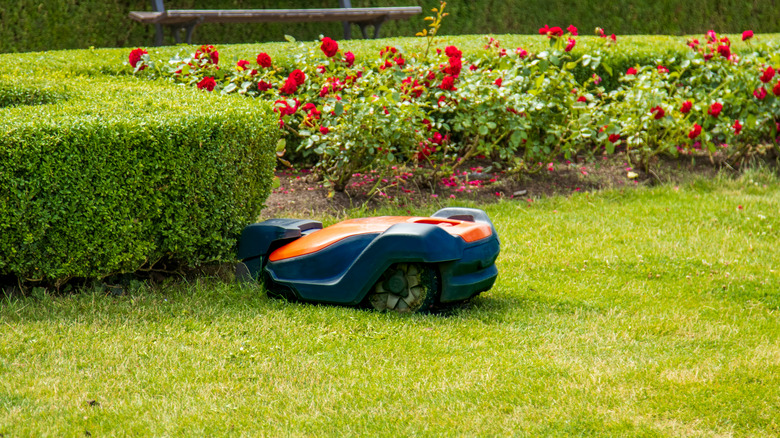
For those who are already unsure whether gas or electric mowers are best for your yard, we don't mean to confuse matters further. But have you considered the possibility of upgrading to something a little less hands-on? Robotic lawn mowers are exactly what they sound like. Like robotic vacuum cleaners, which move autonomously around your floors and keep them clean, robotic mowers cut the grass between a prescribed set of boundaries in your yard. And while there are different types to choose from, the benefit for busy homeowners is that they can shave hours — potentially even days — off your annual yard maintenance routine.
Robot mowers are mainly differentiated by the technology they use to map your garden. Some come with perimeter wires, which need to be dug into the boundaries of your yard (as well as around any features that the mower needs to avoid). Others are fitted with GPS technology, relying on satellites and a centrally based "station," and can map your garden's boundaries with impressive degrees of accuracy. There are even mowers that use lasers to map your yard on-the-go, without GPS, although they tend to cost more than other types. Whichever you choose, provided that you buy the right type — for example, one with four wheels to handle uneven, sloped terrain — robotic lawn mowers are widely considered to be worth the investment.
Upgrade your watering strategy with automatic irrigation
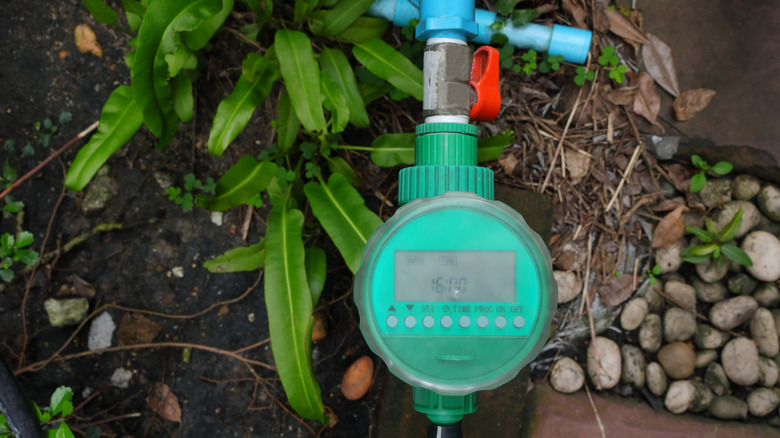
The need for a high-tech irrigation system can depend on the scale of your garden's watering requirements. But if you have more than a few drought-resistant cacti, then it could at least be worth considering upgrading from a watering can, garden hose, or highly manual sprinkler system. Using automatic technology, it's possible to set the time and frequency with which your yard should be watered — without the need for you to actually be at home. In other words, even if you're off on vacation during the hottest part of the year, your yard can stay perfectly irrigated.
What's more, some modern systems can be programmed to provide accurate readings of recent rainfall. They can then use this information to adjust the amount of water they apply to your yard. As for the types of systems available, they vary. You can buy drip-feed irrigation systems, which are useful for containers, greenhouses, and growing beds. You can also buy autonomous sprinkler systems, which will ensure your yard is duly doused, even if you happen to be on the other side of the planet. Some, like this Smart Hose Watering Timer with Wi-Fi Hub from Orbit, use local weather data and in-built weather sensors to automatically adjust based on a given set of parameters. They often feature app connectivity, too, allowing remote access to check everything's running smoothly.
Take pH misreadings out of the equation with a digital soil tester
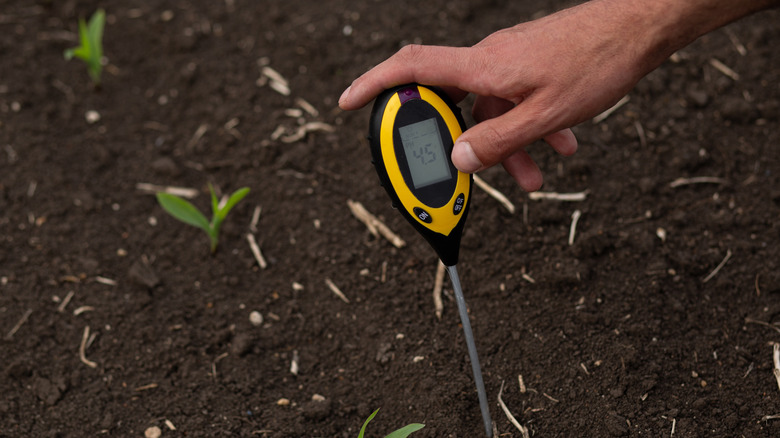
Different plants tend to favor different soil conditions, and whereas some like it slightly acidic, others much prefer it neutral or even slightly alkaline. Nutrients can also become less available in overly acidic or alkaline soil. The old-school way to take soil pH readings is by using pH testing strips. These strips, like litmus paper, turn a different color depending on the pH of the soil in question. They are then compared to a color chart (provided by the manufacturer). While pH strips are reliable, they can be difficult to read accurately. For this reason, if you're serious about getting the most out of your growing season, you'll probably find that the best pH testers for optimal soil are digital.
These high-tech tools can help to remove the possibility of misreadings and are very convenient to use. They give you a precise number to work with, often measuring to within a single decimal point. In other words, you don't have to try and interpret a color or dial. Instead, provided that you keep your tester properly calibrated, you just insert the probe into the soil and wait for it to provide a reading. For large gardens, or if you're trying to achieve different pH conditions for different plants, digital meters are likely to be much more practical than multiple, disposable strips.
Upgrade your manual hedge shears to a cordless hedge trimmer
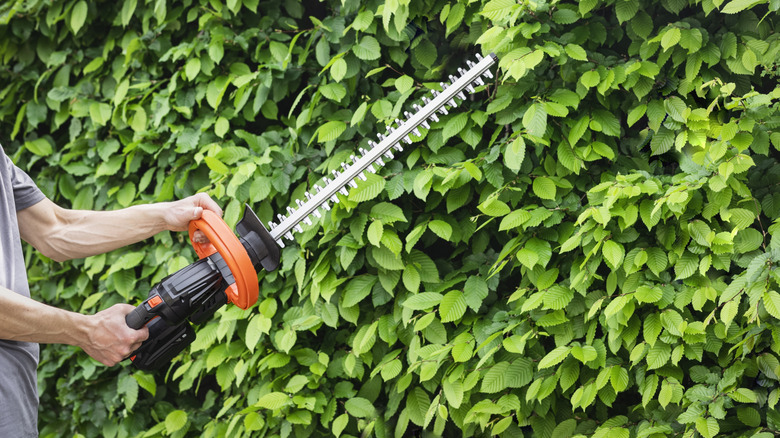
Hand-operated hedge shears certainly have their purpose, even in the most modern garden. They're excellent for precision shearing, for example, on small, ornamental shrubs and plants where accuracy is key to a manicured look. However, if you rely on them to keep your larger, boundary hedgegrows in check, an electrical (or gas-powered) hedge trimmer is likely to be worth the upgrade.
Corded, gas-powered, and cordless hedge trimmers remove a lot of the strain and manual labor from keeping your garden's vertical growth neatly trimmed. They usually feature large, flat, reciprocating blades that allow you to trim large areas with far more speed than with manual shears. Some hedge trimmers feature extra-long blades, too, allowing you to reach to the top of your hedges without the need to set up step stools and ladders. Some even include telescoping handles with adjustable heads. These can be set to different angles, allowing you to trim along the flat top of your hedgerow — again, without the need for a ladder.
Upgrade from a manual post hole digger to a powered earth auger
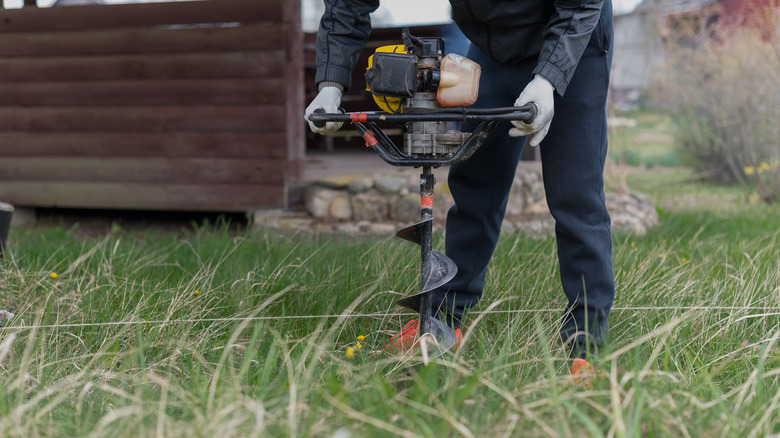
There are various tools that you'll need to have when installing a new fence. But with some of them, you have a choice. One example is the tool with which you dig your fence post holes. Getting these right is key to a stable, long-lasting fence, and depending on the nature of the ground, they can be awfully hard to dig. This is especially true if you rely on a good, old-fashioned fence hole digger. These typically require muscle power to drive them into the ground. Alternatively, you could purchase a hand-operated auger. They effectively drill into the ground, loosening the soil and making it easier to remove, but once again, hand-operated augers require you to physically crank the shaft into the earth. If you're keen to let tech take care of the heavy lifting, and you have lots of heavy lifting to handle, then a powered earth auger might be the best tool for the job.
These tools are available with either gas or electric engines. What they all have in common is that they use mechanical power to chomp through the ground. On large fence-building projects, a powered auger could easily save you hours versus digging the holes manually. And while the process is still kind of physical (requiring you to hold and guide the auger), it's considerably less demanding than punching or drilling those holes without mechanical assistance. If you're hesitant to shell out for a gas or electric earth auger — but have a post-setting project coming up — you can also hire a unit from somewhere like Home Depot.
Give a laser distance measurer a chance to outshine your tape measure
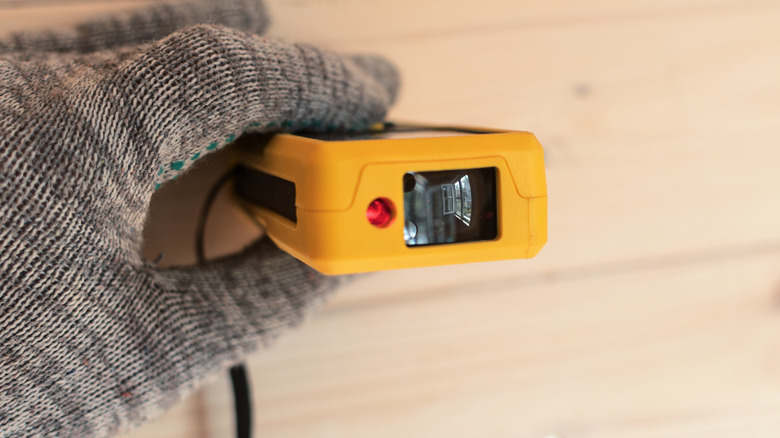
Like a spirit level, a classic measuring tape can be ideal for smaller jobs. For example, you might be measuring up a section of wall to hang some shelves, or checking that your lovely new sofa will actually fit through the front door. In those cases, a regular old tape will do just fine, especially if you employ a few nifty tape measuring hacks to get the most out of your tool. But if, for example, you're laying a new floor, then measuring with a tape may not be the best idea. Since they tend to bend, especially when fully extended, you can easily overmeasure your space. And if your tape isn't long enough to measure the entire room — and you have to measure each length in two sections — then mismeasurements become even more likely.
On larger projects like this, a laser distance measurer can ensure perfect, pinpoint readings. You simply switch them on, position them at the point you'd like to measure from, and aim the laser. They take measurements by calculating the time for the beam of light to travel to a given target and bounce back. You can also use them to take measurements that would be either dangerous or inaccurate with a standard tape measure, like the height of your home's facade, or the volume of a given room. Finally, laser measures are a lovely tool to have if you typically work solo — no more precariously trying to hook the end onto something, only for it to jump off.
If you haven't already, upgrade your brace and bit with a cordless drill
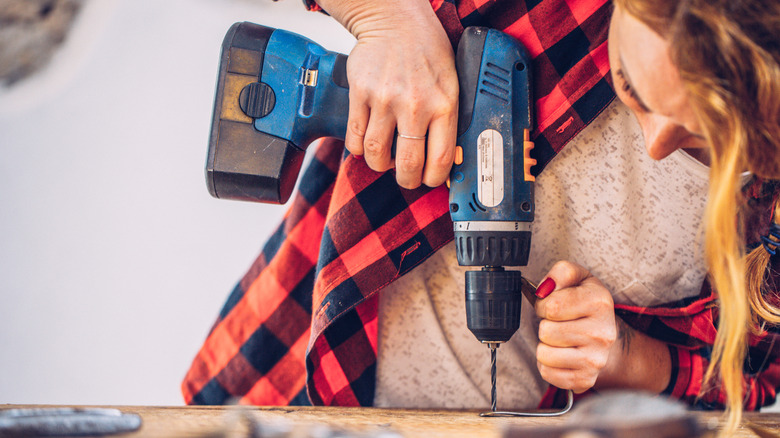
Once a mainstay in the trades, braces and bits have long since fallen out of favor among most professionals and DIYers. They're used to bore holes in materials like wood. The "brace" is the crank-shaped part of the tool that you use to apply leverage, while the bit — like in modern drills — does the actual boring. Today, trading them in for a reliable power tool is a no-brainer, especially since there are now lots of highly-rated cordless power drills for DIYers to choose from.
Battery-powered drills do everything that a brace and bit can do. But they do it much more easily, with greater precision, and without unnecessarily tiring your hands. They can be used overhead or in tight, awkward spaces, where there's only room to work one-handed. They can also be used to drill through various materials, including wood, metal, and even stone — provided that you use the appropriate bits. Plus, there are tons of handy power drill attachments, including paint mixers, wire brush heads, sanding attachments, and an array of cleaning heads for scrubbing, scouring, and polishing. With a Graco attachment, you can even turn your drill into a paint sprayer.
A paint sprayer could shave hours off your decorating project compared to a brush and roller
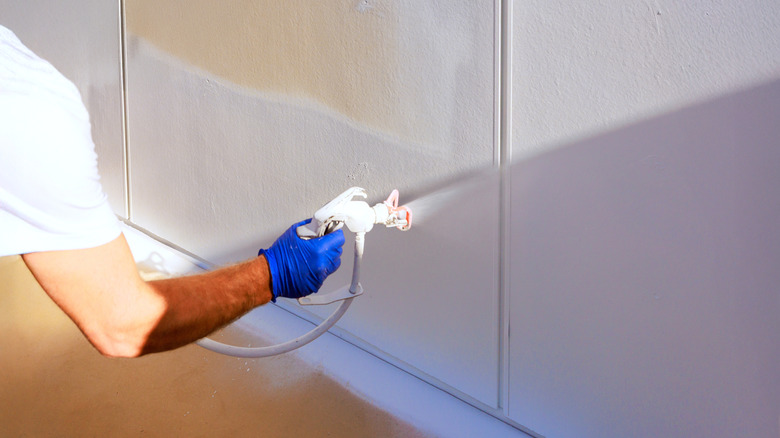
Speaking of paint sprayers, if you're hoping to paint your house like a professional, upgrading to a sprayer instead of relying on rollers and brushes can be a game-changer. These specialized tools are designed to apply a thin, even layer of paint to the surface you're trying to decorate. And in certain situations, they're superior to traditional rollers and brushes in several ways. Firstly, that thin, even coat sidesteps the common human error of coating the surface too thickly, which can lead to peeling. Sprayers also cover larger surfaces much more quickly than a brush or roller, allowing you to decorate your home in a matter of hours, instead of days.
One downside is that they can come with certain additional equipment requirements, like an air compressor, hoses, a regulator, plus cups to hold the actual paint. They can also be quite expensive. However, it's possible to buy kits at surprisingly reasonable price points. For example, there are several highly-rated paint sprayers at Harbor Freight that come equipped with everything you need to get started out of the box. Plus, you can also opt for small, handheld corded units (like the Vonforn Paint Sprayer) that don't require a compressor, or try out a drill attachment for smaller jobs.
Ditch the hammer and nails and opt for a nail gun instead
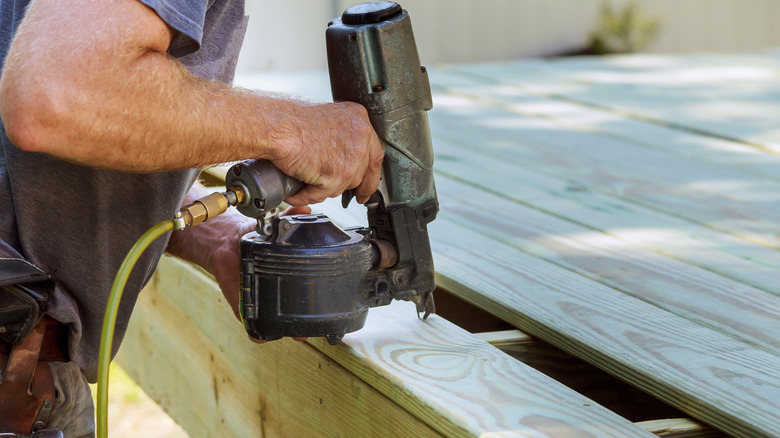
The usefulness of a nail gun will depend on the scale of your home improvement project. For example, if you're just tapping in a tack from which to hang a family photo, then a few gentle knocks with a handheld hammer will do just fine. However, if you're DIYing a new deck, mounting tons of trim, or installing a whole new fence, then you might just wish you had something to make the process a little easier. Both your thumb and hammer arm may thank you for it.
The first step is choosing the right nail gun for your home improvement project. Heavy-duty projects that call for big nails (like installing fencing and decks) require a framing nailer. For jobs like installing trim and moulding, you'll need a finishing nailer. Brad nailers are for very small nails and light materials/applications. In other words, you'll need to make sure you choose a gun that's suited to the nails you need to hammer, including both their gauge (diameter) and their length. A good nail gun should make pretty light work of even the most extensive nailing jobs. And if you choose correctly — matching the right nails to the right materials, and the right gun to said nails — you'll find it does so with minimal imperfections. Compared to a hammer, that makes it all too easy to accidentally bend nails before driving them all the way in, this high-tech upgrade is likely to feel worth it.
Upgrade your rain gauge with a smart weather station and hub
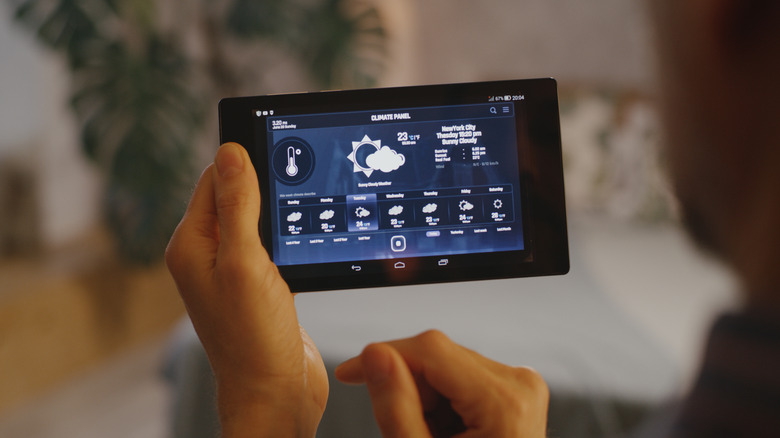
We've covered smart tech for your watering system already. But if you prefer a more hands-on approach to watering, or you like having the excuse to spend more time in your garden, then a rain gauge is worth keeping around. The only downside with them is that they don't always help you make the smartest rainfall-based decisions. Yes, they can give you an idea of how much rain has fallen, in inches, over a given period of time. But what if, after a downpour, the sun comes out and causes some of that captured rain to evaporate? Or you forget to empty the gauge, and it overflows? How accurate will your readings be then?
A smart weather station and hub can eliminate any guesswork from assessing your area's experienced rainfall. These high-tech systems typically feature an array of gizmos designed to draw data on all things meteorological. They measure things like humidity, temperature, wind speed, as well as the amount of precipitation. They do so without manual gauges that can experience evaporation (or get filled with leaves), and the data they provide can help you to identify the unique climatic conditions in your yard. Gardens often have their own microclimates, meaning they lend themselves better to certain planting choices than other nearby gardens — even the one next door. Some weather stations can even send alerts to your phone when temperatures dip near freezing. This provides a convenient cue on when to bring tender perennials indoors or protect them with frost blankets.
Swap fatigue-inducing hand pruners for battery-powered pruning shears
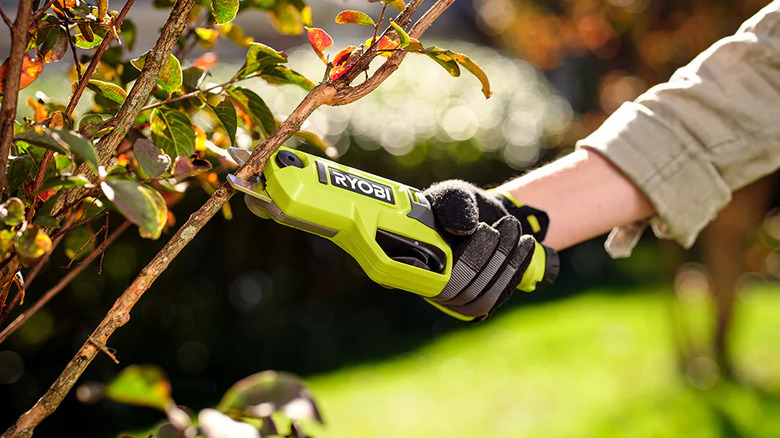
Traditional hand-operated pruners remain one of the most essential tools for gardeners across the country. They're useful for light and seasonal trimming, for deadheading, and for cutting away deadwood from woody plants like roses. And for the most part, manual pruners are more than sufficient. However, in larger gardens, where there are potentially hundreds of cuts to be made, they can quickly become tiring on the hands, and uncomfortable for those who have arthritis.
In these situations, a battery-operated pair of pruners could well be worth considering. They work in much the same way as regular pruners, featuring sharp blades that cut through plant stems. The difference is that all your hand has to do is hold them and pull the trigger. You don't have to exert any pressure, since the battery and built-in motor exerts it for you. And while they might seem kind of "gimmicky," battery-operated pruners are actually surprisingly capable. Take Ryobi's USB Lithium Pruning Shears as an example. Featured among Ryobi's newest releases for 2026, these shears claim to make up to 450 cuts on a charge and take branches up to ⅜-inch thick.