

Not Banana Peels: The Other Fruity Kitchen Scrap Your Compost Will Love
We may receive a commission on purchases made from links.
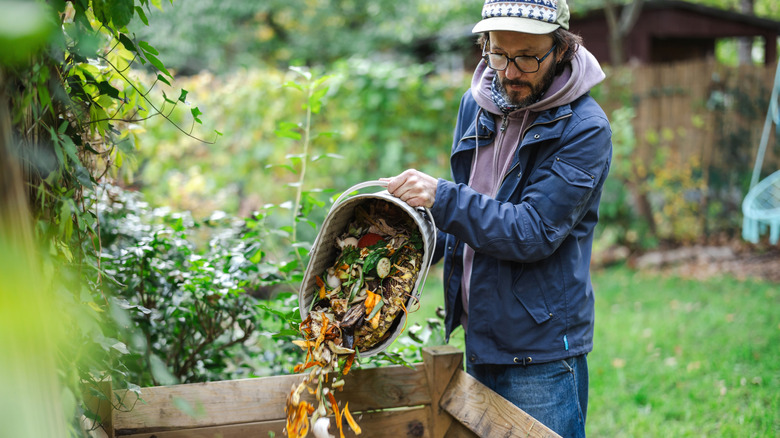
Composting is a wonderful way to fill a garden with the nutrients it needs to produce healthy plants. The practice also promotes environmental health by depositing organic material back into the ecosystem, instead of dumping it in a landfill where it compresses into towering piles, deprived of oxygen, producing a harmful greenhouse gas known as methane. If you have a balanced compost pile with the right proportions of carbon from brown materials and nitrogen from green materials, you will be able to quickly and properly decompose waste.
Banana peels are rich in nitrogen, so they're great for balancing a carbon-heavy compost pile that is full of discarded corn stalks and dead leaves. But aside from banana peels, there are plenty of green materials that can give your compost pile a serious nitrogen boost. If you purchase a lot of fruit, perhaps for smoothie consumption or archery target practice, you should know that melon rinds are one of the best ways to add nitrogen that will feed the microbes inside your compost pile. While nitrogen is important in aiding in the decay of carbon-heavy materials, melon rinds contain plenty of other vital nutrients that will keep your soil in good health. Cantaloupes, honeydews, and watermelon rinds are packed with phosphorus, potassium, and calcium.
The process of composting melon rinds
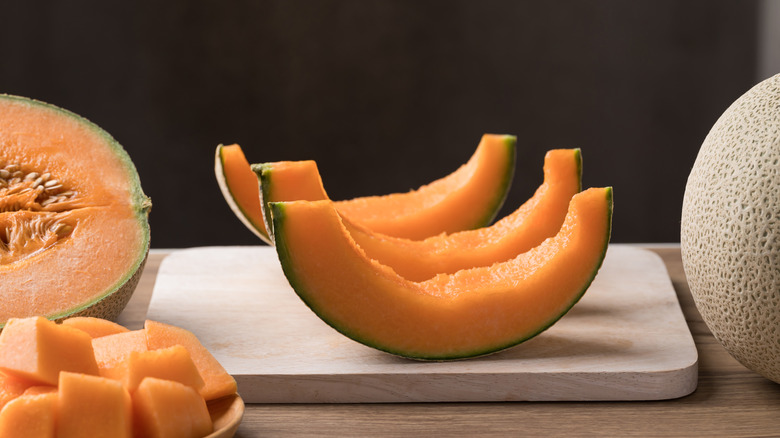
When you make your own DIY compost, you don't want to overwhelm your pile with too much green material. Your melon rinds will decompose faster if you cut them up into tiny pieces. Then place a layer of carbon-rich material, like grass clippings or leaves, on top of your rinds. These segments should fully break down within a couple months. If your material is not decomposing fast enough, try stirring the pile every couple weeks. You can mix the organic material with a shovel or a stick.
Your melon will feed microorganisms in the pile, and in turn, those microorganisms will produce heat. You can use a Greenco compost soil thermometer to check the temperature, and make sure it doesn't go over about 160 degrees Fahrenheit. Just stab its long stem into the pile and wait a few minutes for the needle to settle on the dial. You can turn the compost to increase airflow to the microbes, which should increase the temperature.
If you use melons that contain seeds, there is a good chance that they will germinate in your garden when you use the compost soil as fertilizer. To mitigate this issue, you can either purchase seedless melons or keep your compost pile above 145 degrees Fahrenheit. After you buy your melons, make sure to remove any stickers, which are just one of several things you never want to add to a compost heap.
Other ways to maintain homeostasis when composting melon rinds
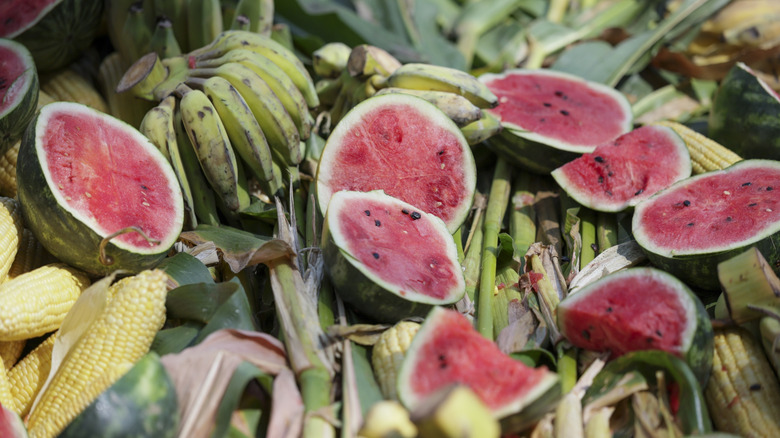
If you treat your compost pile like a garbage bin, there's a good chance you'll end up with a dry pile of sticks and stems or a hot, wreaking mound of wet garbage. Compost piles need to be planned and maintained, and the material that goes in must be curated, otherwise you'll disrupt the sensitive balance between nitrogen and carbon. It's important to remember that melon rinds contain a lot of water. For instance, watermelon rinds are over 80% water, which makes them a welcome addition to a pile that is full of materials like dry hay and grass clippings, to keep it in balance and not too dry or too wet. Microbes will thrive best in a moderate, damp environment.
You might need to limit the amount of melon rinds you add if your pile is already full of green materials. When a compost pile becomes waterlogged, the microbes will suffocate, and the pile will become slimy and smelly. If your pile has the appropriate level of moisture, you should be able to squeeze a few droplets of water out of a handful of compost. Stir the pile or even cover it with a tarp if the handful is soaked. If the handful is dry, you can water the pile with a hose and stir it.
A healthy compost pile needs to be roughly three parts brown material (carbon-rich) and one part green material (nitrogen-rich). Nitrogen-packed melon rings help microbes synthesize protein and grow. If you have too much nitrogen in your pile, the microbes won't be able to consume all of it, and the excess will be aerobically converted into foul-smelling ammonia gas.