

How Many Tomato Plants Would It Take To Replace Store-Bought Tomatoes?
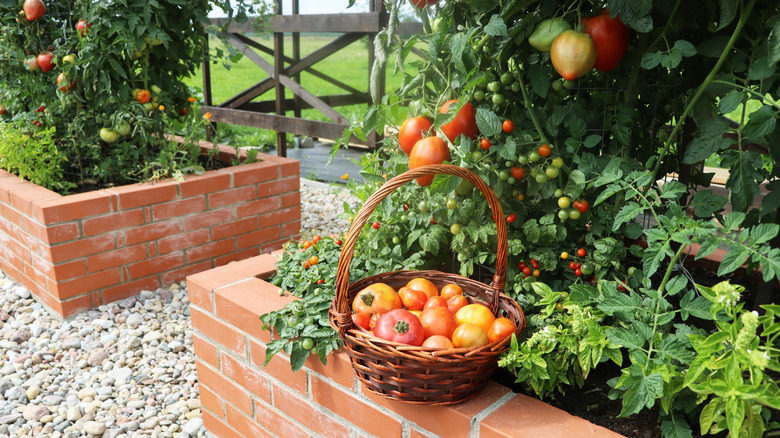
While self-sufficiency may not be the goal of every home gardener, supplementing your grocery budget with homegrown produce sure is a nice feeling. You can walk through the vegetable aisles of the store without baulking at the prices of certain vegetables, knowing full well you've got more than enough growing in your raised beds. If you have enough space, one easy and rewarding crop you can become sufficient in is tomatoes. The list of tomato growing tips every beginner needs for a successful first harvest that will sustain a family for a year begins with knowing how many plants to put in the ground. The exact answer takes a bit of math and depends on your specific needs, but there is a rule of thumb. A good starting point is two tomato plants for each person in the household.
If you're just growing tomatoes for yourself, a couple of plants should be enough. If you're a family of four, you'd need around eight plants. Of course, if you love eating tomatoes fresh or in cooked dishes, you can go as high as three or four plants per person. The calculation is based on a 52-week year — it assumes that you'll eat tomatoes throughout the year, in every season. Obviously, in most parts of the U.S., you can't grow or harvest tomatoes all year long. Therefore, this number relies on the assumption that you'll be preserving your harvest — for example, through canning and freezing — so that you can enjoy homegrown tomatoes well beyond summer. If you like to eat fresh tomatoes out of season, you'll still have to purchase tomatoes imported from warmer regions or grown in industrial greenhouses from the grocery store or greengrocer.
How to fine-tune your tomato plant calculations
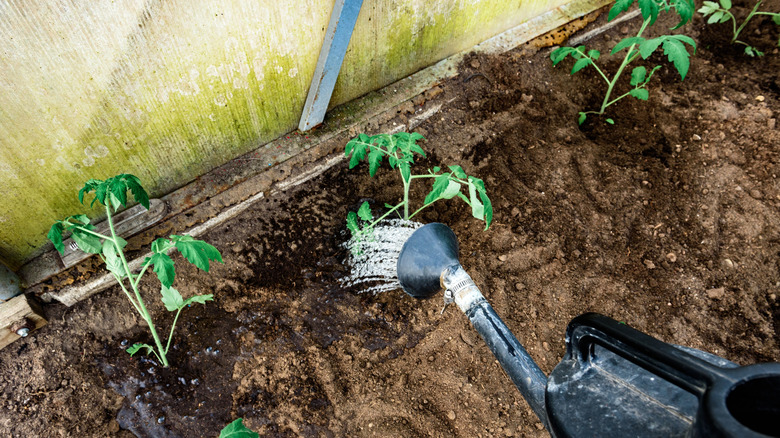
Two tomato vines per person is a great starting point. But if you want to achieve true tomato self-sufficiency, it's important to understand the math deeply enough to design your own system. The key concepts in this equation are yield and weekly consumption, both of which can be measured in pounds. First, keep track of how many pounds of tomatoes your family eats in a week — that's your weekly consumption. Next, figure out the yield of a single tomato plant — that is, how many pounds of tomatoes it will produce in a season. Then, to find out how many plants you'll need, multiply your weekly consumption by 52 and divide by yield (weekly consumption x number of weeks in the year / yield). As you gather more data season to season, you can adjust your numbers.
This approach is more helpful than a generic number per person because not all tomato species and cultivars have the same yields. Some tomato varieties provide bigger harvests than others, meaning you can get away with planting and maintaining fewer vines. If you prefer to go in this direction, choose varieties known for their ability to produce tons of fruit. For example, Better Boy, Big Beef, and Beefsteak tomatoes would all be good options. Tomato vine growing conditions, like making sure they get the right amount of water and sun, can also increase yield. For example, growing tomatoes in a greenhouse or polytunnel helps you better control inputs and extends the growing season. There are other, lesser-known gardening hacks for growing tons of healthy tomatoes, too: dropping fish scraps into the planting holes, planting seedlings sideways, dusting the soil with cinnamon, and many more.