

How Many Houseplants Would It Take To Replace An Air Purifier?
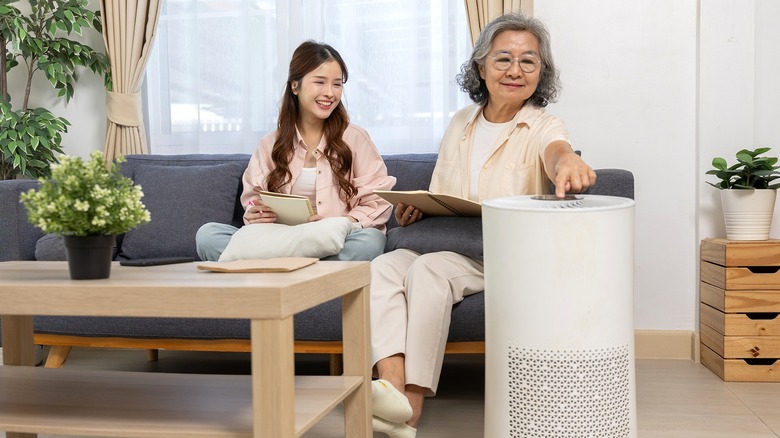
Some debunked myths aren't surprising, others are, and a few might elicit a chuckle. For example, the air-purifying ability of houseplants is a very common misconception, and stems from a 1989 NASA study that concluded plants can filter out dangerous compounds from the air such as formaldehyde, benzene, and trichloroethylene. However, several decades later, the more complicated reality was revealed: It would take an impractical number of plants inside a room to be as effective as an air-purifying system.
Specifically, a 2020 study published in Journal of Exposure Science & Environmental Epidemiology found that it would take between 10 and 10,000 plants per square meter of floor space in a building, such as a home, to achieve the same benefits as those found in "potted plant chamber studies." For a home, this would be equal to ~65 plants in a 70 square-foot room, or the size of a small bedroom.
Another wrinkle in this conversation is how slowly plants can deliver clean air compared to an air purifier. The clean air delivery rate, CADR, is the rate at which an air purifier can clean a room when set at maximum speed. Per Dreame Technology, an air purifier with a CADR of 235 CFM (cubic feet per minute) is capable of cleaning a space of nearly 1,700 feet. This number in m³/h, or cubic feet per hour, meanwhile, is ~400, based on the formula CFM = m³/h ÷ 1.7.
So, how many houseplants would it take to achieve a CADR of 400 m³/h and replace an air purifier? Per the 2020 study, a single plant has a CADR of 0.023 m³/h, which means it would take 17,391 plants to clean a space of equal size.
What having plants in your home can do

Even though a few plants won't be able to purify a space the same way an air purifier could, a room full of foliage and flowers could provide some health benefits, both physical and psychological. For example, houseplants can naturally make your home smell amazing, without the potential toxins that come with air fresheners. Studies have shown that people who spent time in rooms filled with houseplants had lower blood pressure and improved academic performance.
Other studies, such as this now-decade's old paper published in Journal of Experimental Psychology: Applied, suggest that houseplants can help improve concentration and productivity. There are also reports that being near nature can help a person recover more quickly from illness. The studies don't mention how many plants per room were required for someone to feel the advantages they provide, but inviting one or two types of greenery into a space is a good place to start, especially if you're a novice indoor gardener.
Although thousands of houseplants shoehorned into every crevice of your home is unreasonable, creating a bit of an indoor jungle with a few (or several) plants is a multipurpose way to reap their verdant, helpful qualities while decorating your home with plants in a unique way. Research indicates spending time around plants reduces cortisol, the hormone our bodies release while we're under stress.
And so, even though they won't purify your air efficiently, you might still feel significantly better after spending time in a plant-filled home. (Check out these houseplants that will thrive in your sunny kitchen.)