

It Was Popular In The '30s — The Rare China Pattern That's A Thrift Store Gem
We may receive a commission on purchases made from links.
For decades, it was every bride's dream to get engaged and register for a Noritake china set. This legacy brand began as the Morimura Brothers in New York in 1876, becoming Noritake in 1904 as the first Japanese factory to make western-style dinnerware. By the 1930s and for decades thereafter, it was a go-to brand in department stores and high-end boutiques across the United States. (This writer's mother even registered for and collected a set in the 1980s.)
Noritake was (and is, the company is still producing today) loved for its artistry and craftsmanship. The earliest designs, like the Azalea pattern (circa ~1918), were hand-painted and often finished with gold details. By the 1920s and '30s, Noritake pivoted to assembly line production; this allowed the brand to produce its products more quickly, while retaining consistent quality, to keep up with consumer demand.
Along with its style points, because of how it's made (fired), true china is chip-resistant. While most modern Noritake pieces are dishwasher safe, older patterns like Azalea are not. The brand maintains a table of patterns and collections that tells you which ones are dishwasher safe and/or microwave safe.
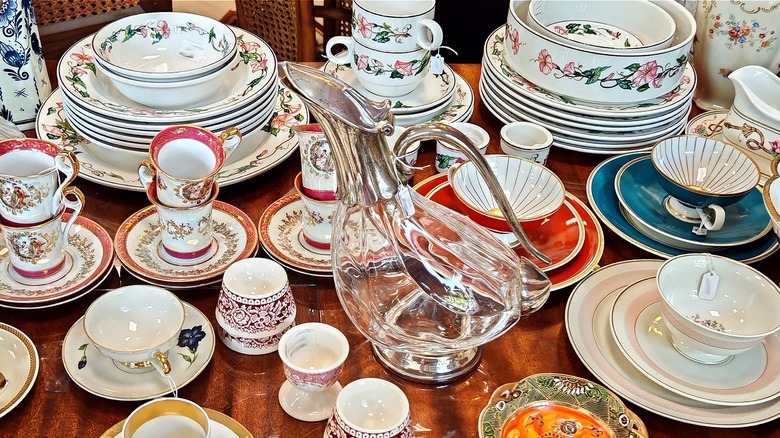
If you aren't lucky enough to inherit a set, Noritake is widely available secondhand, online and in thrift stores across the country. When thrifting for vintage Noritake patterns and pieces, be sure to look on the back or bottom to inspect the maker's mark.
Searching for vintage Noritake patterns
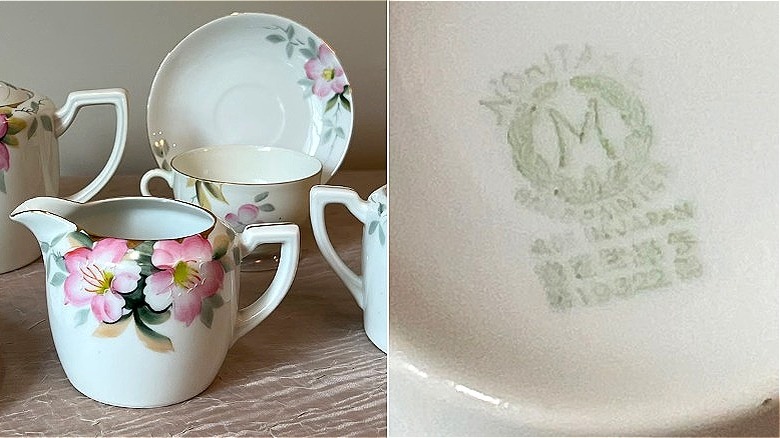
One of the antique and vintage thrift store trends that will take over in 2026, Noritake ranges in value and collectibility. You can still find contemporary pieces at retailers like Dillard's and Williams Sonoma, but the true gems are the vintage patterns.
For example, Noritake's most popular pattern, Azalea (seen above), dates back to circa ~1918, per Replacements, Ltd., which lists its patent number as #19322 or #252622. It was made specifically for the Larkin Soap Co., and was available through Larkin for some 22 years; production of the pattern ended in 1941. As the story goes, according to WorthPoint, Larkin reported in 1931 that Azalea was "Our Most Popular China."
Fast forward eight decades to 2007, and the Sioux City Journal, where Helaine Fendelman and Joe Rosson answered a reader question, confirming that Azalea is "arguably their [Noritake] most popular dinnerware pattern." A Google search for this floral pattern will return many matches, so as said, it's definitely possible to track down vintage Noritake. For Azalea, you'll find asking prices anywhere from under $10 for a single plate to ~$1,000 for a complete 126-piece dinnerware set.
Identifying authentic vintage Noritake pieces
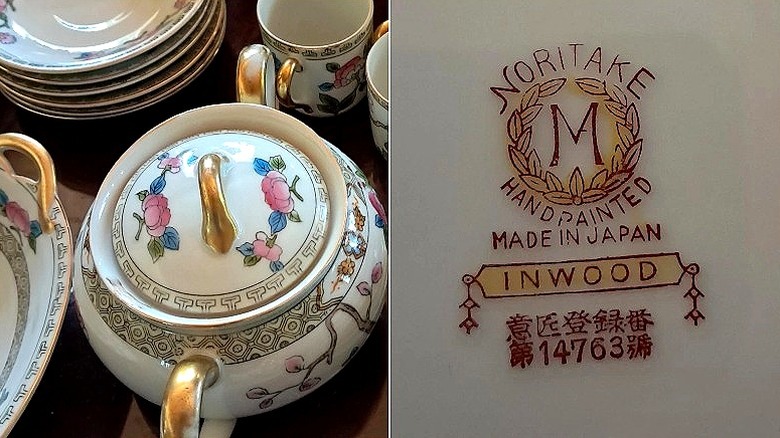
When researching a Noritake piece, you'll want to look for the stamp on the back. Keep in mind, however, that there are literally hundreds of Noritake backstamps (over 400, per collectors), so you may need to do some further searching or asking questions to be sure.
That said, if you see an "M" inside a wreath (for "Morimura") with "NORITAKE" curved across the top (like above), that's one of the stamps that Noritake used for an extended time. It dates back to 1911 and was used for decades: 1910s, 1920s, 1930s, up until World War II.
This stamp was replaced by an "N" (surrounded by laurels) sometime in the 1950s or early 1960s. So, you can start there; if you see a centered "M" or "N," that'll give you an idea of when your vintage piece of Noritake china was made.
Meanwhile, for later pieces, you may see a "Noritake Progression China" stamp; this stamp was first introduced in the 1960s — for Noritake's line of heat-resistant pieces that could go in the oven. The line was discontinued in the early 1980s, so this again will help you know around how old the piece must be. And then there are hundreds more stamps you can look further into, which is part of the fun! (See more dishware trends that'll elevate the look of your kitchen, or valuable patterns of vintage china you'll want to look out for when thrifting.)