

11 Of The Biggest Wastes Of Money You Can Spend On Your Kitchen
We may receive a commission on purchases made from links.
Not only are remodels stressful and inconvenient, but the cost of a new kitchen can also get very expensive quickly. What's more, it's all too easy to squander your budget on fancy features and materials, when the reality is that you don't need them. If you're hoping to get the most bang for your buck when remodeling your kitchen (or doing a new build), then it's important to think long and hard about the things you'll actually use. And that's what this guide is here to help with.
It could be that you've been watching "The Bear" and have decided that a commercial-grade stove is now a must-have in your dream kitchen. You may have your eye on a costly marble countertop, or, in a bid to free up more storage, you might be considering downsizing your dishwasher. As you'll see below, while certain features absolutely have a place in the world of kitchen design, some are less likely than others to be worth the price that they're tagged with.
Oversized kitchen islands with in-built stoves and sinks
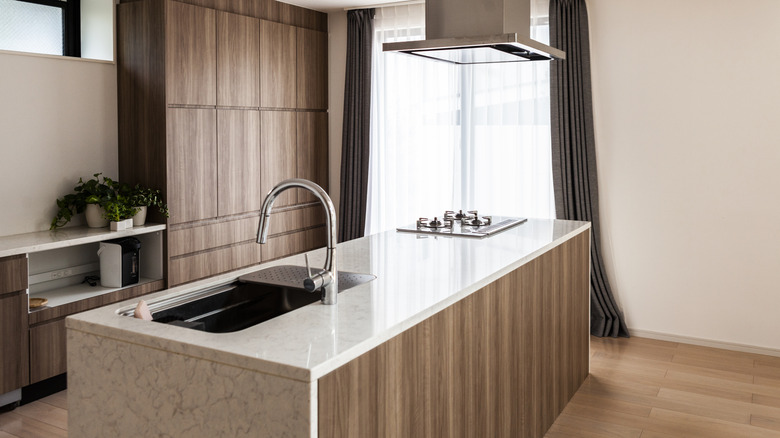
If you're working with a small-to-medium space, then avoid making this classic kitchen island mistake. On the face of it, a large island with in-built appliances seems to make sense. It offers generous additional workspace, not to mention extra storage for your growing collection of kitchenware. Throw in a food-prep sink and a built-in stove, and it's easy to see what makes them so appealing. Unfortunately, the downsides of oversized islands are manifold. Firstly, they're inflexible — you can't move them out of the way when you need the extra space for holiday hosting. Add in sinks and ranges, and they can also become very expensive. Over on Reddit, there are users whose experience tells them that islands fitted with sinks and stoves defeat the point of an island entirely. "Stoves and sinks are terrible in islands," said one, who explained that the point of an island is to free up extra space on the counters. "Having a huge kitchen with limited workspace would drive me insane."
So, what about the cost? Installing an island sink can range between $1,500 and $5,000 — and that's just to cover the plumbing. For a range, meanwhile, you can expect the wiring to run upwards of $500, especially if you're having a contractor do the work. Bear in mind, too, that drop-in range installations typically run higher than standard freestanding and slide-in ranges. They require cabinets to be customized with cut-outs in order to accommodate them, which means your installation costs are naturally bound to be higher. Add to that the price of the unit itself, which can range anywhere between $700 and well over $1500, and your cooker alone could eat up a serious chunk of your kitchen budget.
Commercial-grade appliances

When you're specifying your kitchen, Hilary Farr's advice for buying appliances is to stretch for the fanciest option you can afford. And why shouldn't you? Just don't be tempted to stretch too far. Commercial-grade appliances are often far more expensive than residential alternatives. Ranges, for example, can cost anywhere between $2,000 and more than $15,000 for commercial-grade equipment, whereas residential ranges cost much less, often between $500 and $3,000. Installation costs are also a big factor, ranging as high as $15,000 for commercial ranges, when it might only cost up to $500 for a regular household oven. The reason it's a waste? The average household is unlikely to get the most out of them. Beyond that, the warranties supplied with commercial-grade appliances often only cover them if they're used in commercial settings. That means you may struggle to remedy a breakdown without digging deeper into your own pocket.
Ultimately, for most homeowners, a commercial grade appliance simply isn't worth it. As Carrie Schulz, Head of Design at Block Renovation, tells The Sun, "Unless you're specifically going for a chef-grade kitchen, you'll be able to do everything you need day-to-day with lower-priced tools." Schultz explains that if you're a chef who wants work-level gear at home, then it probably makes sense. But if you're not, it may be more of a problem than it's worth.
Going overboard on upper cabinetry
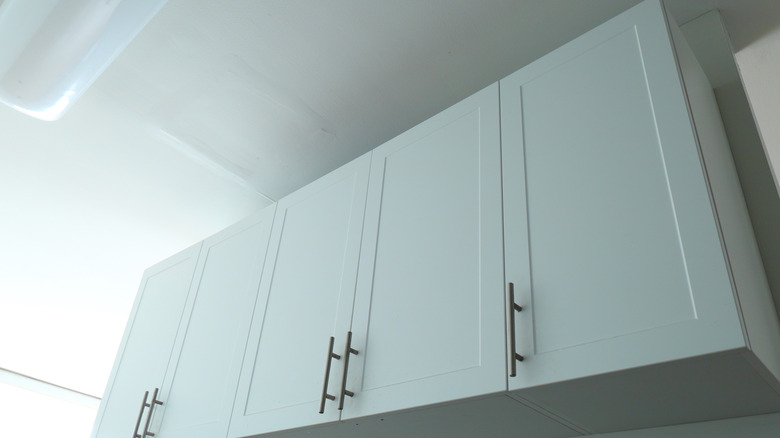
Despite the overwhelming urge to cram your kitchen with storage, there's a strong case to be made for ditching those upper cupboards. That's not to say that you should do away with them entirely, in fact, if you have a large kitchen to work with, then a few in certain places could bolster your storage strategy nicely. But regardless of your room's square-footage, you should avoid going overboard and covering your walls with cabinets.
From a purely practical perspective, additional cupboards are unlikely to feel like a "waste" of money, per se. However, they are expensive. In fact, cabinets usually range between $50 and up to $1,500 per linear foot, depending on specs, quantity, and functionality. And from a visual standpoint, if you're shooting for a more luxurious kitchen aesthetic, then they can seriously spoil the look. As Stephanie Martin, of Stephanie Martin Interior Design, tells House Beautiful, "You'll never find me designing wall-to-wall banks of upper cabinetry." Instead, she explains that the secret to high-end kitchen design, as far as cabinets are concerned, is giving the kitchen room to breathe. Excess cabinetry can make the space feel bulky and claustrophobic. Worse, if a gorgeous, custom kitchen is your goal, then specifying long runs of upper cabinets can feel builder-grade, not beautiful.
Overly customized cabinet interiors
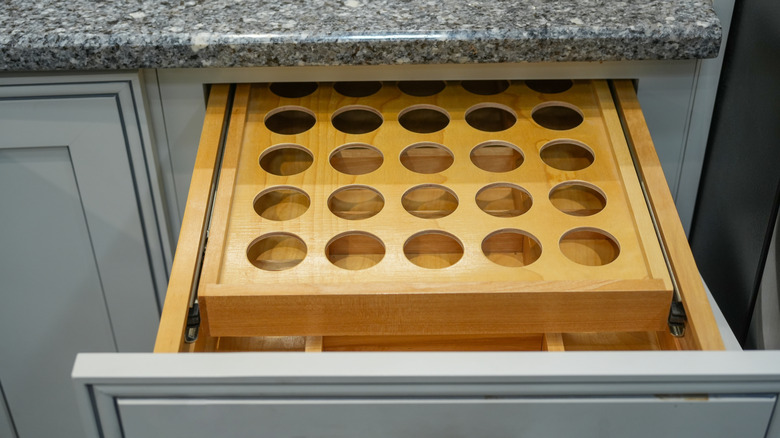
There's no denying that the trend towards more-personalized kitchen storage is here to stay. It has the potential to make life in the kitchen much easier, with storage solutions matched to the unique way you use it. But if you overly customize your storage — by which we mean customizing every single cabinet with dedicated organizers, specialty pull-outs, and custom inserts — it could come back to bite you. The problem is that things change. Our circumstances evolve, with the introduction of children and pets to the household. Tastes change, too, including the food we like to eat and the styles of cooking we favor. Cabinets already account for almost half of most kitchen reno budgets. But there's a huge difference between standard cabinets, which may cost up to $400 per linear foot, and custom units, which can push that price up to $1,200. Do you think that cost will still feel worthwhile when things change in a few years' time?
If you're unsure, then it's usually best to keep at least some cabinets as they are, with simple shelves and drawers. And if you absolutely must organize your kitchen cupboards, then consider springing for products that can be removed later if you need to. Insertable cutlery dividers, for example, and baskets for your shelves, can both help to keep your kitchen clear of clutter. Yet they're versatile enough that you can switch them out when they no longer serve your needs.
Pot filler faucets
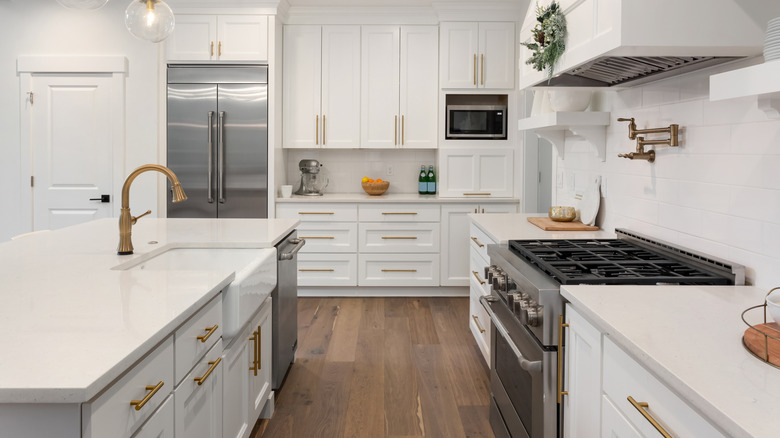
Which custom kitchen features would be on your shortlist if money was no longer an object? Is there a gorgeous, over-the-stove faucet in the window of your nearest showroom that winks at you every time you wander past? If so, think twice about including it in your kitchen. While purporting themselves as useful time and back savers — allowing you to fill your pots directly on the stove, instead of lugging heavy pans across the kitchen — they have the potential to seriously break your budget. Rerouting and wall work alone can drive costs into the stratosphere, ranging from $975 to $3,000.
Unfortunately, homeowners are increasingly tiring of these trendy kitchen inclusions simply because they're way more hassle than they're worth. Among the reasons to skip the pot filler faucet is the potential for plumbing issues. On Reddit, one user explains simply that it's "One more thing to leak without even having a drain!" This is a really good point. If an O-ring dries out, buckles, or melts (which can happen) and your faucet starts to leak all over your oven (not to mention the wall behind it), you may find yourself faced with more than just a faucet to fix.
Striking marble countertops

Natural stone is one of the most reliable, beautiful, and indeed luxurious materials for any kitchen. But choosing the right type of stone is important. Marble is popular among homeowners, delivering striking natural patterns and colors that serve as living, functional art in the kitchen. But compared to other stones, there are several downsides to marble counters that could make them a woeful waste of money. For example, marble countertops scratch very easily — surprisingly so given that they're made from stone. They are also prone to stains because marble is a metamorphic rock made from calcite, which is highly porous. It requires frequent sealing to prevent stains, and if you're not on the ball with this, liquids that spill onto the surface can easily seep into the stonework. In other words, it's unsurprising that marble is losing its place in modern kitchens, especially when you consider the cost, which can run as high as $5,000 for a standard kitchen project.
Fortunately, if you're set on stone in your kitchen, there are other, much-hardier alternatives you can choose from. Granite, for example, is not only tougher than marble, but also retains its natural sheen better, allowing you to keep that "shiny new" look for longer. It's usually more expensive, however, it's also harder to damage and stain than marble, meaning you're less likely to feel like you "wasted" your budget.
The latest trendy finishes
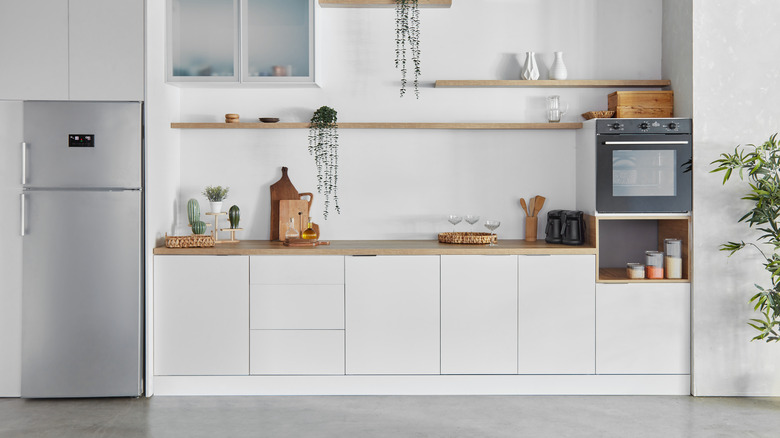
We'll start by saying that you shouldn't completely avoid current trends when designing a new kitchen. But at the same time, you shouldn't just copy and paste whatever's on the cover of your favorite magazine. Trends have a habit of falling out of favor just as soon as we buy into them — just look at the current movement away from white and gray. Not so long ago, these were considered the pinnacle of design, offering a cool, neutral foundation on which to layer color. Now, they've cooled off to the point that they're cold, with homeowners pivoting to warmer, more earthy palettes. Had you gone all in last year with a gray kitchen, you could easily be regretting it right now.
To avoid design-decision regret, try to incorporate current trends in more timeless ways. For example, if you're opting for a striking shade of granite for your counters, consider reserving the stone for just one or two subtle features, like your backsplash. The same goes if you have your eyes on a particularly handsome set of brass hardware, or a vibrant, shade of terracotta. Such materials and decorative elements often command a premium. If you saturate your space with them and they go out of style, you could find yourself wanting to refresh your kitchen all over again in just a few years' time.
Built-in wine refrigerators
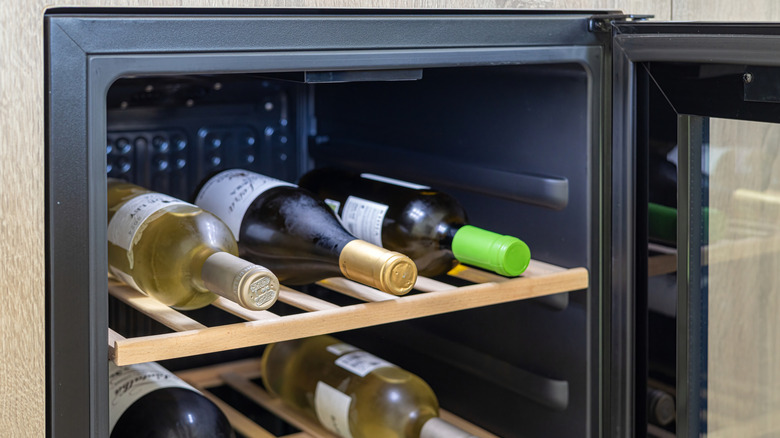
There are several features that epitomize a luxury kitchen, but if there's one that's likely to feel like a real waste of both money and space, it's a built-in wine fridge. On the face of it, it feels like a worthwhile investment — especially in the summer, when the fumé blanc is flowing. But if you're not a collector, or you don't regularly have the need to store more than a couple of bottles, then a wine fridge is likely to end up feeling wasteful. They soak up under-counter space that could otherwise be used for further storage. They're usually expensive to buy, too, with Food and Wine's best-ranked built-in wine fridge currently retailing for $1,699 over at Lowe's. What's more, while modern appliances can undoubtedly be very efficient, they still add to your home's electricity bill.
Of course, whether or not a wine fridge is a true waste of money depends on your specific situation. For example, if you're an avid collector with lots of bottles to store at the right temperature, then yes, it could be worth the splurge. However, if you're only trying to age a handful of bottles, then you can easily do so without a dedicated fridge. You can stash them in the back of a closet, under your bed, or even in a kitchen cabinet away from the stove. Provided that it's relatively cool — and that it stays that way all year — your wine will age just fine. What's more, there are plenty of places you can find a quality, well-aged bottle of wine online should you need one for a special occasion. Even though they'll cost more upfront than unaged bottles, you'll probably have to buy quite a few of them before you come close to covering the overall cost of a wine fridge.
Deep, uncustomized cabinets
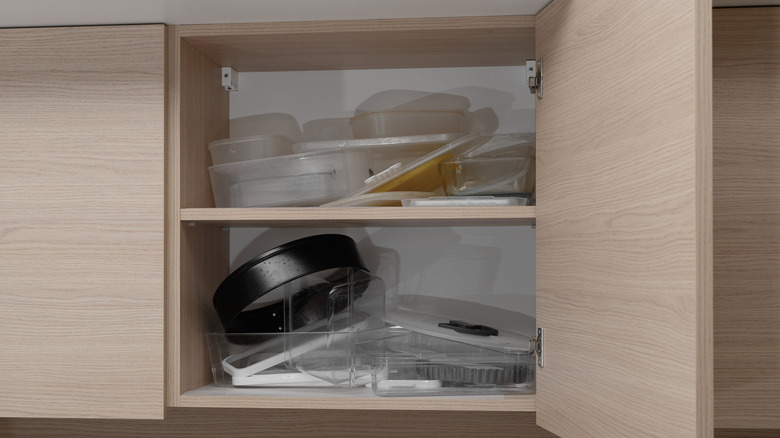
This one seems counterintuitive. Don't kitchens and cabinets sort of go hand-in-hand? Well, yes, they do. But that's not exactly what we're talking about. In this case, we're specifically talking about deep cabinets. They sound great on paper, offering oodles of space in which to store things. However, for bulky, unwieldy items, like pots and pans, they can quickly become cluttered. More than that, the items at the back become very difficult to reach, and even harder to extricate without knocking things out and onto the floor. What we're saying is that, considering that these extra deep cabinets are likely to cost more than more standard sizes (since they require more materials to build), they come with an awful lot of downside. They don't need to, though.
Whether you have a small kitchen in which you need to maximize cupboard space, or have already spent on deep cabinets, there are several things you can do to capitalize on them. If you have an array of smaller items that have become cluttered, like ingredients and sauces, then some simple baskets could declutter the cabinet while making it easier to access everything stored inside. Alternatively, you could retrofit some slide-out cabinet drawers, like this pair of pull-out cabinet organizers from Kistorack. These are excellent for larger items like pots and pans, allowing you to maximize those spacious cabinets without worrying about things becoming stuck or lost in the back of the void.
Slimline dishwashers
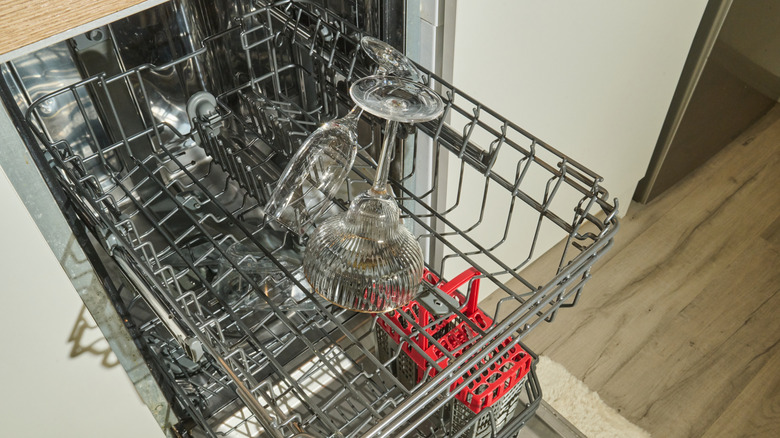
Despite the fact that they're smaller, did you know that slimline, in-built dishwashers are generally more expensive than their full-sized counterparts? For example, one slimline dishwasher from Frigidaire at Lowe's currently retails for more than $800, while a larger, similar model from the same brand retails for $300 less. Since demand for them is much lower, manufacturing costs are naturally higher — costs which are almost invariably passed onto the customer. Of course, provided that they help you save space, and that they do their job well, that shouldn't really matter. But if they leave you with counters cluttered with dishes that you can't fit inside for a single cycle, then that extra cost starts to matter a great deal.
Slimline dishwashers typically hold up to 60 items, which sounds like a lot. However, regular dishwashers typically hold up to 150, and for both, those are the best case scenarios. If you plan to load your dishwasher with pots and pans, you'll find that the number of items you can wash at once drops dramatically. Of course, for small households, this may not be a problem. But even then, there are some who question whether saving on space with a slimline unit is a false economy. One Redditor, who has had two slimline dishwashers in the past, said, "The two that I've had (both good brands) were both totally impractical for two of us." They explained that there was never a good way to stack things, and that the usable space inside the washer is much less than you might expect. In their own words, "I wouldn't wish one on anyone!"
Downdraft ranges (especially if you do lots of cooking)
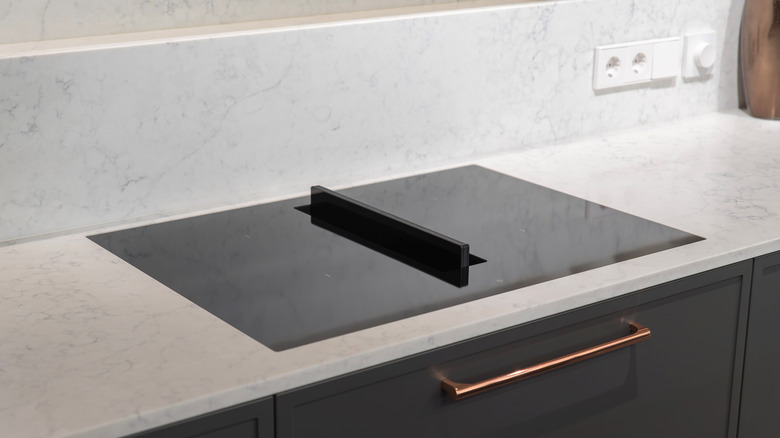
There are different types of stoves that you can choose from to suit your kitchen budget. One type that's popular in islands, as well as in smaller kitchens, is the downdraft stove. These nifty appliances incorporate fan extraction right into the unit, foregoing the need for a space-hungry overhead extractor. This sounds great, and in many instances, they could well be worth the investment. The thing is, they usually cost more. At Lowe's, for example, a 30-inch four-burner range with downdraft exhaust from KitchenAid currently costs $3,499.99. From the same brand, a standard 30-inch gas range (with five burners, not four!) costs $1,599.99 — less than half the price. Installation costs are likely to be higher, too. It depends on where you live and who you hire, but as an example, some companies charge up to $100 more for a downdraft range than they would for a comparably-sized standard gas range. The issue is that all those extra dollars actually buy less in terms of extraction power. This is a massive consideration, especially if you use your kitchen a lot and need something that's capable of keeping up with your cooking.
If this sounds like you, then you may well be better off investing in a classic range hood. The upside is that it'll cost less than a downdraft. It'll also absorb less of your under-counter storage space, since downdraft systems often have complicated components that require housing inside your cabinets. Most importantly, it'll more than likely perform much better. As one Redditor said, "If you cook that often, then prioritize functionality over aesthetics. An overhead hood, properly ventilated, will perform well. Why take a chance with a downdraft?"