

Not Neem Oil: The Natural Way To Deter Mole Crickets From Your Garden
We may receive a commission on purchases made from links.
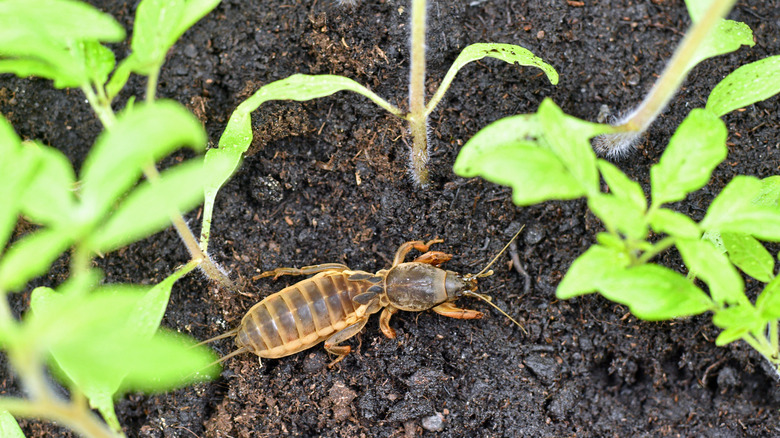
One of the strangest creatures that could be lurking in your backyard, mole crickets are unique from other members of the Orthoptera order, best known for crickets and grasshoppers. For starters, they look like a different insect type altogether, with short hind legs and stubby, paw-like forelegs. Instead of leaping and flying like grasshoppers or locusts, mole crickets primarily burrow through the soil and spend most of their lives underground. Some sources suggest neem oil as a way to disrupt mole crickets' life cycle and discourage them from feeding on plants, but once sprayed, neem oil doesn't sink very far into the soil, so it really isn't the most effective approach. If you actually want to get rid of mole crickets, you'll need to get on their level. Or rather, send an army of microscopic soldiers to meet them on their level. Nematodes are up to the task.
North America is home to several mole cricket species. Some of these are invasive, and while not all of them are pests, those that are can wreak havoc. Mole crickets tend to prefer soft, pliable soils, and they eat low-growing plant foliage, roots, fruits, vegetables, and tubers. They can even pull small seedlings straight down into the ground and slice through grass roots as they dig. All of this makes your lawn and garden a prime target, but not if you know how to fight nature with nature.
Apply beneficial nematodes to guard your garden
Nematodes have been studied for decades as a means for controlling mole cricket populations. The most effective is a species known as the mole cricket nematode, Steinernema scapterisci, although other species like Steinernema glaseri and Steinernema carpocapsae can also do the job. Nematodes will invade a mole cricket's body by entering through the mouth or respiratory pores, but this isn't what kills it. The nematodes actually harbor an even smaller weapon: a symbiotic bacteria that infects and kills the mole cricket within a few days. After that, more infectious nematodes are released into the soil, and the cycle continues. Although these nematodes spell certain disaster for some insects, they're totally safe for people, pets, plants, and other wildlife.
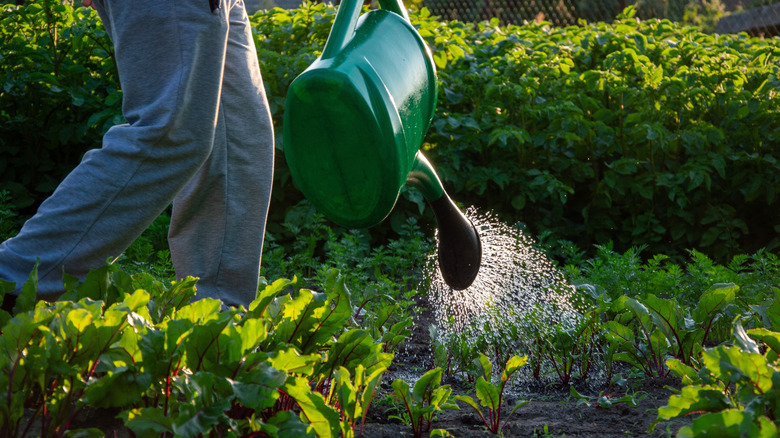
Beneficial nematodes are also incredibly easy to deploy. They can be purchased in a dry powder form, like this Natures Good Guys Steinernema carpocapsae. Typically, you'll mix them with water and pour them over your lawn or garden. To give them the best odds of survival, apply nematodes in the spring or fall during sunrise or sunset. There's no need to cover every square inch of your property; nematodes can spread on their own. In one study published in Agricultural and Horticultural Enterprises, one species of introduced nematodes was found in mole crickets 10 miles away after just three years.
Of course, there are some factors to consider. Firstly, the nematodes you might purchase online or in garden centers are often not native species. Although they haven't raised concerns as invasive, they might be technically unsuitable for strict native-only gardeners. Second, beneficial nematodes will attack a wide range of insects, not just mole crickets. That said, their impact is usually minimal, and might be a small price to pay for a mole-cricket-free yard.