

No Dehumidifier? Help Paint Dry Quickly With An Appliance You Already Own
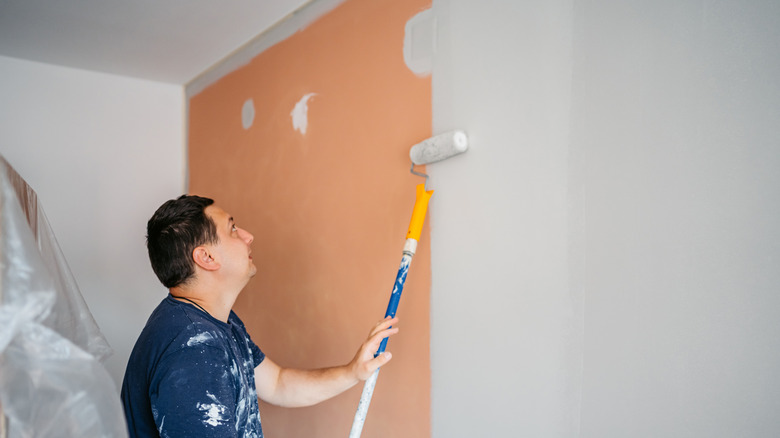
Waiting for paint to dry can feel like a test of patience, especially when you're squeezed for time. Standard wisdom suggests you can make your fresh paint job dry faster with the help of a must-have solution — a dehumidifier. The appliance pulls moisture from the air, drying paint faster, creating a smoother finish, and preventing the growth of mold and mildew. Of course, not every homeowner has a dehumidifier. Luckily, you don't need to shell out a lot of money for this specialty appliance. You may be able to use a machine you already own.
It turns out that your air conditioner is sort of like a high-powered dehumidifier in disguise. With a simple tweak to your AC settings, you can create a high-efficiency drying environment that could cut paint drying times in half. If you have a fan — like a box, stand, or ceiling fan — you can pair it with your AC to boost the airflow in the room, evaporating surface moisture from the paint quickly.
Water-based interior paints like latex and acrylic dry through evaporation, among other factors. When the humidity levels in a room are high, the air is saturated with water vapor and the moisture has nowhere to go. This leaves the paint on your walls tacky for longer. Opening your windows to let air circulate is a feasible option, but if the weather is hot and humid outside, it can actually make matters worse. Plus, you risk outdoor debris sticking to your wet wall paint. By dragging warm, moisture-heavy air across cold evaporator coils, your AC unit naturally causes water vapor to condense and drain away, leaving behind drier air. In short: your AC can act as a dehumidifier, helping reduce how long it really takes for paint to dry.
How to use your air conditioner to speed-dry your wall paint
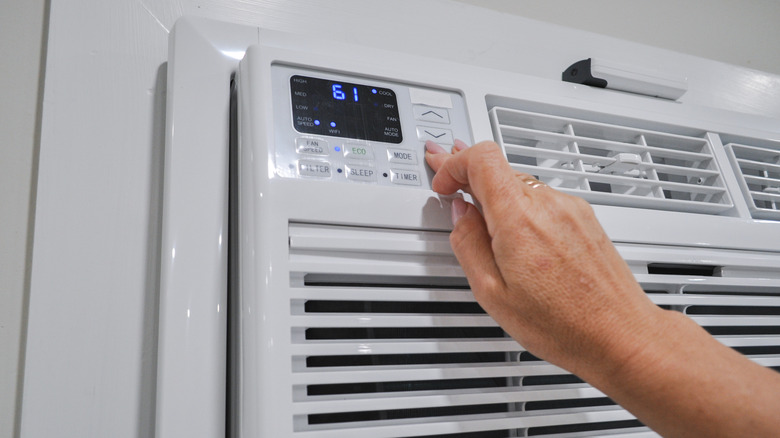
To harness the dehumidifying powers of your air conditioner, set your thermostat to a few degrees lower than usual. Lowering the set point can help the compressor stays engaged longer and reduce the chance of short-cycling. This allows the AC to remove moisture from the room for longer periods. If you have a window unit or mini-split with dry mode (the raindrop icon), switch to that setting to slow the fan speed and maximize moisture extraction. Additionally, you'll need to make sure your thermostat fan is set to auto, not on. Leaving it in the on position can allow moisture collected on the evaporator coil to re-enter the air, reducing the dehumidifying effect of your AC unit.
If you have an oscillating fan, set it up in the room, but angle it away from the walls or toward the doorway. The surface of the paint layer may dry too fast when exposed to a direct breeze, trapping wet paint underneath. You could also blow dust onto your freshly painted but still damp wall. Close all exterior windows tightly to keep the humid outside air out. However, keep interior doors open to encourage air circulation and allow your HVAC system to move air more effectively.
Note that paint fumes containing volatile organic compounds (VOCs) can circulate through central HVAC ductwork. When using latex paints, help maintain better indoor air quality by choosing low-VOC formulas or running an air purifier alongside your AC and optional fan. By combining strategic HVAC settings with gentle, indirect airflow, you can paint your home like a professional and achieve a smooth finish quickly — no dehumidifier required.