

12 Storage Shed Safety Tips To Protect You And Your Belongings
We may receive a commission on purchases made from links.
There are few things more satisfying than a neat and tidy shed. Not only does it make life easier whenever you need to wheel out your trusty steed and mow the lawn, but it also makes using your outbuilding safer. However, it's easier to talk about than it is to put into action, which is why we've created this guide.
Below, we've explored 12 effective ways to optimize your garden shed storage and make it safer for you and your family to use. There are tips on organization, from labeling certain items to the height at which you should store them to prevent potential drop hazards. You'll find tips on how to burglar proof your backyard shed and keep annoying pests from making themselves at home. And if the climate in your area tends to hover at the extreme ends of the meteorological scale, there's even advice on how to keep the rain from ruining your equipment. From lighting and labels to insulation and chemical storage, if the storage in your shed fills you with fear whenever you unlatch the door, then the actionable tips below are sure to help.
Create and maintain clear walkways
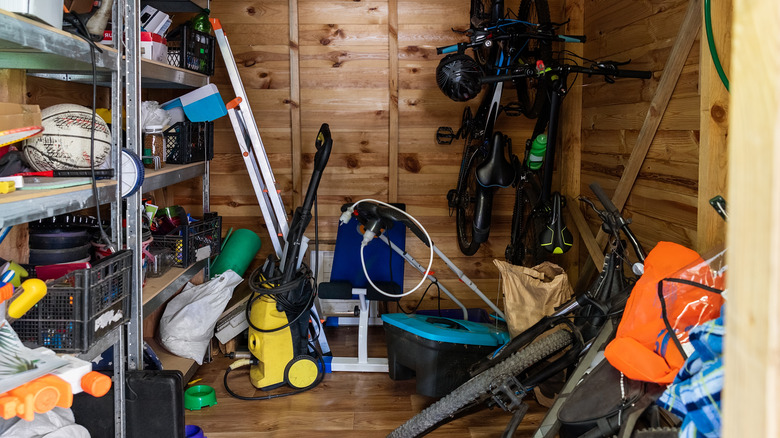
This one is all about freedom of movement. If your floors are covered in bags, tools, and whatever else you keep in your shed, you'll have a nightmare every time you need to find something. More than that, messy floors are a hazard, threatening to trip you whenever you step inside the shed — and that's before you try to pick something up. When you do go to lift out your mower, a trip becomes even more likely.
The solution? First, if your shelves are filled to bursting, then aim to declutter those first. Remove items that you don't need — things like out-of-date paint cans and those quarter-bags of grass seed that have probably degraded. With space freed up on the shelves, use it to store things that are on the floor, thus clearing your walkways. The goal is to ensure there's space left in the aisle for you to move and access everything inside your shed. And if you find yourself running out of storage space, consider whether your existing cabinets are maximizing your shed's height. For example, could you install a rack for those tools? Could you install a taller cabinet to give yourself more shelf space? By capitalizing on your shed's full height, you'll have the best chance of clearing out the walkway and making it safe to move around inside.
Arrange your belongings so that the heaviest are at the bottom
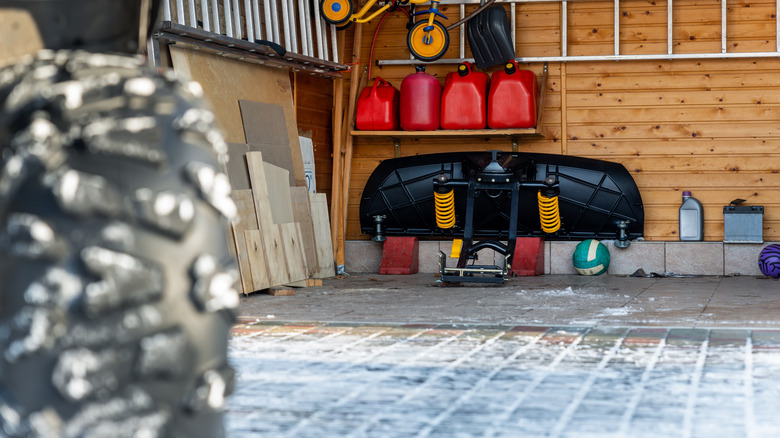
Now that you're freeing up space on your shed floor, it's time to think about which of your items weigh the most. If you can avoid it, the heaviest items in your shed should never be stowed at the tops of your shelves. This is for three reasons. Firstly, if they're balanced at the top and you accidentally knock the shelves, they risk falling on top of you. Secondly, if they're only just within reach and you have to stretch to grab them, you run the risk of accidentally dropping them on yourself. Finally, if you've yet to anchor your storage to the shed wall (more on this later), then those top-heavy shelves risk toppling over.
So, when you're organizing your shed, work out which items are the heaviest and keep them as low as you can. Ideally, stick to the lowest shelving tiers. Alternatively, while you should avoid storing too much on the floor, it's safer to keep heavy items at ground level than higher up, especially if you can also maintain a clear walkway. If you're concerned about dampness on the floor, then again, we'll talk about this in more detail later. But as an extra step to protect boxes and perishables, you could use something to raise them off the ground. This needn't be complicated; something like some spare stone pavers, or some wooden boards mounted on bricks. Provided that it keeps those perishable items clear of the floor, you should be able to avoid moisture damage.
Store sharpened tools in a rack, and use their protective sheaths
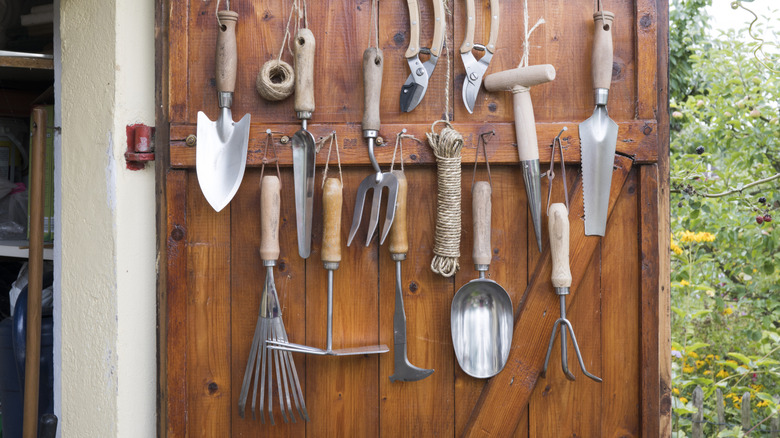
Using a rack to store your tools, especially those with sharpened edges, is perhaps the best way to make the most of your shed's storage space. It keeps them clear of the ground, thus ensuring you avoid a Krusty the Clown moment with your garden rake. It also ensures that your sharpest tools, like your shears, hoe, and saws, are easy to grab, instead of having to rake through a pile of tools and risk cutting yourself in the process.
To do it, there are several ways. You could DIY a sturdy tool storage rack from a wood pallet, for example, or you could buy one that's ready to go out of the box. Depending on your tools, hooks or a magnetic rack might be better. For tools with string loops, or with holes in the end of the handle, hooks are the most practical. Magnetic strips are useful for bare-metal tools, although, for the sake of safety, it's better to keep sharpened tools like blades and saws covered. This protects the curious hands of your kids from accidental cuts, while also protecting the blades from things that might damage or dull the edges. You can either use your tools' supplied sheaths or, if they didn't come with covers (or you lost them), you can easily fashion sheaths out of something like cardboard and a roll of duct tape.
Keep hazardous materials and chemicals separate and locked away
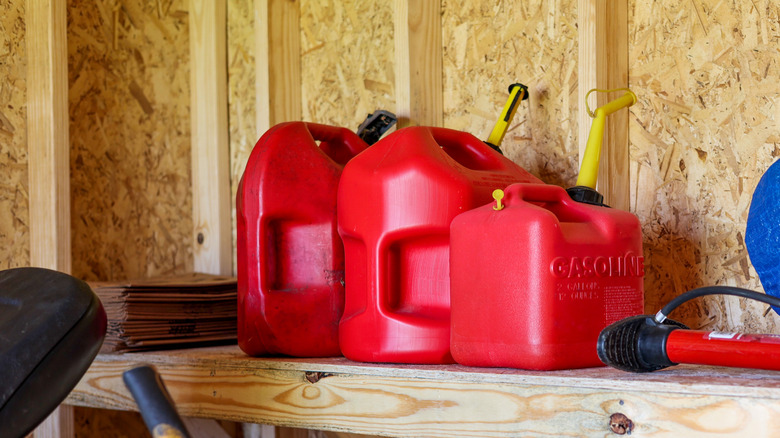
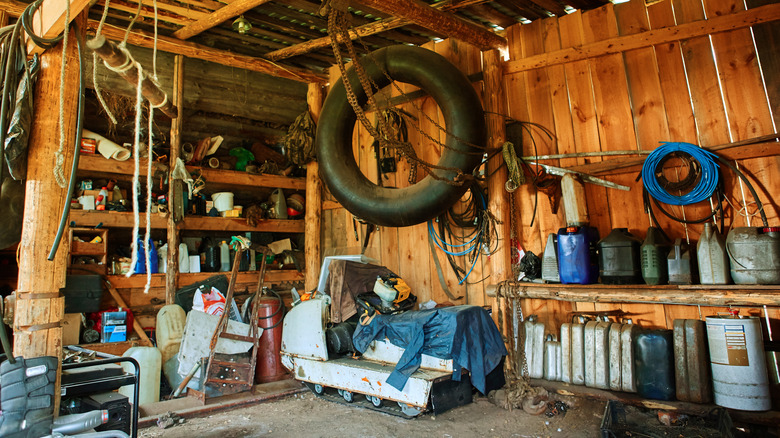
Other items to try and keep out of the reach of your children are the chemicals, fuels, and other hazardous consumables that frequently find their way inside the shed. If you have gas-powered lawn equipment, then the gas needs to be stored safely, as does that leaky can of oil that you've been meaning to replace for the last two summers. The same can be said for pesticides and herbicides. Try to keep them organized in a dedicated area, and if you have the ability, store them in a locked box or cabinet to prevent curious kiddies from seeing what's inside the container.
If you're unable to lock them away, then try at least to stow these substances somewhere out of sight. You should also aim to keep them away from anywhere that they could accidentally be kicked over or knocked off the shelves. Somewhere low, in the back corner of your shed, is a good bet. Stored this way, those cans and bottles are less likely to get knocked or knocked over whenever you shimmy past them with the mower.
Use labeled and sealed bins to protect consumables and avoid pest damage
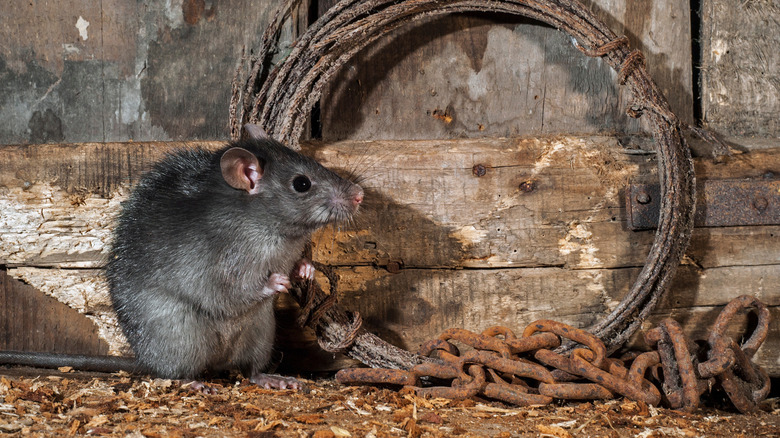
As well as your gas, petrol, and lawn care chemicals, you should also think carefully about how you store things like grass seed, bird food, and other granular products. One of the simplest ways to keep sheds organized with items like this is to use hard-plastic bins or boxes. These items are highly perishable, especially when exposed to wild mercurial swings. Dampness can lead to mold, while heat can cause them to dry out and render them useless. Not only that, but they also offer a tempting proposition to any rodents who are sniffing around your shed's foundations. And if rats are allowed to get inside, they in turn represent several safety concerns of their own.
For starters, rats can spread disease with their urine and droppings — which they'll invariably leave strewn across your floor. They can also cause safety issues with their incessant need to chew. They do this in order to keep their gnashers from overgrowing, and they're none too fussy about what they chew to do it. Wood is especially attractive, which immediately puts your shed's structural integrity into question. Electrical wires are also fair game. If chewed, these can lead to electrical fires — not what you want if you have dry seeds and gasoline sitting on the shelves of your shed. Finally, if they get into those bags of pesticide — which, if they find them, they will — they could leave the floor of your shed littered with poisonous pellets that pets or small children could ingest. By keeping those consumables out of sniffing distance — and by either repairing or blocking entry points — you should be able to avoid the ramifications of allowing rodents to run rampant inside your shed.
Burglar-proof your shed and belongings
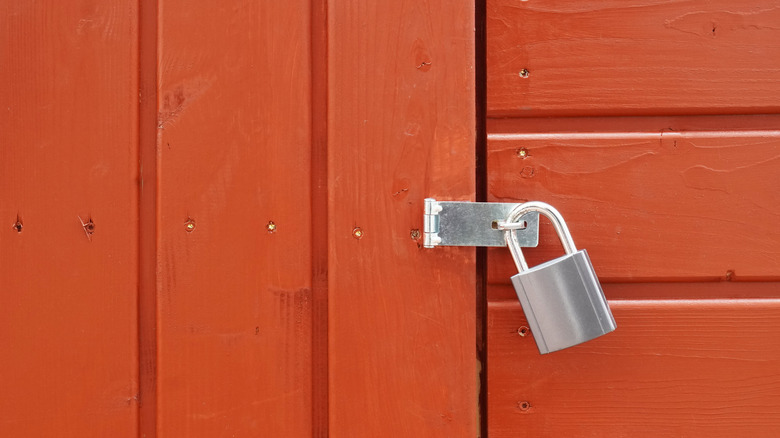
Safe shed storage is as much about keeping things safely inside as it is about keeping unwanted people out. As little as we like to think about it, burglaries happen, and an unlocked shed in the darkest corner of your garden could represent an easy win for any ne'er-do-wells — especially if it's loaded with expensive tools. In other words, if you want to keep your belongings safe, it's important that you secure them. The most obvious way is to buy the best shed security lock you can find and fit it to the door of your outbuilding. But you can take it further than that.
To keep your shed and its contents protected, inspect the exterior regularly for weak points — like doors, windows, and hinges — and aim to repair them whenever you notice a fault. You could also install a security light, either on the shed itself or in the general vicinity. This needn't be complicated, either; in fact, there are various ways you can illuminate your garden without the hassle of hardwiring. You can even buy motion-activated, solar-powered security lights that may effectively ward off intruders. And while the prices of these products vary, there's no reason to fork out a fortune. These LED Solar Security Lights from Tuffenough, for example, usually retail for $43.99, and they come as a set of two.
Store frequently-used items at waist or shoulder height
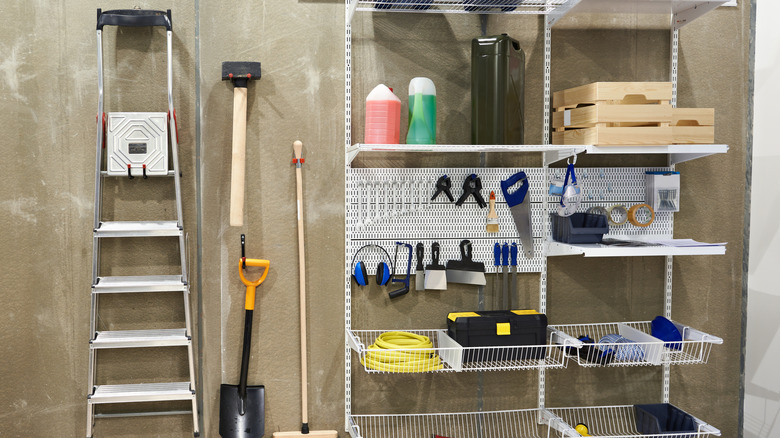
If you're in and out of your shed on an almost-daily basis during the summer, then organization is all the more important. Repeated trips inside increase the risk of trips and falls — especially if you don't follow the tips already featured. However, as well as keeping your walkways clear and your shelves stacked with the heaviest items at the bottom, you should consider which items you use most often. For things that you use on a daily or weekly basis, it's best to keep them in the most accessible parts of your shed. Vertically speaking, keeping them at around waist or shoulder height is the most practical, as it saves the need to repeatedly bend down and risk accidentally bopping your head.
Storing items this way also reduces the strain on your back, since you shouldn't have to bend down, and it mitigates the risk of things falling on you, since you shouldn't have to stretch. Of course, the exception to this rule is your shed's heaviest items. These are still best reserved for your shed's lowest elevations. With that being said, there's nothing stopping you from keeping them closer to the door, preventing the need to haul heavy gear from the back of the shed and risk tripping.
Anchor freestanding cabinets and shelf units to the wall
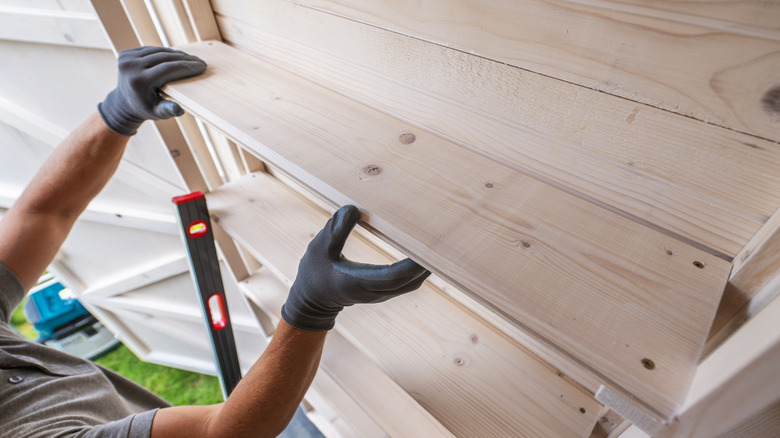
Another way to improve storage safety in your shed is to make sure that your shelves are nice and sturdy. Ensuring that your shed's base is level will help here, as will buying shelves with adjustable feet, which can be tweaked to suit any imperfections in your floor. You can also build shelves directly into the shed's wall. But if you have freestanding shelves, it can be worth installing wall anchors to the backs of your shelving sets. Even the most organized shelves, with heavy items at the bottom, can run the risk of toppling over. This is especially true if the floor's uneven or if the kids decide to climb them in order to reach their toys. Anchors screwed into the wall should prevent this from happening.
As for how to do it, first buy yourself some wall anchors, like these Stainless Steel Furniture Anchors from DAMILA. Fix them to the wall of your shed and the frame of your shelves, then connect the corresponding parts with the anchor cable. This product is especially useful in sheds, since it's made entirely from steel and is designed for stabilizing heavy furniture. However, per the spec, it's strongest when installed on solid walls, studs, and concrete surfaces. That means that if you don't have sturdy wood supports in your shed — or your shed or shelves are made from metal — you may need to choose a different product.
Keep the floor dry, and consider non-slip flooring
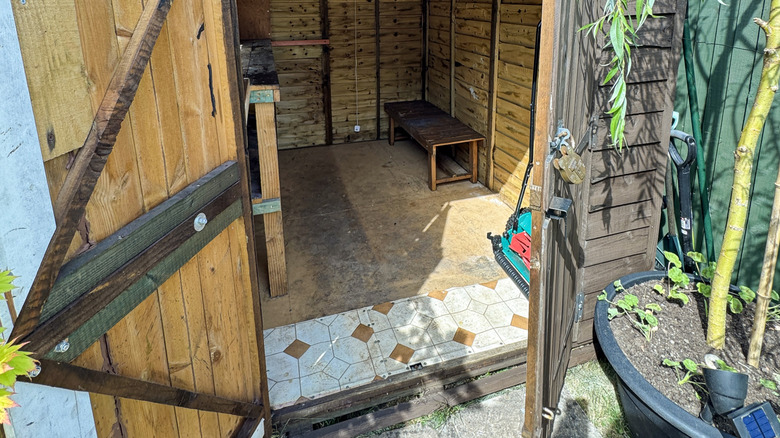
If the floor in your shed gets wet, then two things could happen, depending on the nature of the floor. Firstly, and perhaps most obviously, you could slip, which, even if you're not carrying anything, is unsafe. But if you're burdened with an armful of sharp or heavy objects, then that slip could become downright dangerous. Secondly, if your shed floor is raised on a frame above the ground and it's made from wood or chipboard, then repeated exposure to moisture could lead to rotting. Over time, this will seriously weaken your floor, potentially causing you to fall right through it when you walk inside to grab your spring gardening tools. And don't forget, items that can degrade like seeds and granular lawn treatments can easily degrade if exposed to moisture.
With all of this in mind, it's best to keep your shed dry. Aim to fix any leaks that present themselves as a matter of priority. And to be sure that slips don't scupper your gardening plans, consider adding a non-slip floor covering to your shed. Rubber mats are a good option, or you could run an outdoor rug along the walkway of your shed. Whatever you use, as long as it provides your shoes with extra traction, you should be able to avoid accidental slips.
Keep kids' toys towards the shed door
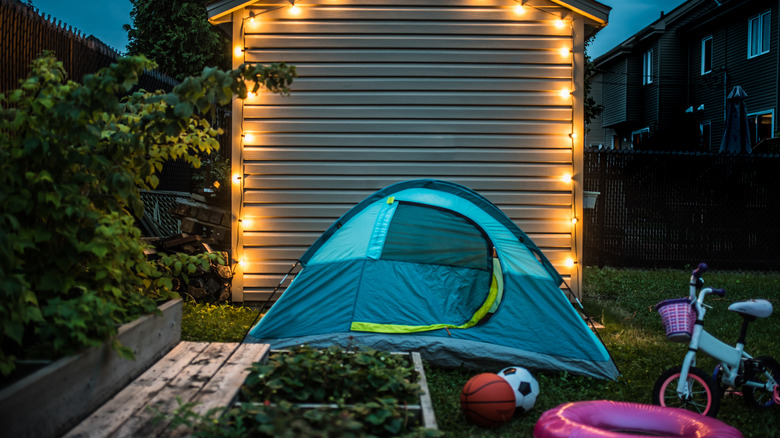
Dangerous tools and children's toys are more likely to share shelving space in the shed than they are in any other place around the house. This is especially true in smaller gardens, where there's only so much room in which to store your various belongings. But that's not to say that you can't make things safer for your youngsters whenever they open the shed.
To prevent curiosity from getting the better of your kids, aim to keep their toys stored as close to the door as possible. This will ensure that they find what they're looking for quickly, instead of stumbling upon an interesting-looking tool and getting distracted with that instead. At the same time, aim to make your most dangerous items as inaccessible to them as you can. You could lock them away in a cabinet, for example, or, depending on their weight, you could stash them high on a shelf. To be sure, you could also consider labeling certain items with "Danger" or "Do not touch." Alternatively, for kids who aren't afraid to dally with danger, you could try to throw them off the scent with something boring, like "Napkins" or "Dad's records."
Use lighting to enhance storage safety
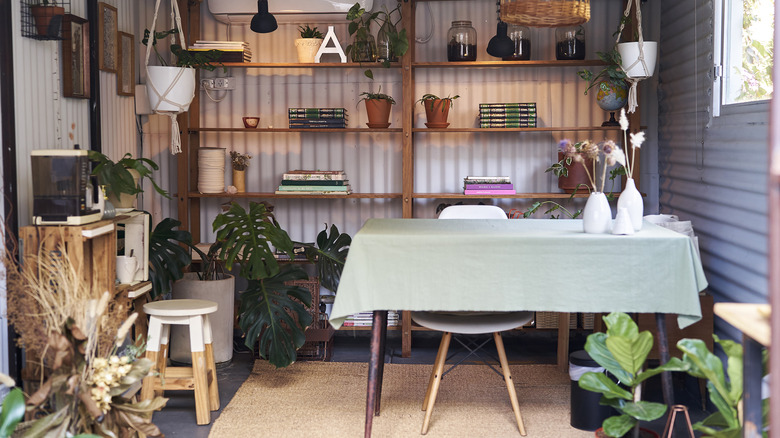
We've talked about the importance of light outside your shed and how it can help to ward off burglars. However, paying attention to lighting is also one of the simplest ways to transform your shed's interior. Depending on the style of your shed, you may not need to actually install lighting. Instead, ensuring that you have clean, clear windows can help to fill the shed with natural daylight — especially if you only use it in the daytime. Even if it doesn't have windows, you may be able to install some, especially if it's made from wood and you can easily cut out an opening.
To take the idea a step further, it may also be helpful to install lights on the walls or ceiling of your shed. If there's an electrical outlet, then you could either plug a light in or wire one straight into the mains. You could also buy a battery-powered light and mount it to the wall. Alternatively, if you'd prefer to avoid electrical wiring and annoying battery changes, then a solar light may be the easiest way to illuminate your shed. Just bear in mind that you'll need to run the solar panel cable through your wall, which in turn will need to be sealed in order to prevent water from making its way inside.
Insulate your belongings against fire and wild temperature swings
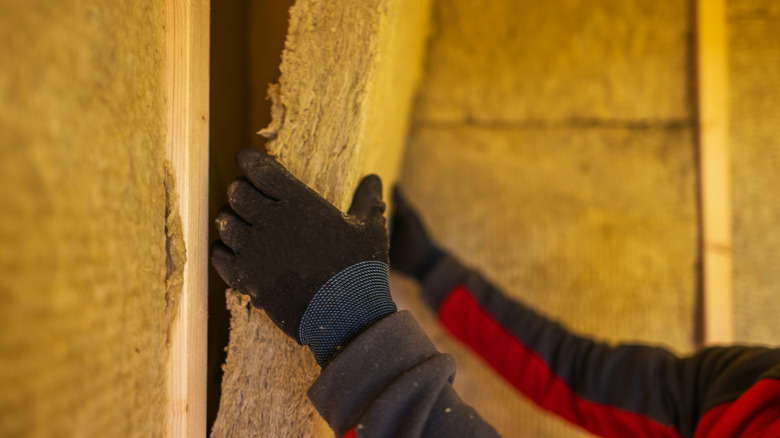
There are certain things that should never be stored in an outdoor shed that's not properly insulated. As we've seen, fertilizers, seeds, pesticides, and other similar items can degrade if exposed to constant, extreme temperature swings. However, if you can line your shed with insulation, then you can somewhat mitigate the risk of spoilage. Insulation will help to maintain a more stable temperature inside your outbuilding, thus helping to get the most out of those products' shelf lives.
If you choose a fire-resistant type of insulation, like fiberglass, mineral wool, and sheep's wool, then you can also guard your belongings against exposure to flames. It may sound unlikely, but in the summer, when the grass clippings on your lawn are dry and you or your neighbors are firing up the barbecue, accidents can happen. What's more, while it's rare, garden fertilizers can actually self-combust if the temperature and humidity levels in your shed reach a certain point. In fact, if you're unable to insulate your shed, and the summers in your area are especially hot, you should consider moving your fertilizers out of your shed altogether — ideally somewhere dry and well-ventilated.