

15 Most-Wanted, Valuable Trinkets From The '60s To Always Look For At Thrift Stores
We may receive a commission on purchases made from links.
When I'm thrifting, the random knick-knack shelves are the first place I look. It's where the thrift store staff put all of the little annoying things that they don't know what else to do with. A little treasure like a Bitossi cat can sit for months, hidden between a novelty mug and a yellowed resin lighthouse souvenir. I've been thrifting for decades and reselling for close to 10 years, and I never get tired of the thrill that comes from finding hidden treasure at the thrift store. I mainly collect things everyone had in the '80s at the thrift store, but I resell quite a bit from the mid-century.
Not too long ago, I found a Higgins glass dish for just a couple of dollars to add to my own collection. There are plenty of trinkets from the '60s that you'll probably recognize from your grandparents' house. Some are cute and nostalgic, but have no real value to anybody but a collector. Others, especially if they still have their labels and are in great condition, are worth a considerable sum. Check all of those weird little knickknacks that look like old tat, but could actually be a ceramic pixie worth a few hundred dollars.
Higgins fused glass ashtrays and catchalls
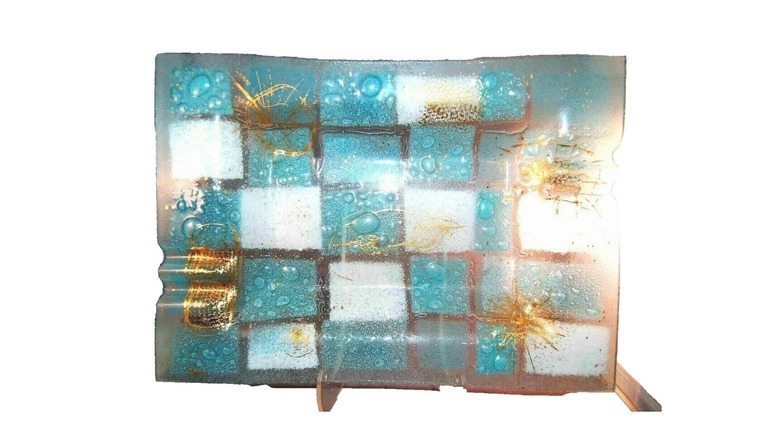
Higgins fused glass trinkets are very '60s bold experimentalist, and they feature starbursts, grids, and scattered color play. Even though they get a bad rap, as fewer people smoke today, it's surprisingly easy to repurpose ashtrays. Instead of blowing glass, the Higgins' fused sheets of colored glass together in the kiln. This is why some of their pieces feel oddly dense or slightly sunken, but it's this off-kilter look that really gives them their charm.
To know exactly what you're looking at and the approximate date, look at the base. Early pieces have an odd little raised stick figure known as the dancing man. Newer pieces, still from the mid-century, but from the Dearborn Glass Company years, generally contain a lowercase Higgins printed in gold on the front surface. Because ashtrays and catch-alls were in pretty much every home during the '60s and took a bit of a battering, make sure you keep an eye out for chips. You'll also need to check that the signature hasn't been polished away by 50 years of enthusiastic cleaning.
Murano sommerso birds, fish, and paperweights
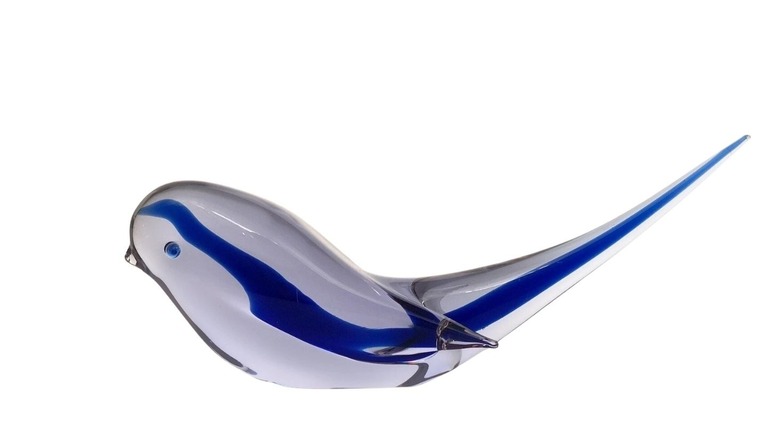
Murano glass from any era is just fantastic and it is highly collectible, but Murano sommerso birds, fish, and paperweights are extra special. The sommerso effect is an elegant oddity. The colors look as if they are floating in the middle, underneath thick clear glass casing, as opposed to sitting on the surface in the way you would normally expect. Sommerso translates as "submerged," and this technique involves sinking one color inside a contrasting one while the glass is hot and then blowing it from there. The layers stay separate and you end up with this strange, but striking, two-color finish. My grandparents collected these and kept a fairly large collection in their curiosity cabinet that, as children, we were fascinated by, but never ever allowed to touch. You'll find all kinds of little animals, including swans, cockerels, and fish, as well as charming little paperweights.
These things weren't terribly valuable back then, and they aren't today, but they are incredibly charming. So many companies made sommerso items that it's hard to prove provenance, as many of them aren't marked and there are also quite a lot of modern replicas. If, however, there's a foil label still stuck to the base that contains the Murano logo and the piece is in mint condition, it could have a little value.
Georges Briard gilded trinket trays and lidded boxes
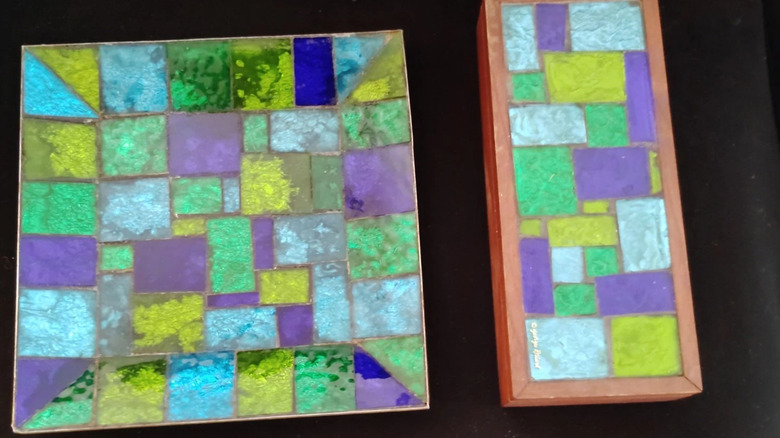
Gilded trinket trays, glass dishes, small lidded boxes, and shallow trays from George Briard are highly collectible '60s knickknacks and you'll often find them lurking in overlooked corners of the thrift store. The barware from this brand is very collectable and many people already know what they're looking for, so you'll rarely find these at a good price in good condition. The smaller pieces are plentiful — their beauty and their value, however, is ruined by the loss of the gilding.
Before you squeal in delight and rush to the checkout, hold the piece up to the light and to make sure that there are no dull gray patches where the gilding is worn through. This is usually an indicator that the piece has been washed inappropriately too many times or has been put through the dishwasher, in which case you should put it down and continue your search.
Holt-Howard Pixieware condiment jars
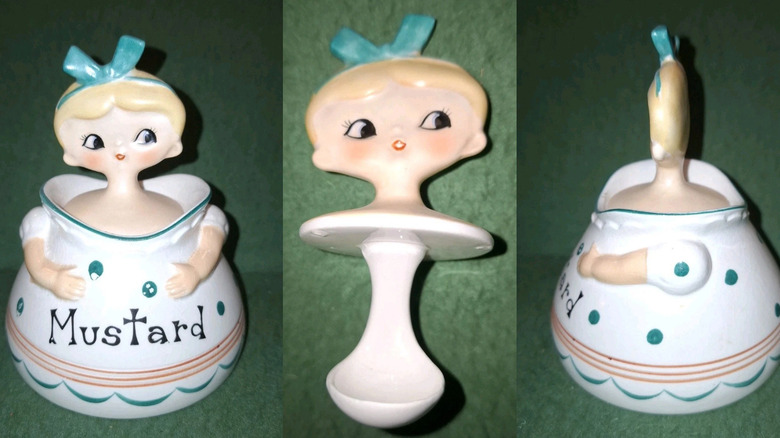
I adore Holt Howard Pixiewae. It is completely and utterly ridiculous in the very best way, and there are lots of them to collect, with over 60 in the original range. They feature a fairly plain or slightly patterned glazed base to hold the condiment, and the lids are flat characters pulling ridiculous expressions. You'll get short squat ones for things like mayonnaise and ketchup, and tall thin ones for oil and vinegar. Some of them also have spoons built into the lid.
Today the original pieces are something of a rarity, because the heads were relatively delicate and would snap off. A complete one of these jars with its spoon and the head intact can fetch over $300. Soup spoons, towel holders, and other kitchen items were also included in the range, with the same cute-but-silly characters.
Lady head vases by Inarco, Napco and Relpo
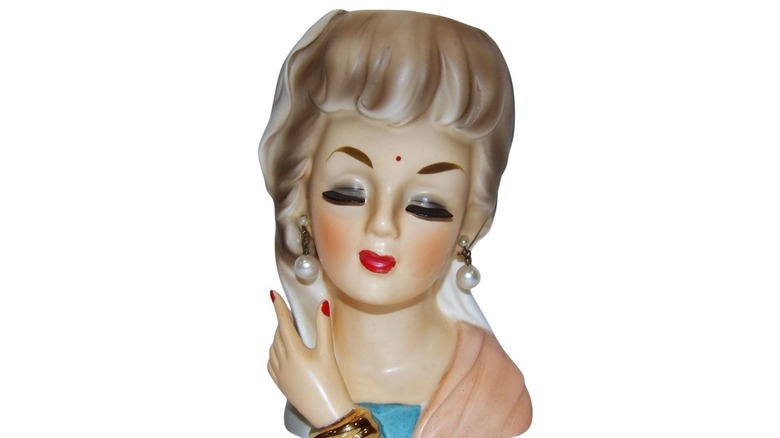
My grandmother had a whole collection of lady head vases, and after her passing, these fetched quite a sum. They are quite literally what the name implies. They are a little bit like Toby jugs, except they are the ceramic heads of ladies, usually in large hats, that can hold small bunches of flowers. I personally find them rather off-putting, but there are many people who collect these by the dozen. To me, however, they fit in the same category as creepy old dolls.
These mostly began as a marketing technique to sell small bouquets. Today they can fetch anywhere from $10 to over $2,000, with a Marilyn Monroe lady head vase selling for $2,600 and a 1964 Jacqueline Kennedy one reaching $9,000. Inarco, Napco, and Relpo are the most collectible brands, especially the celebrity versions. There are an awful lot of reproductions, though, so do be careful. The newer ones almost always have an even and immaculate glossy glaze, whereas the originals frequently have fine cracking and you may find that the painting, especially around delicate areas like the eyelashes, is slightly off. These are the ones you want.
Napco knee-hugger Christmas elves
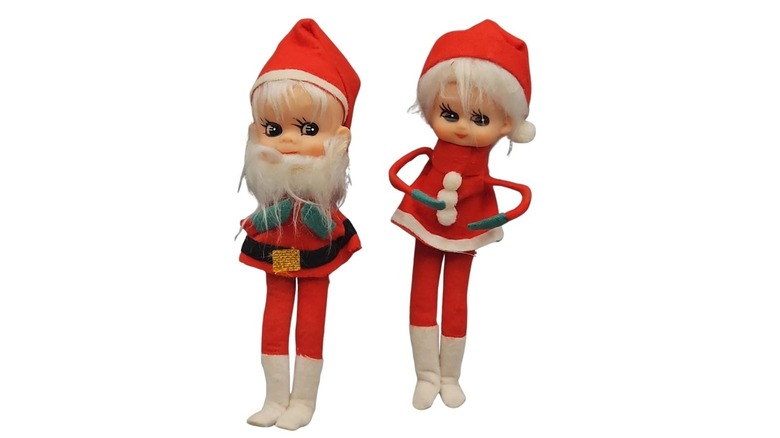
Napco Knee Hugger Christmas Elves are one of the most collectible '60s Christmas decorations , but you can still find plenty of them at thrift stores, usually buried at the bottom of a mixed box of old Christmas ornaments that nobody wants. These weird and sometimes slightly disturbing-looking little Christmas elves are mostly unbranded. One of the main tells is that when you squeeze the arms, you can feel wire in there, which is the mechanism by which the elves hug their knees.
The elves are usually dressed in felt (or sometimes burlap) and have painted faces. Usually, on the originals, you may see a small mark that says "Made in Japan." These things are delightfully creepy in the way only vintage Christmas decorations can be and still be considered cute. They have molded plastic heads and their expressions are frequently bizarre or slightly menacing. But they're also kind-of adorable, and I have a few that come out every year with the rest of the vintage Christmas weirdness that I have a weakness for.
Bitossi Rimini Blu ceramic animals
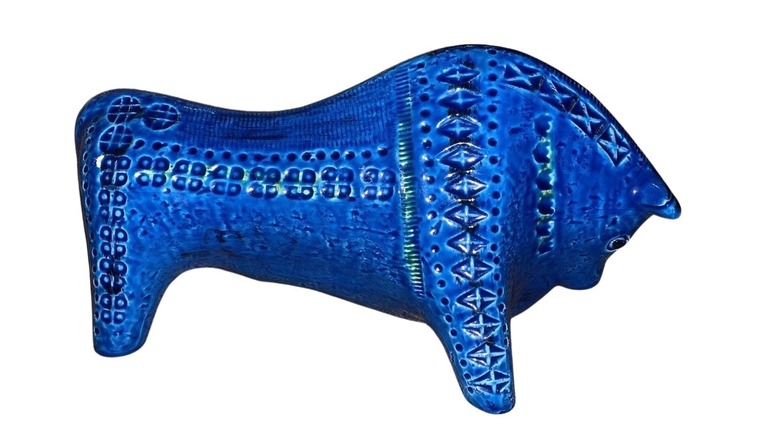
The rough, wild, and slightly chaotic finish of Bitossi's Rimini Blue Ceramic Animals makes them instantly recognizable. Many have little x's, lines, and dots all over, and the glaze is in varying shades of blue, turquoise, and a little green. They don't really look like typical ceramics and they are surprisingly heavy.
I have a rather adorable Rimini Blue cat with a little triangular head, as well as a cute mischievous-looking Dachshund, both of which I found on the knick-knack shelves of the local thrift store. Although they are worth substantially more than I paid, I love them, so won't be letting them go any time soon. While many in good condition are worth several hundred dollars, some, such as the highly prized ceramic horse, can sell for several thousands, especially if they are signed by one of the original makers.
West German lava bud vases
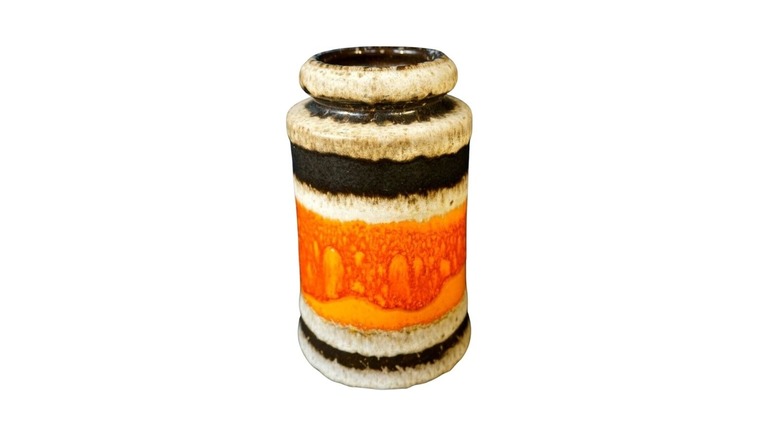
When people think of West German lava vases, they tend to think of the huge floor vases, but actually you can find some utterly adorable tiny bud vases too. These frequently get mistaken as souvenirs or little nothings in the thrift store, and get relegated to the back of those knick-knack shelves. They are lovely and range from 2 to 4 inches tall, and are just big enough for one stem. Or you can put one on your desk to hold your pen.
They have the same drippy volcanic glazes and the same beautiful finishes as their larger floor-standing counterparts. There was a huge range of these colored drip lava glaze on white clay vases produced during the '60s and '70s by makers like Scheurich. Genuine ones are easy to spot, as they have molded base marks with a three-digit form number, plus a second number that tells you the vase's height in centimeters. If you find "W. Germany" or "West Germany" alongside this model number, you'll know that it was created between 1949 and 1999. If you just see "Germany," it may still be authentic, but will fall on either side of these years.
Sascha Brastoff ashtrays and dresser boxes
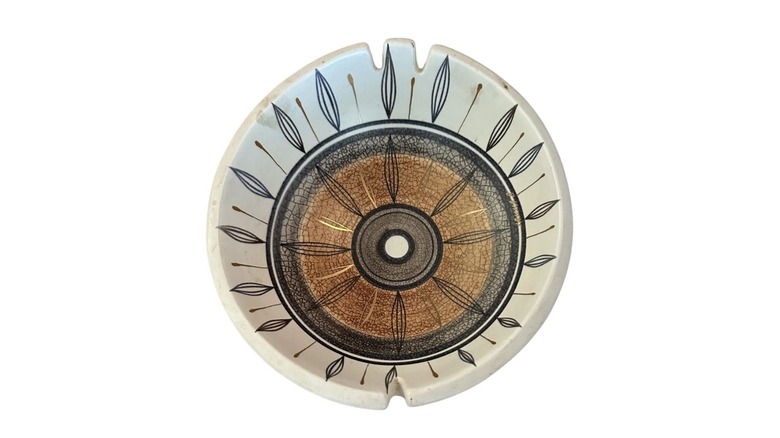
Cigarette boxes, ash trays, trinket trays, and even covered dresser boxes from Sascha Brastoff still look wonderfully modern and on-trend, sitting on your coffee table or sideboard, with their loose abstract designs and lovely gold trim. You can find ceramics, enamel on copper, and metal from this particular artisan. If you're really lucky, you'll come across pieces signed with the full Sascha Brastoff signature. These were generally decorated by Brastoff himself.
Other pieces with the shorter Sascha B signature are still very collectible and just as pretty, but not quite as valuable, as these were more frequently the work of his studio staff. Some minor glaze crackling when you look at a piece in the light is perfectly normal for ceramics from the '60s, but intense cracking should be avoided. If you're looking at one of his enamel on copper pieces, check for more than just light surface scratches, as this can quickly ruin the value.
Kay Bojesen wooden animals
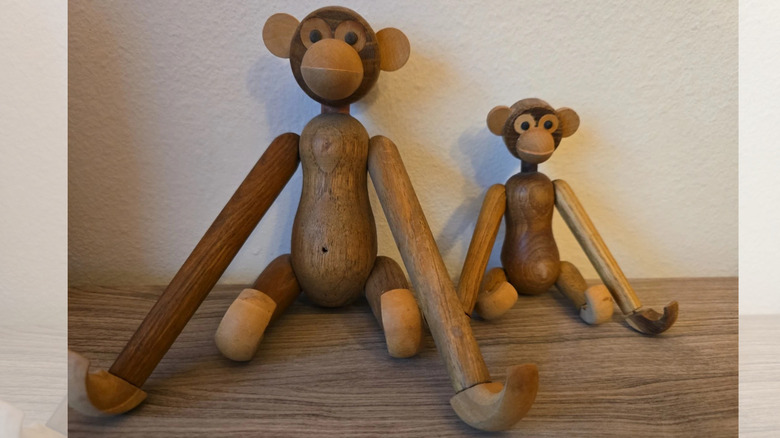
A wooden animal from Kay Bojesen would be one of my dream thrift store finds. They are spectacularly quirky and I really want one, but I've never been lucky enough to find one. I particularly want one of the jointed teak monkeys. They are playful and childish in their appearance, and yet are wonderfully engineered and really are an exquisite piece of nostalgia. They have movable limbs that let them hang from shelves or sit upright, and they are just adorable. The wooden monkeys came out in 1951, but were still sold well into the '60s.
There are plenty of other animals in the range too, from cute little birds to ponies, rabbits, and elephants. Genuine Kay Bojensen pieces usually have "Kay Bojensen Denmark" stamped somewhere on their base, often on the underside of a foot. True aged pieces from the mid-century tend to have a deep even patina. If it's in good condition, the joints should still be tight enough to hold a pose without flopping over. That's not to say that a monkey with loose, wobbly joints is worthless, because it's still collectable and you can repair or replace its internal cord to tighten the whole piece back up. The same goes for the smaller jointed bears and zebras.
Howard Pierce porcelain birds and animals
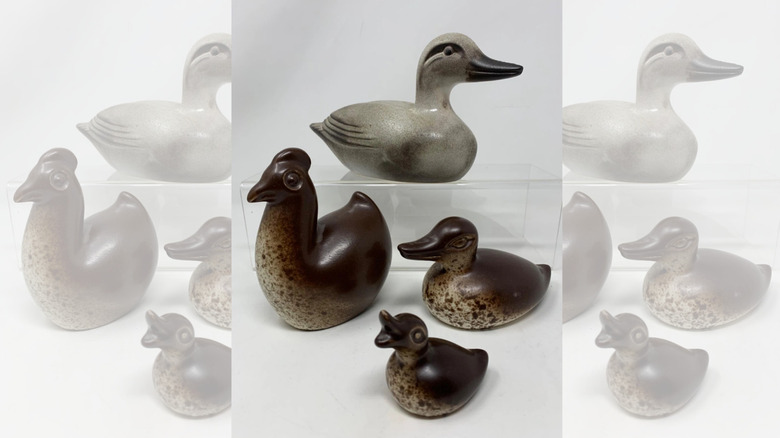
Howard Pierce's Southern California studio produced all kinds of ceramic figurines, from road runners and quail to deer, cats, goats, and hippos. His ceramic animals are charmingly rustic and have a matte or satin-matte glaze, and simple flowing shapes. They look just as wonderful on a curio shelf today as they would have done in a true mid-century living room.
I'm a big fan of the brown on white animals and I really loved the pairs where one was slightly larger than its little counterpart. The difficulty is that many of the smaller figures weren't marked. Even when they were originally sold as pairs, often only the larger carried the Howard Pierce mark. So the smaller ones end up looking like just generic ceramic items, and they are easy to miss. Once you recognize them, you can start to build a nice little collection. They just aren't necessarily worth too much if you can't prove their provenance, because they lack maker's marks.
Dam troll dolls
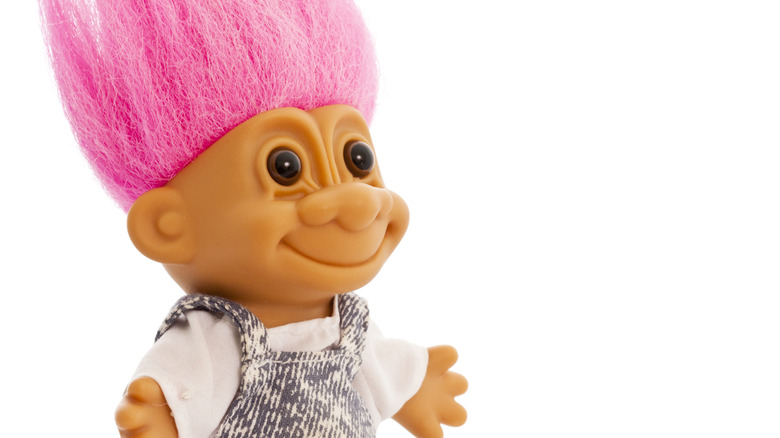
I am a child of the '80s, so I had so many troll dolls with bright purple and neon pink hair, often naked, some with gems in their bellies. They were weird creatures, but I loved them as a kid and had a huge collection. And you can find the '80s and '90s versions, and even the comeback trolls from 2016 onward, by the hundreds at thrift stores across the country, but the originals, the Dam troll dolls, are rare and a real find. The story goes that Danish woodcutter Thomas Dam created the first troll doll in 1959 because he couldn't afford to buy a Christmas gift for his young daughter. The other children in the town loved the doll so much that they wanted their own, and he ended up turning this carving into a business.
While you would be exceptionally lucky to find an original wooden Dam troll doll, you can find plenty of the plastic models from the '60s. The '60 Dam troll dolls have a stamp under the chin, on their backs, or on their feet that says "Made in Denmark" with Gjol at its center. Also, during the '60s, there were a lot of 3-inch dolls and animal trolls, but they carry no marks, so they are harder to spot. Some of these are really fab. I am lucky enough to have a '60s Dam troll lion with a real wool mane. I love him and his name is Bob. As for the regular-sized troll dolls, if you are not sure whether you are looking at something from the '60s or one of the later versions, check the hair, as many '60s versions had real wool hair and they tended to be slightly less vivid in color.
Fornasetti porcelain ashtrays and small dishes
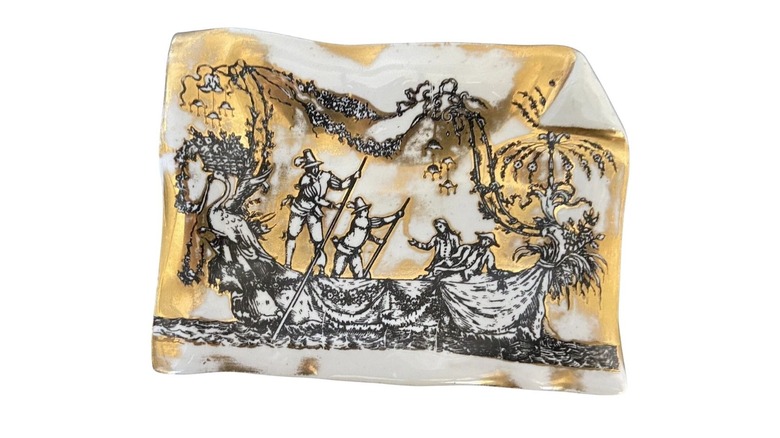
Black and white transfer-printed porcelain catch-alls and ashtrays showing faces, hands, or newspaper pages are classic Piero Fornasetti trinkets. Some of the most iconic finds that collectors look for come from his Tema e Variazioni series. These items were popular decor in the '60s and still look fab in modern homes, as a nod to the beauty of the past.
Everyone had ashtrays in the '60s. These particular pieces are built around the face of the famous opera singer Lina Cavalieri. The really collectible ones that people endlessly hunt through thrift store shelves for are the original Milan-made ones. These are marked on the underside with a round black ink stamp of a hand gripping a pen, surrounded by the words "Piero Fornicetti, Milan, Italy."
Enesco Prayer Lady kitchen pieces
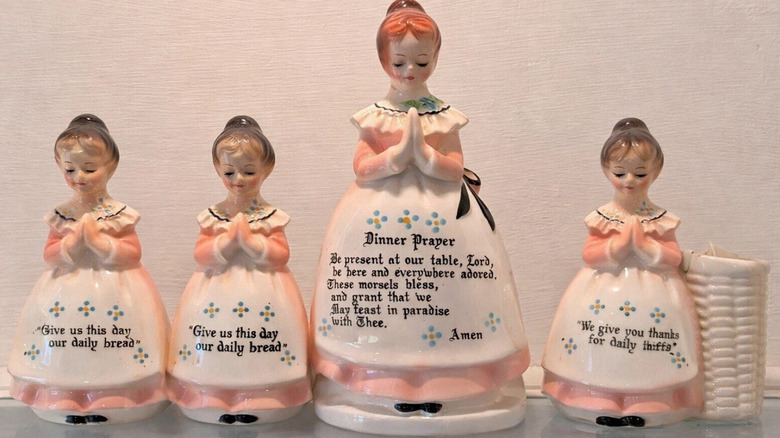
My grandmother was a passionate collector of Enesco prayer ladies, and they are very much nostalgic kitchen decor from the '60s and '70s. I personally find them oddly repellent, but there are plenty of people who love these pink aproned ceramic ladies with their folded hands and bowed heads. I sold my grandmother's collection of these demure, submissive little kitchen ladies after her passing, and they were snapped up at a very good price remarkably quickly.
There are salt and pepper shakers, spoon rests, napkin holders, toothpick holders, and all kinds of other kitchen ceramics in the Enesco prayer lady line. You'll also sometimes see them sold or labeled as "Mother in the Kitchen." Because they were kitchen ceramics, they are frequently chipped or broken, so they are now considered pretty collectible. Each of the ladies carries a different prayer or Bible verse printed across their aprons and, while they are most frequently in pastel pink, blue and yellow are also available, albeit harder to find.
Blenko glass ashtrays
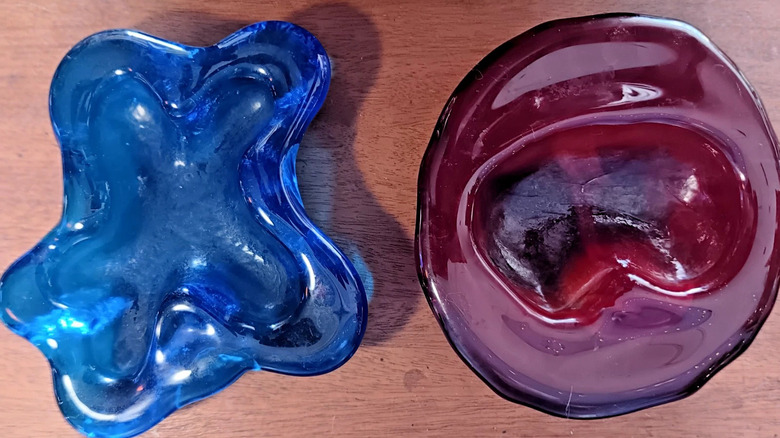
I love Blenko glass, but the oversized decanters that the company are so famous for are way out of my price range and not something you would normally see at a thrift store. The ashtrays, however, are different. They are usually around 5 or 6 inches across. While we have no smokers in my house, the ashtrays do work very well as little catch-alls and candy dishes. I have a lovely dark blue bubble Blenko ashtray that goes beautifully in my bathroom, holding rings, watches, and so on. They turn up regularly on knick-knack shelves in thrift stores across the nation, because ashtrays are unremarkable and not very fashionable.
With Blenko, you are looking for ashtrays with a ribbed sunburst texture or maybe a rounded brutalist shape with a heavy controlled bubble effect. The playful shapes and colors are trends that defined many '60s homes. You'll find all kinds of colors from tangerine and amberina to smoky charcoal. These things are surprisingly chunky and heavy given their small size. Look for ball shapes, odd angles, heavy textures, and intense colors, as these are mid to late '60s pieces, often from Blenko designer Joel Philip Myers. If you're lucky, you will find one with the original paper sticker still on the base.