

What Makes Lawn Mower Oil Different From Car Engine Oil?
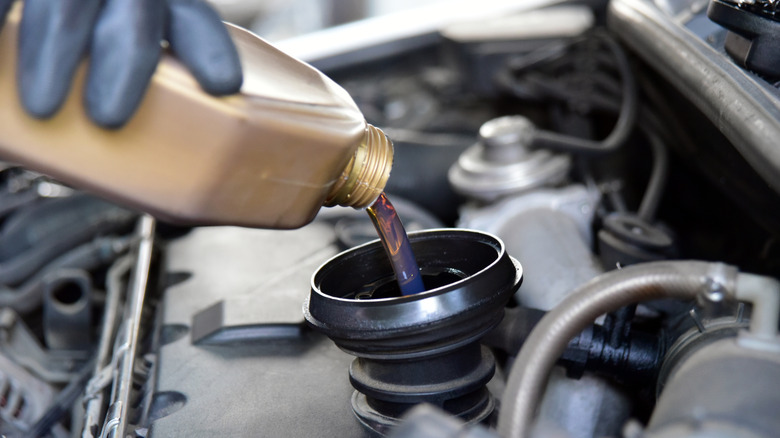
Even though it can be time-consuming and messy, some people enjoy the idea of changing their own oil in motor vehicles and lawn mowers. If you're new to the idea of doing this work yourself, you'll want to avoid common mistakes people make when changing lawn mower oil and vehicle oil. One mistake is adding oil made for automobiles to your lawn mower.
Motor oil's primary function is to provide lubrication, limiting wear by minimizing contact between that metal parts. It also aids in keeping the engine cool by reducing friction. In a car, oil may cool parts of the motor that the coolant liquid cannot reach. Because the car's motor is water-cooled to regulate its temperature, though, its oil isn't intended to endure high engine temperatures. Lawn mowers, on the other hand, typically use an air-cooled design, which doesn't require a radiator and reduces the amount of weight in the machine. The air-cooled engine in a lawn mower may run 50 to 75 degrees Fahrenheit hotter than an engine that uses a radiator and coolant, meaning the oil used in the motor needs to be able to withstand higher temperatures. To achieve better performance in these temperatures, lawn mower oil uses different formulations than what's used in a motor vehicle. Consequently, you don't want to put car oil in your lawn mower or vice versa.
How motor vehicle oil and lawn motor oil formulations differ

Viscosity, a measurement of a liquid's thickness and resistance to flowing, is a key difference between motor vehicle and lawn mower oil. Oil with a higher viscosity will flow slower and be thicker, while lower viscosity formulations will flow faster. Motors in lawn mowers need higher-viscosity products that work best with air-cooled engines. However, if you commonly use the mower in low-temperature weather, you may need a lower-viscosity oil to keep it flowing smoothly. Because cars have temperature-controlled engines, they can operate safely with lower-viscosity oil.
If you have a two-stroke lawn mower engine (which is rarer for modern mowers than a four-stroke engine), you must mix gasoline and two-stroke engine oil designed for mixing at the proper ratio. Consult your mower's manual for specifics. You should never use car engine oil for a two-stroke engine, or you run the risk of damaging the engine with carbon deposits. You could also damage the spark plugs.
Regardless of which type of formulation you are using, you need to dispose of motor oil the right way after you change it, usually through taking it to a professional for recycling. Motor oil designed for either lawn mowers or motor vehicles could contaminate water, harm animals, and kill plants if you put it in the garbage or pour it down a drain instead of disposing of it correctly.
How to differentiate between lawn mower oil and car oil in a store

The Society of Automotive Engineers (SAE) developed a system to classify viscosity with a numeral, where higher numbers represent a higher viscosity at normal operating temperatures. For four-stroke small engines (as in most lawn mowers), you should generally look for SAE 30 motor oil in stores. It should operate sufficiently in warm weather, which is when most people use their mowers. If you run the machine in cooler weather, you may want to use a thinner viscosity product, such as 10W-30 motor oil. Before you select your oil, however, check your mower or vehicle's manual to confirm the correct viscosity to use.
As for motor vehicles, most cars can typically use 5W20 when operating in cold weather areas, and 5W30 or 10W30 when driving in warmer climates. These products have two numbers because the first number indicates viscosity in cold weather (the "W" is for winter), and the second number measures viscosity when engine temperatures reach 212 degrees Fahrenheit. The SAE 30 oil that's recommended for most lawn mowers has only one number (and no "W") because it isn't made for use in cold weather. Using the wrong oil formulation in your motor vehicle or lawn mower could cause damage that necessitates expensive repairs. You might even void the machine's warranty.