

Building A Retaining Wall? Ditch Landscape Fabric For These Soil-Stabilizing Materials
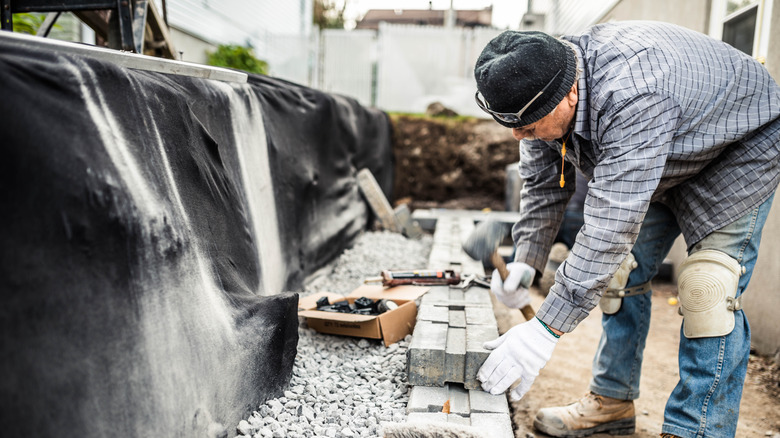
There are a lot of ways your DIY projects can save you money, but that's only if you avoid major pitfalls. Choosing the wrong materials can end up costing you more than you think, and sometimes you don't find out until it's too late. When you're building a retaining wall, much of the critical work gets buried, so you may not know something is wrong until problems develop. To build it right the first time, ditch landscape fabric and weed barriers. Instead, use non-woven geotextile fabrics and geogrids to help prevent retaining wall failures.
Non-woven geotextiles — not regular landscape fabrics — are used to separate layers of soil from drainage rock behind a retaining wall. They allow water to pass through while preventing soil from migrating into the drainage rock. Landscape fabrics are made for separating materials (like keeping your gravel from sinking into the ground), but they can collect small particles of dirt as water drains through. When installed behind a retaining wall, landscape fabric can clog over time, potentially restricting drainage and increasing hydrostatic pressure behind the wall.
Geogrids extend into the soil and interact with it. Different types of geogrids, made from synthetic materials like polyester and polyethylene, reinforce the soil by interlocking with it, helping the retaining wall resist lateral pressure. They're installed every two feet vertically to prevent retaining wall failures, such as cracking, leaning, falling over, or sliding downhill.
When you need geotextiles and geogrids to build retaining walls
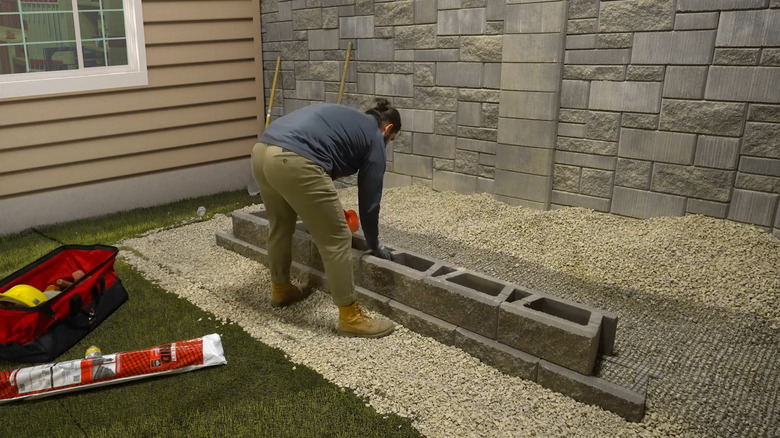
When you're building a retaining wall, it may need some gravel, drainage rock, or even a complete drainage system behind it. Non-woven geotextile fabrics are what you use to keep the soil that surrounds it from clogging up the rock. There are different strengths for each type. For example, if you're wrapping the pipe for the French drain in your retaining wall, a 3 to 4-ounce fabric will work in sandy soil, but you'll need a heavy-duty 6 to 9-ounce geotextile fabric in soils with heavy silt or clay.
Geogrids are typically needed when you have poor soil conditions or tall walls with heavy loads. Soils with a lot of organic matter or expansive clay soils that swell when they absorb water don't make good foundation soils. When you're building a dry-stacked retaining wall, engineering may be required depending on local building codes, particularly for taller walls.
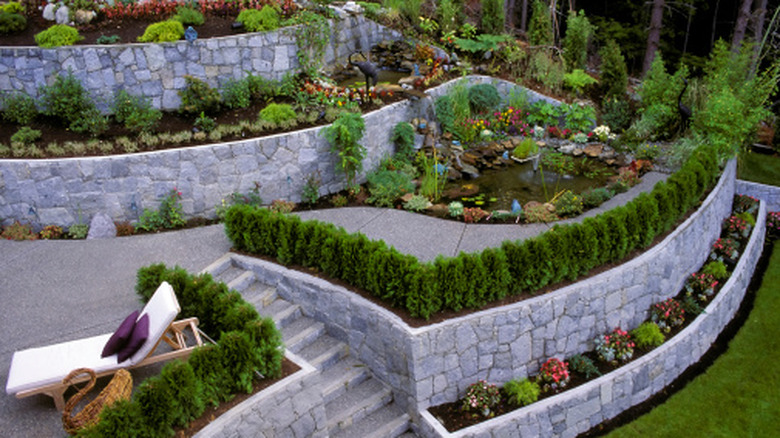
If you have a short wall and suitable soil, you may not need geogrids. However, if you have engineered plans, they must be followed closely since they're based on the soil type and amount of surcharge for your project. Surcharge just means extra weight, such as when your retaining wall holds up a heavy load like a driveway or patio. More tiers of retaining walls are also considered extra weight.
How to install geotextiles and geogrid in a retaining wall
A well-built retaining wall sits on a leveling pad about six inches deep, also extending out six inches at the toe and heel (front and back). Depending on your site conditions, the drainage system may sit on this leveling pad at the bottom of the wall, behind the first row of blocks, or at a higher elevation, with the pipe raised high enough that it can drain out the face of the wall. The geotextile is placed between the drainage rock and native soil.
Non-woven geotextiles are a permeable fabric, whereas geogrids are open grids. Like geotextiles, geogrids are also installed horizontally, perpendicular to the wall itself. That way, when they interact with the fill materials, they serve as soil reinforcement. Geogrids are also connected to the wall system, with the blocks securing the geogrid according to the manufacturer's design, so the reinforced soil mass behind the retaining wall becomes part of the structure.
With the French drain providing drainage for your retaining wall and the geotextile fabric preventing soil from contaminating the clean drainage rock, geogrid reinforcement can be added according to the wall design and manufacturer specifications. Each layer of the fill zone is compacted every six to eight inches so instead of having loose fill that doesn't have any structure, the density of the fill and the geogrid work together to create the interlocking soil mass.