

Ancient Romans Made It First — The Durable Stone That Has Stood The Test Of Time

Cobblestone doesn't just look ancient; people have been using it for thousands of years, making it older than many of our modern civilizations. In fact, there are records of cobblestone being used in Mesopotamia as early as 4,000 B.C. But when it comes to cobblestone as we know it today, we can thank the ancient Romans for refining how we use this durable, historically significant building material.
Ancient Romans used cobblestone around 300 B.C. to create fortifications across the empire's vast coastline (in those days, the Roman Empire encompassed the entirety of the Mediterranean, as well as the Iberian peninsula). More famously, the Romans also built one of the world's first extensive road networks (the very first road being Appian Way). Some sections of Roman roads are still completely intact, and when looking at them it's easy to imagine that they haven't changed much in the millennia since their construction.
Romans had a specific method for creating such long-lasting roads, and it's extremely similar to how we create paths with loose materials like gravel or cobblestone today. The roads were made with three layers: a foundation made with a concrete-like material, a middle layer of crushed rocks, and then the cobbles themselves.
Each stone had to be set by hand. And, since the Romans were just using whatever cobbles they could find around them, stones would be different sizes, creating a much more organic, freeform look than what we will see in the following centuries.
Cobblestone construction is a time-tested tradition
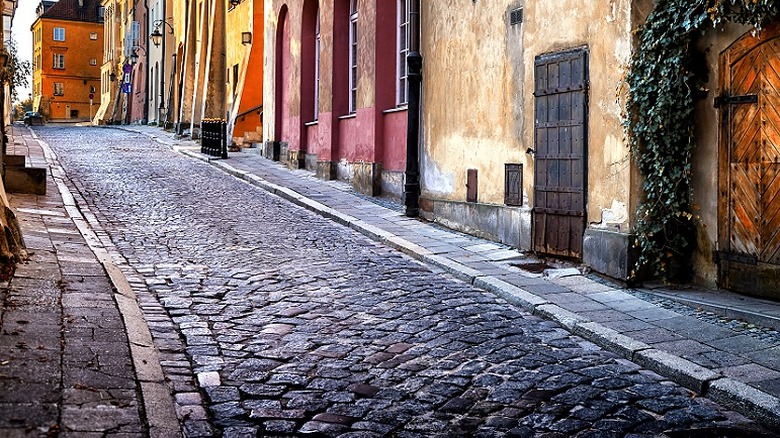
Cobblestones can refer to any variety of hard stones that are arranged together such as basalt, granite, and much later flint. The rounded look of old cobblestone comes from erosion; ancient workers would typically source the rocks from rivers, netting them a pile of smooth stones.
Cobblestone was initially used because it could stand up to the wear-and-tear of feet, hooves, and carriages, but as the years went by, people discovered just how versatile this material could be, as well as how to optimize its aesthetic value. By the 16th century, cobblestone streets were laid in intentional patterns rather than haphazardly, and the stones were also being implemented to build walls and houses. (This is the time of Rome's famous sampietrini roads.) Eventually, cobblestone became something of a status symbol, since not every city could afford to have paved roads.
Still, cobblestone roads provide more than just rustic charm. Aside from their durability, the Romans also had drainage in mind when deciding how to build their roads. You've likely noticed that most modern roads are built with a slight hill in the middle to allow rainwater to flow away quickly — that was first done with Roman cobblestone, and you can see the method copied in cobblestone roads around the world, both new and old. Even today, cobblestone is a great alternative to concrete pavers if you want to reduce runoff in your driveway.
How homeowners may use cobblestones today
For a few hundred years, cobblestone could be seen most everywhere. By the 1800s, the building method had reached the United States, and stones were starting to be produced by machine rather than scavenged. However, like its creator the mighty Roman Empire, cobblestone's reign couldn't last forever. As anyone who has driven on a cobblestone street can tell you, it's a bumpy ride, so once new paving technology like synthetic asphalt came into the picture, it wasn't long before cobblestone streets were phased out.
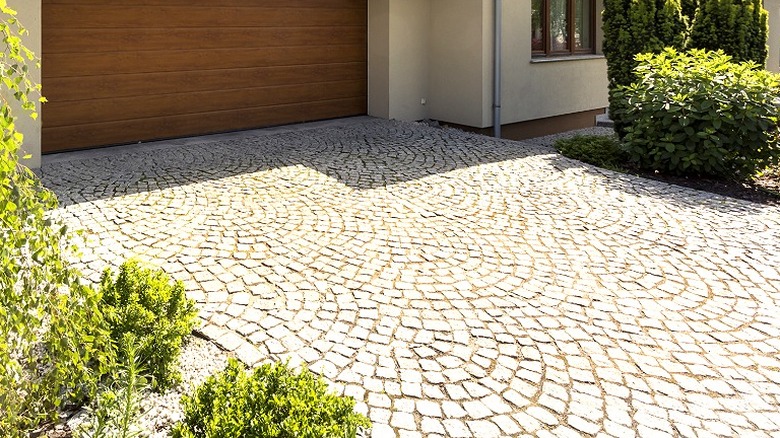
Luckily for the cobbleheads out there, the durability of cobblestone also extends to its popularity. Even if we aren't using it to pave roads anymore, it's still a popular (and in many cases ideal) material for loads of landscaping and construction projects. For example, cobblestones are a low-maintenance material that can give your driveway an upscale, historic look. Cobblestones are also great for lining flower beds or adding a rustic touch to your entryway — and you can use the same method as the Romans if you want to be truly authentic.
You may even spot a new cobblestone road being installed, especially around historic downtown areas. Cobblestones are an accessible, easy-to-use building material, which means that it's not hard to bring their nostalgic, cottagecore appeal to your home. But if you're lucky enough to live near a cobblestone structure that was actually built hundreds — or thousands — of years ago, take a moment to appreciate just how much those humble stones have contributed to our society.