

Use Cinder Blocks To DIY A Budget-Friendly Feature That Makes Your Home More Inviting
We may receive a commission on purchases made from links.
With the prevalence of delivery services, we've likely all been stuck behind a delivery driver moving at a crawl as they're peering around for house numbers. There actually are ideal spots to place your house number, but in general, it's a free-for-all. Not all neighborhoods require curbside painting, so numbers are typically displayed wherever and however suits the owners: around the front door, next to the garage, on a mailbox, etc. If you have flexibility, there are many ways to creatively display your house number, one of them being a budget-friendly DIY project that requires (at minimum) a cinder block and paint supplies.
Before you start, think about the purpose of house numbers. They help houseguests, service providers, and delivery drivers locate homes. But they're also critical for helping emergency responders quickly find people in need. Because of this, the numbers must be obvious, particularly at night or during inclement weather. Choose a decipherable script over one that's ornate, a legible font size and color, and a spot that is well-lit and not obstructed.
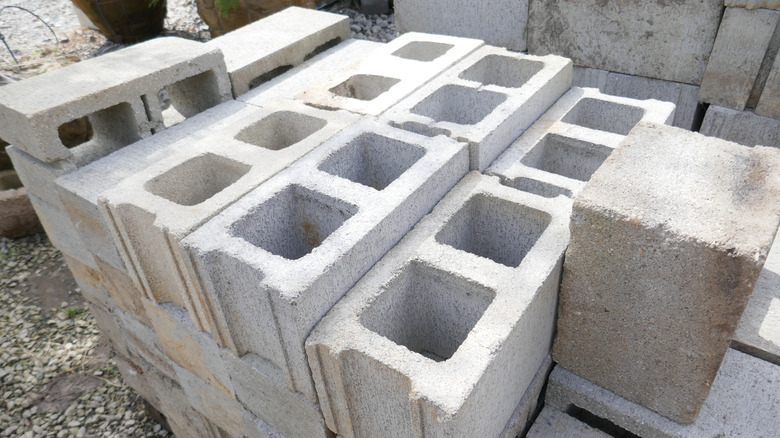
This DIY project is simple enough for novice and expert DIYers alike. Cinder blocks are great for crafting; they're lightweight and affordable, even free if you have any leftover from another project. Concrete blocks — similar to cinder blocks but made for load-bearing projects — can also be used. Both materials are very porous, so they need to be waterproofed when used outside. Prep the block with a primer like Zinsser Bulls Eye 1-2-3 Primer that is suitable for masonry.
Tips for turning a cinder block into a house number display
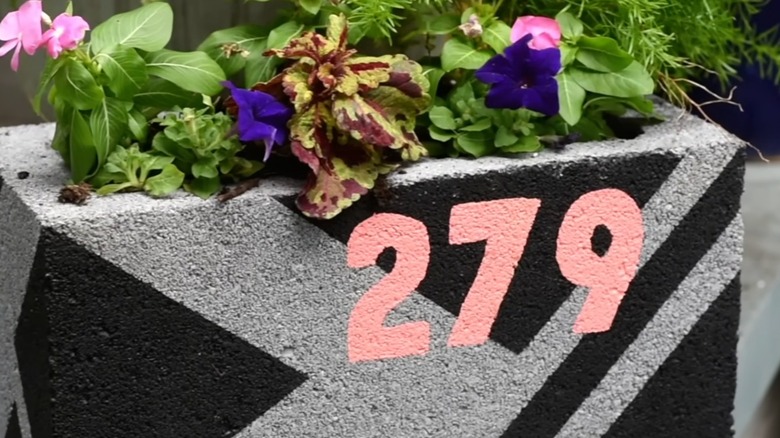
Once the cinder block is cleaned, primed, and dried, decide how you want to decorate it. The design should be simple enough for the numbers to be easily read, unless you have another set of numbers elsewhere that will serve as the main signpost. For a minimalistic look, paint the block a solid color or outline it with a color that complements the main hue. For something more eye-catching, use painter's tape to mark off geometric shapes before painting the exposed block. Always use an exterior acrylic paint, like Krylon ColorMaxx Spray Paint, that is suitable for masonry.
Use outdoor acrylic craft paint to add house numbers by painting them freehand or with stencils. To double-check if your color and font choices are legible, paint your house numbers on scrap cardboard and look at them from the street. You can also glue store-bought numbers onto the cinder block with an adhesive waterproof caulk, like Gorilla Heavy Duty Construction Adhesive, that is suitable for outdoor use and on masonry.
Your project is ready to go now, or you can adapt this idea of building a succulent garden out of concrete blocks and turn your block into a single planter. If the block will sit on the ground, glue 1 inch by 1 inch stained and weather-proofed pieces of wood across its underside, spaced about an inch apart. This allows water to drain without pooling underneath the block.