

Use A Common Kitchen Scrap To Give Your DIY Natural Wood Stain A Blue-Green Hue

For avid woodworkers, it's always exciting to discover unusual ways of crafting unique wood pieces. How you color the wood, for example, can make a huge difference. Perhaps you've even thought of trying out some natural wood stains. If you agree that pricey wood stains are a waste and want to DIY a cheaper one, one way to go is with common kitchen scraps and staples; specifically, some of that raw red cabbage in your fridge and the tub of baking soda in your pantry.
This unexpected combination won't only result in a unique blue-green wood color but it's also quite affordable, and the fact that with it you avoid using harsh chemicals on your wood makes it an eco-friendly swap in your home, too. The process of turning red cabbage and baking soda into wood stain is pretty straightforward, as demonstrated by the Dusty Workbench on YouTube: boil the cabbage or juice it, sieve, then mix with baking soda. It's that simple.
But how exactly does red cabbage work as a wood stain? Well, this vegetable contains a pigment called anthocyanin which is typically found in plants that have a red, bluish, or purplish appearance. This pigment gives red cabbage its unique color, and it's that color that you can extract into a dye or stain. But why is this stain blue-green versus red; that's due to the reaction with the baking soda.
Turning red cabbage into a natural wood stain
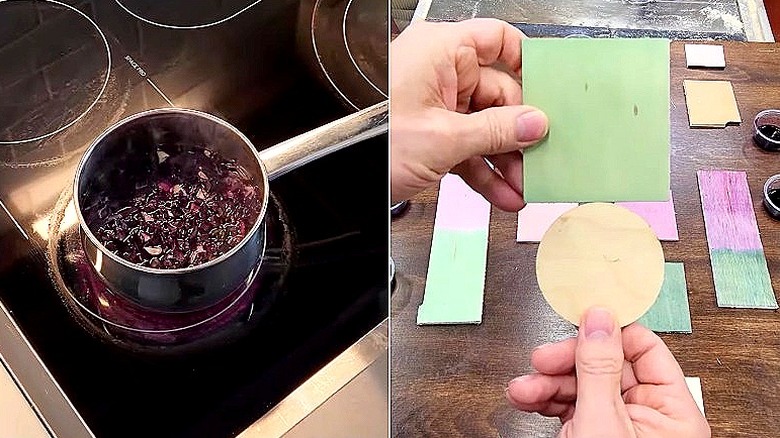
As explained by the American Chemical Society, red cabbage's anthocyanin is pH sensitive and can indicate if a solution is an acid or a base by what color it turns when mixed. If the solution turns red or pink, it's an acid, a pH level below 7; if it turns green or yellow, it's a base, with a pH level above 7. Baking soda is a weak alkaline base, with a pH level of ~8.3, so when the red cabbage juice is mixed with it, the solution — or homemade wood stain — turns green.
There are two basic ways to extract the purple-red color from a red cabbage. One way, as shown by Instructables, is to use a juicer or food processor. The other method is to boil the cabbage pieces, as seen above; this is how the Dusty Workbench goes about the extraction process. This method takes about three to four hours. For both methods, you will sieve it through a cheese cloth or strainer.
Next, mix the red cabbage juice with baking soda. This will take some trial and error, as the amount of baking soda you mix in will determine the shade of the wood stain. The stain will turn more green the more baking soda that's added, so it's best to start with a little baking soda and increase it until the color is what you're looking for.
When ready to apply to your wood, use a piece of cloth or brush. Remember to sand the wood first for better stain uptake (which is one of those helpful tips savvy DIYers know to use before using wood stain). What's more, if you already have some wood that's been stained with red cabbage juice, you could always add some baking soda solution to it, increase the pH to above 7, and change its color.