

Plastic Pots Leave A Large Environmental Footprint: Try This Eco-Friendly Alternative Instead
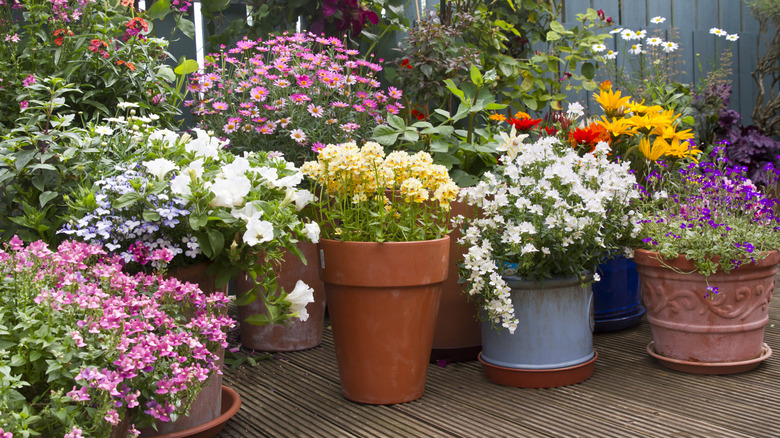
If you've looked around your garden recently and appreciated the beauty of its impermanence and imperfection, there could be one thing catching your eye that feels out of place. Amidst all of the vibrant foliage, beautiful flowers, and weathered wood, you have a plastic planter — and it's the one thing that doesn't look better with age. Hypertufa pots, which look like they're carved from stone, are an eco-friendly alternative that you can make yourself. Unlike plastic pots, they look better over time and never need to end up in the landfill.
There are a lot of ways to repurpose plastic in the garden, but most plastic pots, even the ones stacked up in the back of the shed, will end up in the trash eventually. One alternative is to use hypertufa, which has traditionally been made from Portland cement, peat moss, and perlite. You can even replace the peat moss with other organic materials like coconut coir.
A long curing process is required for hypertufa to reach full strength, but then it lasts for decades. As it ages, it gets covered in moss and lichen, blending beautifully into the landscape. Hypertufa is quite porous but it doesn't need to be sealed, since it's actually best left alone to breathe and grow moss. If you want it to hold water for a bird bath or trough, it needs to be thick. When your hypertufa pot eventually cracks or falls apart, it can be repaired or used in a rock crevice garden.
How to make hypertufa pots
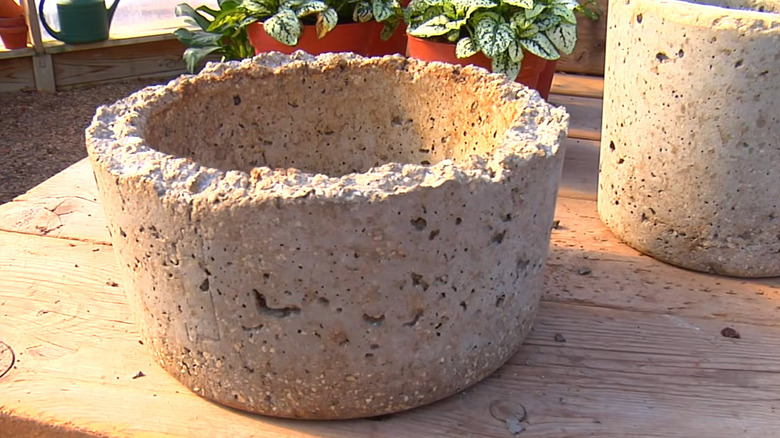
Hypertufa looks like concrete, and you use Portland cement just like when you're mixing concrete, but it is lightweight. That's because the recipe uses airy filler aggregates like perlite and vermiculite instead of gravel. To make hypertufa with coconut coir instead of peat moss, start with a recipe of three parts of coconut coir, three parts of perlite, and two parts of Portland cement (which isn't the same thing as premixed concrete). Add water gradually until the mix holds together like cookie dough since hypertufa is shaped and molded by hand rather than poured.
You can use almost any container as a mold, and sand casting is often used for free forms. For that, you need a mound of sand in the shape of the pot you want, then you pat the hypertufa mix over it and shape it with your hands. Or you can spray an old planter pot with cooking spray and use it as a mold, with another inside. Make it a few inches thick on the bottom, down to one inch on the sides. After the pot is formed but before it cures, you can poke a drainage hole or two through the bottom with your finger.
Hypertufa pots need to cure for about 24 to 48 hours in the mold before being removed. You should wait another one to four weeks before using them. If the hypertufa can be scratched with your fingernail, it's too soon.
Other ways to make hypertufa more sustainable
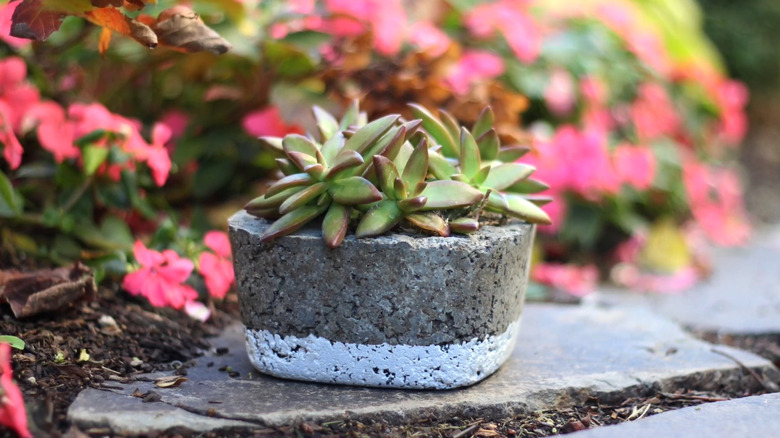
Hypertufa lasts for decades and looks better as it ages, so it's a good replacement for plastic pots. However, there are a few ways to make it even more environmentally friendly. Peat moss, which forms slowly in bogs, releases carbon when it's harvested, so many people do not consider it sustainable. Also, the coconut coir that's sometimes used to replace it may not be any more environmentally friendly, since it requires a lot of water and chemical inputs to process. By changing up the traditional recipe, you can avoid using unsustainable materials and experiment with some alternatives.
To find other options that are more eco-friendly, look no further than your own backyard. Leaf mold, which is the decayed leaves from deciduous trees, is one option that others have had success with. While some materials may be more experimental, you could try everything from sawdust and dried grass clippings to shredded paper. You can also use some sand in your mix, and instead of paying for perlite or vermiculite, replace it with repurposed Styrofoam packing peanuts, pumice, or rice hulls. You can even add pieces of broken pots or glass as an aggregate. When you're making hypertufa, the one ingredient that's not entirely sustainable is Portland cement. Unfortunately, there's not a reliable substitute for it at this time, even though greencrete, which is a futuristic polymer material, is being used in place of regular concrete for driveways.