

Sharpen Your Bulb Planter For Easier Digging With A Tool You Already Own
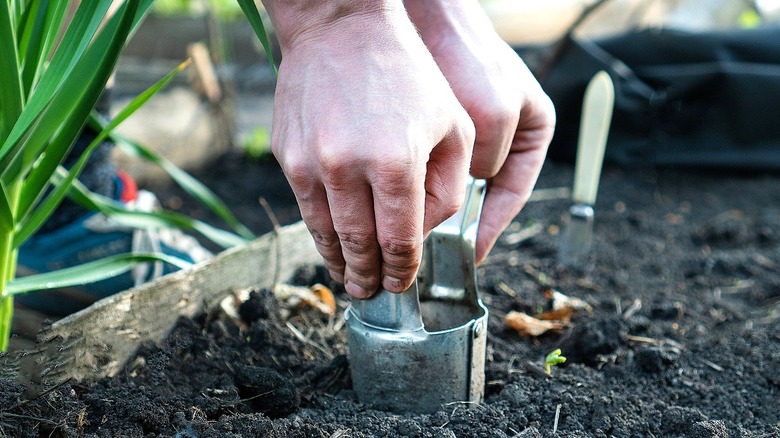
If you're planning to fill your garden with plants like tulips, ornamental onions, or daffodils, one of our top must-know bulb-planting tips is to invest in a tool for the job. Metal bulb planters allow you to create even, standard-sized holes across your entire garden bed in a matter of minutes, helping to minimize the effort and guesswork that goes into hand-digging. Thanks to their cylindrical shape and convenient handles, these tools essentially punch a hole in the soil, freeing up the perfect amount of space for you to easily plop in your bulb of choice. But what if this simple process suddenly takes an extra boost of effort? It may be time for a sharpening session, and a few basic files are all you need for the job.
Metal bulb planters are a gardening tool you should be sharpening regularly, but because of their somewhat odd shape, figuring out exactly how you should complete this task can get confusing. Luckily, the process is actually deceptively simple. While a dull edge on your tool certainly isn't ideal, it doesn't need to be razor-sharp, either – this can actually lead to accidental injuries if you're not careful. A quick brush up with a metal hand file along the outside perimeter of the tool is all that's needed to keep your metal bulb planter in good shape, and because you're not going for an ultra-thin edge, precision doesn't have to be at the top of your priority list.
How to sharpen a bulb planter with a metal file
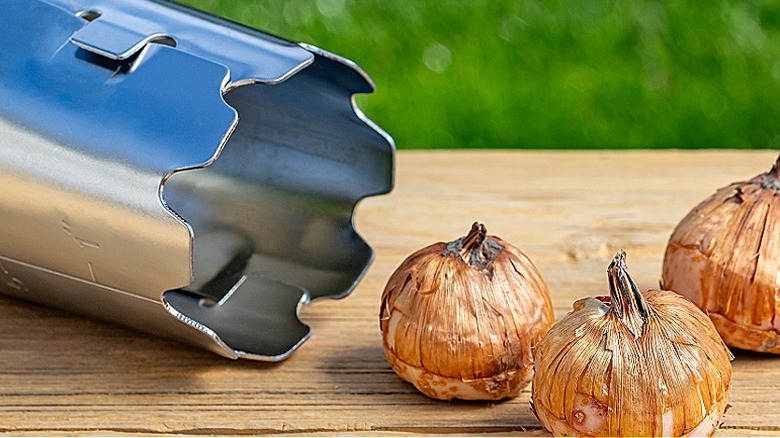
Before you get to work sharpening, you'll want to give your tool a good clean, especially if there's any stuck-on debris. Cleaning and disinfecting your garden tools gives you a much more clear starting point, but it also lowers your risk of spreading plant diseases throughout your garden. Go in with a wire brush or a scrub pad, then finish it off with some isopropyl alcohol or acetone to eliminate bacteria.
As a general rule of thumb, step-upon bulb planters should be sharpened to about a 45-degree angle, while handheld planters should be at about a 35-degree angle. Either way, the final result shouldn't be sharp enough to cut skin; you'll want it to be just above the sharpness of your typical butter knife. If your tool is very dull or came with a blunt edge, begin the process with a 12- to 14-inch medium-coarse file – this will eliminate a lot of material quickly. Follow up (or start, if the first wasn't needed) with an 8- to 10-inch medium file to reach your desired angle, then finish with a 6-inch smooth file to get rid of any burrs.
Throughout this process, you'll want to focus solely on the outside perimeter of the bottom edge of the tool. The interior is hard to access, especially considering that you're dealing with teeth, and in many cases, you'll just end up hurting yourself. For regular upkeep, refine your angle from time to time with a machinist's hand file, especially if you frequently find yourself bumping into rocks. With regular care, your tool can last for years or even decades.