

The Popular Garden Herb You Should Plant Under Fruit Trees
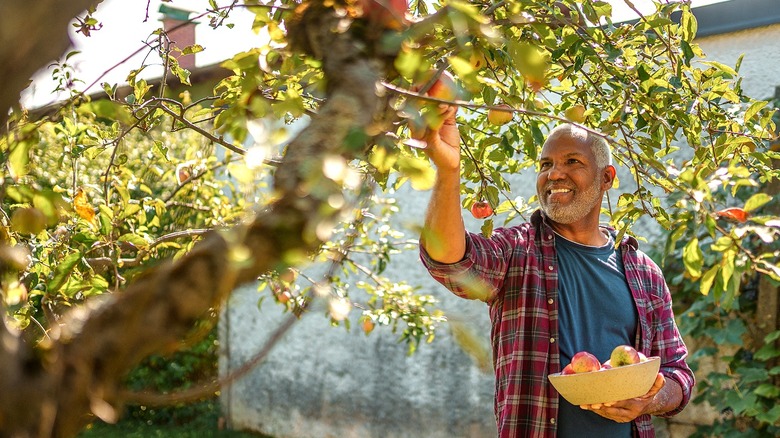
A "pocket orchard" of backyard fruit trees is a homeowner's dream. But far less dreamy are the pests that can ruin the harvest before it begins (not to mention the chemicals so often used to control those pests). Fortunately, interspersing your fruit trees with flowering herbs such as dill (Anethum graveolens) can help attract the "good guys" that keep orchards healthy, while also adding to the beauty of the yard.
Dill is helpful to grow near fruit trees because it offers multifold protection. First, it repels garden pests, especially aphids and spider mites. Aphids are particularly a problem for apple harvests, but can present a danger to other fruit trees as well. Mites are also a menace to a variety of orchard fruits, including apple, plum, peach, and nectarine types.
The second way that dill helps keep fruit trees healthy is by attracting the types of insects that feed on fruit tree pests. Once dill is allowed to flower, it attracts a large number of beneficial insects and pollinators, many of which are important to fruit tree health. The small umbel blossoms that make up yellow dill flowers feed insects like the dill-loving parasitic wasps and parasitic flies.
These tiny insects feed on a number of garden and orchard pests, including aphids, beetles, whiteflies, scale, and leafhoppers. Among the other "good guys" dill attracts are ladybugs and lacewings. Finally, this summer-blooming herb that pollinators love attracts bees, and also hosts parsley worms, which turn into swallowtail butterflies.
Allow dill to flower for the best fruit tree protection
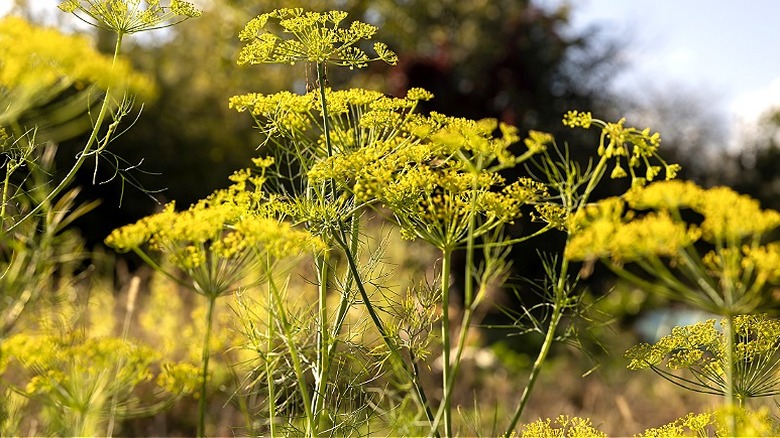
Because dill seedlings don't transplant well, you'll get best results direct-seeding them near your fruit trees. Fortunately, dill is among the easiest herbs to grow from seed. For ease of walking between the trees, consider a more compact variety, such as 'Fernleaf' dill. Don't choose a site directly under the fruit trees, because dill needs full sun in order to thrive. Remove any existing grass or other vegetation before planting.
If your soil is on the alkaline side, adding an acidic product like iron sulfate or ground sulfur can lower it to the pH of 5.8 to 6.5 that dill prefers. Wait until the last frost date in your area has passed before seeding. Set the seeds about 1 inch deep and at least 12 inches apart, if you're growing a patch. Otherwise, just establish individual dill plants among other orchard-friendly botanicals such as yarrow, coreopsis, fennel, and cosmos. Like dill, these plants attract the natural predators that eat the "bad guys" that attack edible crops.
Although dill leaves are routinely harvested about three months after planting when grown as a culinary herb, dill grown as a fruit tree companion should be allowed to "go to seed." That means letting the plant produce its yellow flowers. Not only will flowering dill fill your garden with beautiful butterflies and bees, but those flowers will, again, attract the "good guy" insects that can help control orchard pests.