

Say Goodbye To Concrete: Build A Rustic Garden Bench With This Alternative
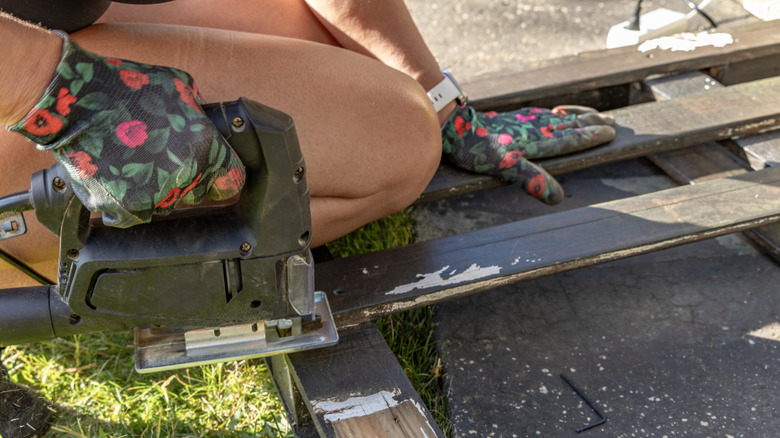
We may receive a commission on purchases made from links.
Having a homemade bench in your front or backyard can add an earthy sense of tranquility to the space. Whether it's made of wood, stone, or steel, learning how to style a garden bench can help these pieces blend seamlessly into almost any outdoor theme. For example, YouTube channel Wire Fence demonstrated how you can build an impressive gabion bench partly constructed with upcycled broken stones, a few wood planks, and rubble from around their garden. What exactly is a gabion bench, you ask?
A "gabion" typically refers to a wire mesh cage, often constructed with galvanized steel, and filled with stones and rocks. They're mainly used in landscaping for retaining walls and erosion control, and have been around since the 14th century. Gabions are more popular in Europe than in the US, where they may be more commonly seen in urban settings, as they're also built to keep pedestrians and buildings safe from passing vehicles. So, a gabion bench is simply one constructed with a stone-filled, wire mesh cage design and often, as is the case with this design, topped with wood planks that serve as the seating area.
In the video example, three wood planks are secured to the cage's lid by way of three batten-sized wood pieces, each roughly 2-by-2-by-18 inches. This design is just one of many ways to build a stylish garden bench. Gabion benches are best for spacious outdoor areas, given the typical sizes of the cages. It's also worth picking a permanent spot for this build ahead of time, since once it's filled with stone, the bench isn't going to be easy to relocate.
Procuring the materials and building the bench
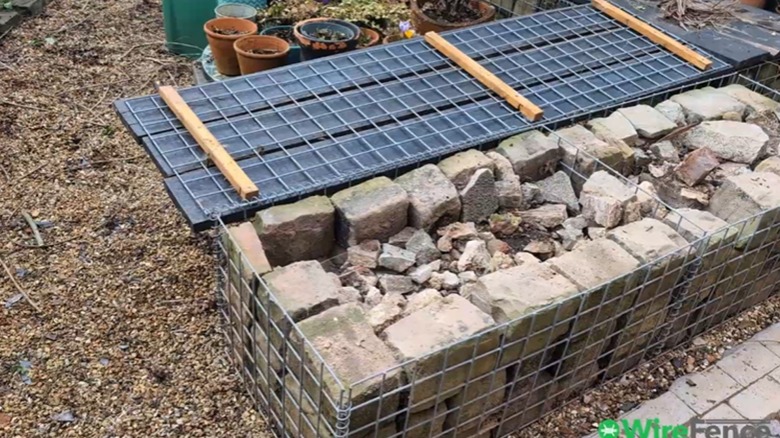
You can find the gabion cages at many home improvement stores or on Amazon. While many of these cages cost upwards of $100, this vidaXL StoreGabion Raised Bed Galvanized Steel cage is available on Amazon for $60. To recreate this bench design, you'll also need enough wood planks to cover the top of your cage as the seating area. The exact size and number will depend on your cage's dimensions, but anywhere from two to four 2-by-8-by-8-foot boards should be enough, and you can always cut them down to fit.
You'll also need stones to fill the cage. There are several ways to source these, including finding demolition construction sites, checking Facebook Marketplace, or simply asking around. And, like the YouTuber, consider using low-cost stones for the outward-facing areas, then fill the middle with affordable or free urbanite. Once you've measured and cut your wood pieces and gathered your stones, place your cage in its designated spot. Begin filling its inner perimeter with your "showcase" stones. Then fill in the middle with your more affordable stones, ensuring that the top is level across the cage, particularly around the edges.
Next, set the wood seating planks on top of a couple of portable worktables. Open the cage's lid so that it's upside down and resting on top of the planks. Then, add your three batten-sized wood pieces on top of the lid, evenly spaced across it. Drill the batten pieces into the planks, securing the cage lid to the planks so the whole thing forms one solid unit. Press down along the length of the bench to check that everything sits flush and secure.
Different ways to design your gabion bench
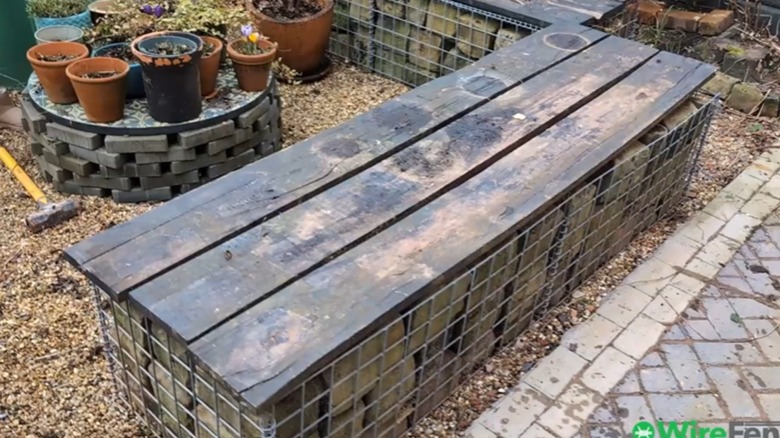
The simple gabion bench style is one that's super easy to upgrade for a more personalized look — and without adding a lot of bells and whistles. For example, you can add a dark stain or coat of paint to the top planks to give it a more modern aesthetic. Colors such as black, cream, or dark gray would work well for creating a sleeker feel to the design.
Or, you can keep with the country-inspired feel of the bench, and go with a deep stain or neutral earth tones, like terracotta or beige. Try switching things up by incorporating various types of rock used in landscaping for the outward-facing parts of the cage, mixing colors, sizes, and textures for a more custom look. For example, you can place the largest stones at the bottom and slowly build a gradient, where the smaller stones end up on top.
This will give the bench a more unpredictable and less sterile look. You can also bring in a few outdoor seating cushions to go on top of the wood planks for additional comfort, as wood seating can become a bit uncomfortable after a while. Saturated colors such as wine red or ocean blue work well to bring out the neutral colors of the stones. And of course, you can always match them to the wood planks instead, going with earthy tones such as light gray or avocado, for a more cohesive, blended look.