

Living Room Trends That Are On The Way Out In 2026 (So Far)
Updating your living room with a fresh new design is an exciting process. It's a chance to fill your space with a "bit of you," to layer it with daring colors and textures, and give yourself a new reason to smile when you come to relax in the evening. It's an opportunity to push the envelope with how your home looks and makes you feel, and to infuse your space with some of the design world's most up-to-the-minute trends. But that's the thing: Trends move on. Yes, some have serious staying power, but as is the nature of trends, others are likely to fall out of favor just as soon as the paint in your living room dries.
To prove the point, while helping you to ensure your new design stands the test of time, we've identified 11 recent living room trends that risk dating your interior. Some, like cheap, matching furniture, are disappearing entirely. Others, like the influence of social media on our living room designs, are evolving. To help you make sense of it all, we've dug into what's no longer hot (and why) in the world of living room design. And should any of our findings cast doubt over what's currently adorning your mood board, we've also included some tips to help you pivot and keep your design scheme current.
Fast furniture is headed the same way as its fashionable cousin

One of the home trends you'll want to avoid falling for in 2026 is trying to fill your space with all-new furnishings. If you have your finger on the pulse of furniture design, it's easy to be sold by the prospect of a designer dupe — one that's designed to look like the real deal, but without the hefty price tag. The problem is, these are cheaper for a reason. They're often made with lower-quality materials, and while they look the part, they likely won't last.
In the place of fast furniture, there is a growing dedication among homeowners to sustainability, which, paired with a desire for timelessness, makes those budget-friendly dupes less desirable. Instead, homeowners are looking for higher quality pieces that are designed — and priced — to both last and look good in the long term. As Designer Sally O'Connor of Hesellic tells Forbes, "Clients are wanting to prioritize sustainability and quality, leaning towards timeless pieces made from durable materials that promise longevity over disposable options." Now, that doesn't necessarily mean you have to buy completely brand new. Instead, you could look for quality pieces secondhand — perhaps from the thrift store or Facebook marketplace. In fact, this is actually recommended if you're hoping to keep your living room on trend. As we'll explore in more detail later, a curated look with different furnishings, from different eras and with different materials, is now far more favorable than a space filled with cheap, perfectly-matched pieces.
Social media has a smaller say in living room design

As well as thinking more carefully about the quality of their furnishings, design-savvy homeowners are relying less on which designs receive the most likes on social media. Importantly, they are also worrying less about how their own spaces will look when shared on Instagram. This may not come as good news for those of you with Pinterest boards filled with ideas for your upcoming refurb, but if you look at it as a means of freeing your inner designer, it's a good thing. In fact, according to some designers, it's becoming increasingly acceptable — and, in fact, encouraged — to go your own way. And it's about more than mere individuality.
Instead, interior designer Ryan Saghian explains to Forbes that it's about practicality and thinking about what you want and need from your living room, instead of what's likely to look good on the 'gram. In his own words, "Homes that prioritize perfectly curated, picture-ready rooms are starting to feel dated. When form outweighs function, the space stops serving the way people actually live." In other words, ask yourself that same question: How do you and your family live? Do you sit together each evening to watch TV? Do you play board games? Do you have pets who like to curl up with you on the sofa? You'll find it's far better for your living room to be comfortable and usable, than to match what looks good on social media, but be entirely impractical.
Overdone high-gloss finishes lack warmth and reveal imperfections easily
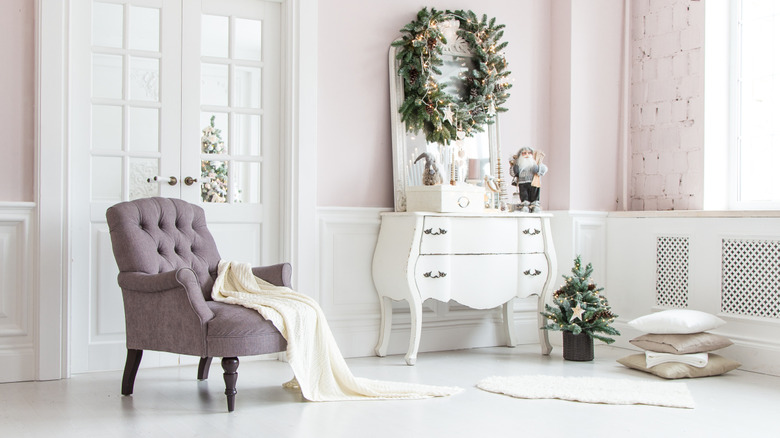
High-gloss finishes have been particularly popular in recent years, helping lend darker spaces a feeling of brightness that matte finishes struggle to match. The problem is that, if used excessively or in the wrong space, gloss can be hard to keep looking its best. Glossy floors, for example, can easily show scuffs, not to mention scratches if your pooch is prone to an occasional funny five minutes. On your walls and ceilings, reflective finishes can cause a space to lose its warmth. And if there's one area of your home where you want to feel cozy, it's surely in your living room!
That's not to say that you should ditch that can of glossy paint from your basket. Instead, you might be better off reserving gloss paint for interior accents, like doors and trims. By using it in smaller amounts, and pairing it with matte surfaces and natural materials, interior designer Noha Hassan tells Livingetc that you can retain your room's warmth, while making those features stand out. Not only that, but as she explains, "That balance gives a space more refinement and longevity." In other words, you're less likely to tire of your chosen finish in just a couple of years than you are if you go all-in with gloss.
Accent walls are failing to satisfy a desire for refinement
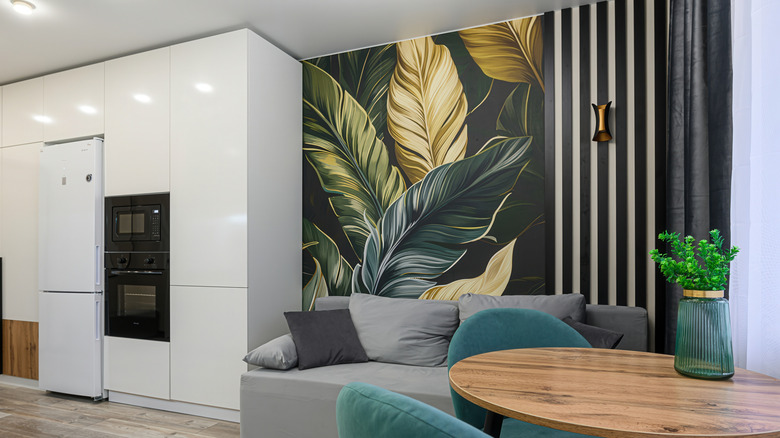
There are plenty of accent wall ideas that can bring your home to life. Not only that, but up until recently, accent walls with vibrant colors patterns offered homeowners an easy way to add interest. Now, however, designers are seeing this trend evolve. For example, instead of saturating a wall with a single color, designer Miranda Cullens tells Better Homes & Gardens that accent walls are more about adding subtle contrast. She explains that the idea of creating a focal point is still very much valid, but that it's becoming more nuanced. In her own words, "It's less about a flat pop of color and more about tactile surfaces that warm up a space and create dimension."
So, what does that look like, exactly? Well, there are several ways that you can do it. You could color-drench your entire living room, then layer your space with interest and texture with furnishings and textiles. The key, to quote designer Sally O'Connor, is to remember that "The trend of single accent walls is losing its charm." As she explains to Forbes, her clients are now opting for more dramatic approaches, with layered finishes and color drenching both viable options. She also sees a shift in focus towards softer finishes like limewash and plaster, with designs achieving a more refined aesthetic by moving away from flat matte paints.
Faux plants require little maintenance, but they lack authenticity
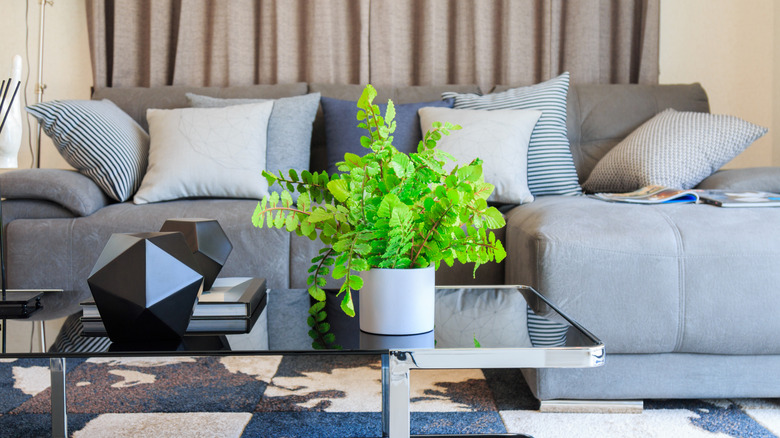
Given that interior design in 2026 leans heavily on natural, organic forms and colors, a dip in popularity for faux plants might seem strange. However, according to Lauren Saab, founder and principal designer of Saab Studios, it's the difference between real and fake plants that makes the latter less compatible with current sensibilities. As she tells The Spruce, "Real plants catch the light, they move with the air, and that is what gives a room its life." In other words, they look authentic, and if you're serious about grounding your living room in nature, fake plants may end up working against you.
This may not be what you want to hear, especially if you have a poor track record when it comes to managing plants. Fortunately, Saab explains that you don't have to fill your room with real greenery. Instead, she says, "Even a single tree in a simple planter can do more than a whole wall of plastic leaves." Not only that, but there are plenty of easy-going houseplants that anyone can keep alive. Snake plants, for example, rarely need watering more than once a fortnight, and will make do with just about any level of sunlight. Finally, if you really don't trust yourself to keep plants alive, then consider investing a little more in high-quality artificial greenery. As interior designer Fariha Nasir tells Better Homes & Gardens, "If your shelf is sporting a plasticky looking succulent, replace it with something else that looks more natural on a shelf."
Gallery walls are a risk at a time when homeowners want less clutter
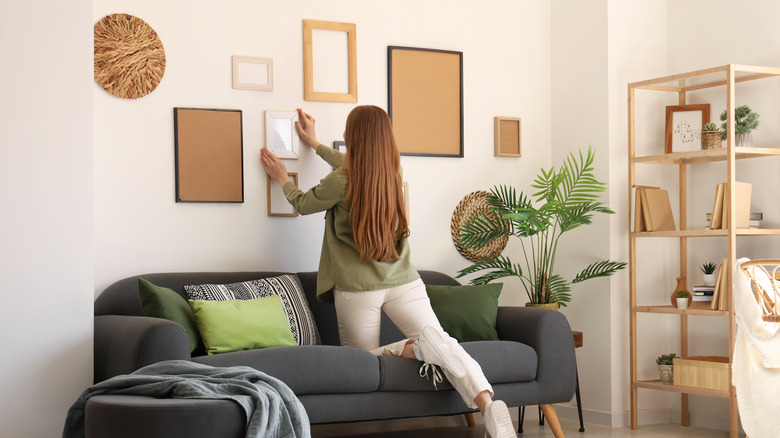
Gallery walls can help to layer your space with personality. It could feature photographs from your travels, prints from your favorite artists, or both. It could even include shelves with a few sculptural pieces thrown into the mix. Unfortunately, while it looks exciting on paper, there are some interior designers who believe that gallery walls are starting to feel tired, not trendy. As Brittny Button, founder and principal designer of Button Atelier, tells The Spruce, "They just feel done and overrated." Not only that, but in smaller spaces, filling up a wall with framed photos and artwork risks contributing to living room clutter.
All of this isn't to say that you shouldn't celebrate your life's most special moments or your favorite artists' best pieces. Instead, says Button, "If you want to display more photos, get some picture frames and display a group together on a console or end table." As for what to use on the wall, she proposes that less is almost always more. A single piece of carefully curated artwork, she says, can have a greater visual impact, while also reducing visual clutter. This is especially true if you're trying to make your small living room feel bigger. By giving your walls room to breathe, your space will naturally feel less claustrophobic and cluttered.
Too many curves is becoming counterproductive
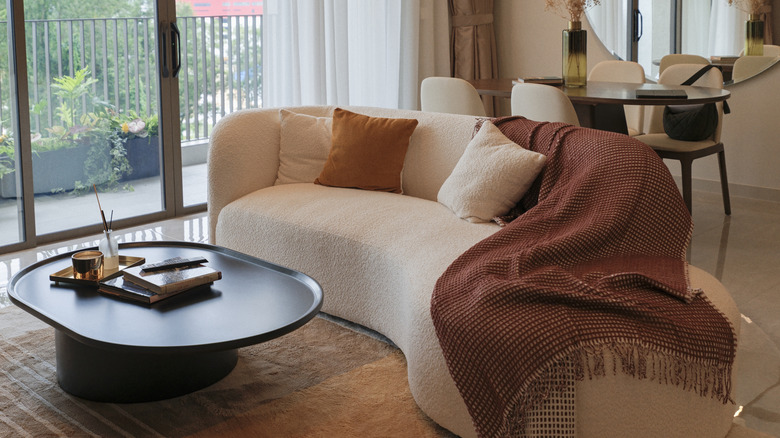
Soft curves and organic furniture forms have been growing in popularity for decades. They offered homeowners a tonic to the harsh, angular lines so typical of more minimalist design modes in the late 20th century. More recently, they have formed part of a wider trend towards more calming, nature-grounded spaces. Which is an interesting point. This desire for closer connections to the natural world, particularly via our living spaces, is something that, at least for now, is here to stay. But if you try to achieve it exclusively with curvature, then according to some designers, you risk dating your space.
As Ryan Saghian puts it in his interview with Forbes, curves have become so omnipresent. That's not to say that you can't still benefit from a few curves, though. Used appropriately, they can still help to soften starker spaces, while lending visual interest. Noha Hassan explains to Livingetc that the key to avoiding them being unfashionable lies in conservatism. That means balancing curves with straight lines to achieve contrast in your design, which Hassan says "gives a space longevity and keeps it feeling timeless."
Styling your shelves to hit a trend lacks intention and personality
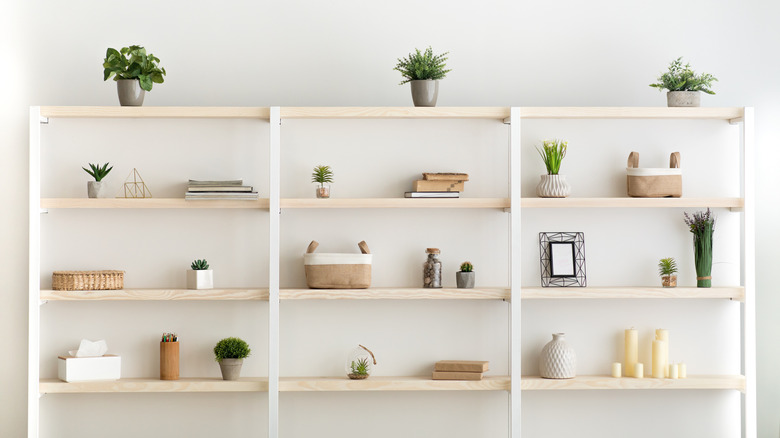
Now more than ever, interior designer Vanessa Katzen explains to Livingetc that it's important to avoid over-styling your shelves. This, she says, is often done to make a space look trendy, with little thought paid to how it'll actually serve a wider design. Done properly, and a few curatorial pieces on a shelf can create a vignette that tells a story, or which evokes a particular mood. But if you overdo it, you'll merely be creating clutter.
This ties back to the point we made about social media — that it's important to design your space for you, and not for your followers on Instagram. Over-styling your shelves, says Katzen, is "an easy formula that photographs well, but when every surface is filled, nothing feels intentional." Now, don't panic if you've fallen for this particular trap and wish to remedy your mistake — all that's needed is a little editing. As Katzen puts it, "Luxury often comes from what you choose to leave out," so figure out which decor pieces are cluttering up your shelves and remove them, leaving only those that you absolutely adore.
The time has come to stop hiding your TV

Given our desire for spaces that feel calm, intentional, and, above all else, designed, it's understandable that many would want to hide an intrusive TV. Not only that, but this desire for discretion has given rise to myriad creative solutions for those with the determination (and budget) to go the extra mile. But it also begs the question: If your TV is there to be watched, then why bother hiding it? That's not just us asking. There are also some designers who are ready to see the retirement of living room designs that try to disguise the screen. As an example, Designer Ashley Ferguson tells Apartment Therapy, "I am ready to retire the notion that a TV can't be above a fireplace or that it's taboo."
Sure, she admits that TVs are rarely "cute." However, given the technology that's available to us nowadays, these devices can actually double as pieces of functional art. In fact, you can now buy televisions in framed designs. These are literally made to look like artwork, and while it may sound like a gimmick, Carla Fonts of Dunbar Road Design tells Veranda that they're incredible. As she explains, "You can easily change the art to match your mood or the season, providing a fresh look whenever you desire." Now, whether such devices are, as Fonts puts it, "the best thing since sliced bread," is not for us to say. But it's at least reassuring to know that you can simply mount your TV on the wall, instead of forking out in order to hide it with custom cupboards or cabinetry.
Matching furniture feels flat and lacks personality
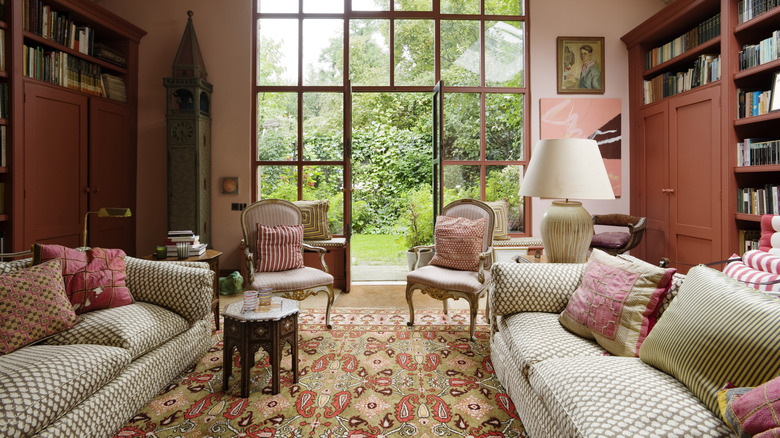
For a long time, one of the most common approaches to furnishing a living room was to buy a matching set. Not only that, but one of the best tips for designing a cohesive living room is to reinforce your chosen theme with repetition, be that color, texture, or pattern. However, if you take it too far — and especially if you do it with your furniture — you could end up with a flat and lifeless design. So, says Ryan Saghian when speaking with Forbes, "Spaces where everything matches perfectly from the same collection are beginning to feel flat and predictable."
Instead, he explains, "The most compelling interiors feel layered and personal rather than overly styled." In other words, design-savvy homeowners now curate their furnishings, instead of buying them en masse. This means finding pieces that hail from different eras and which are designed in different styles and materials. This eclectic approach contributes to that layered aesthetic, and it also lends your space character. Importantly, provided that you choose pieces that you love — and not just those you saw on Pinterest — it'll give your space a dose of your own personality.
The industrial look (and its associated fixtures) feel cold instead of cool
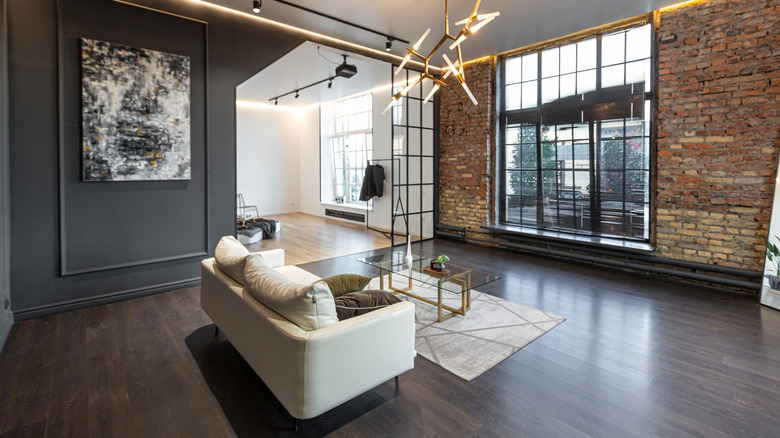
While industrial design still has its place in some settings, it seems that, as we approach the fall of 2026, it's quickly losing its luster among designers. Any guide to industrial decor will tell you that this mode often draws on cool grays, exposed brickwork, and minimalist furniture, none of which much suits the desire for a warm, cozy interior. But industrial design is also strongly associated with specific fixtures and fittings, including Edison-style bulbs, which lend such settings their distinctive vintage look. And as Alexis Pew, designer and partner at Kaminki + Pew, explains to Apartment Therapy, "The industrial fixtures that support the gray rooms are starting to look a bit tired."
But aren't Edison bulbs supposed to be a timeless choice? Well, as it turns out, they are — but only in very specific settings. As Brittny Button tells The Spruce, while they have helped to bring a dose of vintage to industrial-style schemes for years, the harsh lighting that they emit feels "done." In her own words, "Unless you're creating a live-work space where an industrial modern [feel] is prevalent, it's a definite pass!"
Light wood lacks the warmth that home designers crave
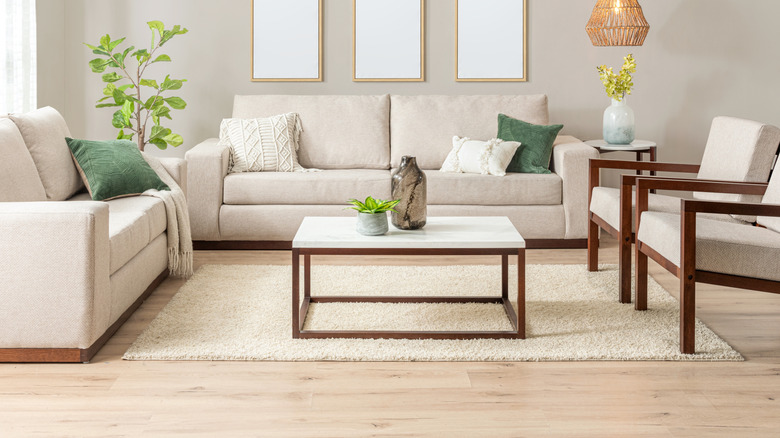
There are various wood flooring colors proving popular in 2026, and unfortunately, white oak isn't one of them. While beautifully textured, it shares the same fallibility as cool gray in that it feels a touch too cold for current sensibilities. That's backed by co-founder and principal designer of Pure Salt, Leigh Lincoln. As she explains to Forbes, while white oak has been popular in interiors for several years, especially in the world of flooring, it's no longer the go-to choice it once was. "Instead," she says, "we are gravitating towards depth and warmth."
This rings true with what others in the field have to say, including Kelly McGrath from Studio McGrath, who explains to Vogue that "Darker-toned woods are making their return after many years of paler varieties dominating." And this extends to more than just the floor. Whether you shop online or like to comb the shelves of your local thrift store, a few worn, reclaimed-wood pieces can really help contribute to a space that feels personal, layered, and, most importantly, loved.