

Can I Throw My Neighbor's Dog Poop Back In Their Yard?
It's a tale as old as time — or at least as old as neighborhoods. Your neighbor's dog needs to relieve themselves while on a walk and they choose your lawn to do the deed. While plenty of dog owners know that the polite thing to do is pick up after their pet, some owners skip this step. In some cases, they may not even know their dog has designated your yard as a bathroom if the deed is being done while the dog is outside unsupervised. So, when it happens, can you simply throw the dog poop back into your neighbor's yard?
"Tossing it back may feel like poetic justice, but deliberately putting something on someone else's property can be trespass, and it may violate local littering or sanitation rules," Zachary Schorr, lead real estate attorney at Schorr Law in Los Angeles, told House Digest in an exclusive interview. "It also makes you look like the aggressor if the dispute escalates, and judges and mediators notice who acted reasonably."
As tempting as it can be to toss the problem back into the dog owner's yard, it's not going to help you solve the problem in the long run. Instead, Schorr recommends trying more constructive ways to stop your neighbor's dog from pooping in your yard: "Bag it, document it, and handle it the right way." Even if these smaller steps don't completely resolve the problem, they are important to help you build a case if it does end up escalating to small claims court or professional mediation.
How to deal with a neighbor's dog pooping in your yard
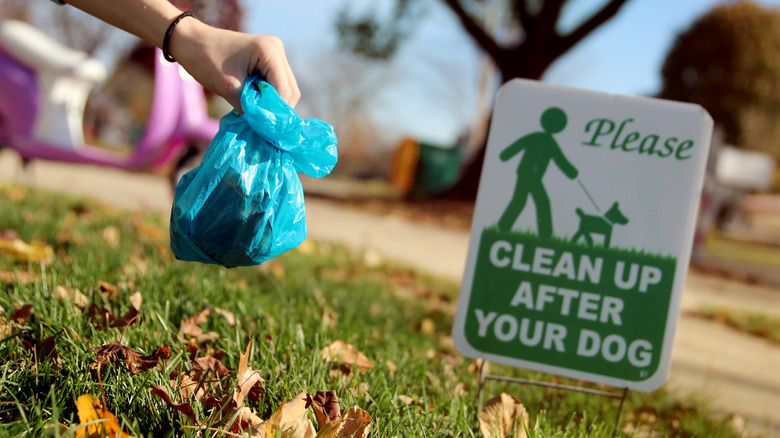
It's not overreacting to be upset about dog poop left in your yard. Not only is it unpleasant to step on, but dog droppings can attract rodents. Plus, if you don't realize it's there, you might drive yourself crazy trying to figure out why your yard smells. Still, Schorr advises against escalating too quickly or taking any action that could make you look like the aggressor. That includes throwing the poop back into your neighbor's yard.
Instead, a better first step is to simply talk to your neighbor. "Many owners don't realize it's happening, and a friendly conversation solves most of these problems," said Schorr. At the same time, document what's happening. If you have a video doorbell that captured the dog doing the deed, make sure you save that clip. If not, take photos before cleaning up the mess. You can also take note of the date you spoke to your neighbor and how the conversation went.
If you can't seem to catch them while they're home, leave a note in their mailbox or on their door. "A polite, factual note shows good faith," Schorr said. You can also add the date to this note and keep a copy or photo of it for your records. In the meantime, it doesn't hurt to brush up on any applicable laws or HOA rules. "Many cities and HOAs require owners to pick up after their dogs, and your local animal services office can tell you what applies." Knowing these rules now will help you better understand what your legal options might be if your other attempts at addressing the issue don't work.
What if the dog keeps pooping in your yard anyway?

If your neighbor keeps letting their dog poop in your yard despite your best efforts at talking with them, that's when it might be time to escalate. But it's important not to skip those early steps mentioned above. "Those steps keep the problem small and put you in the strongest position if it grows," according to Schorr, "Once neighbors start retaliating, a minor nuisance can become a real legal fight, so staying calm and keeping records early matters."
Still, if you did everything right and the dog poop just keeps showing up, the next step is to contact the appropriate local authorities. "A homeowner can report the problem to animal control, code enforcement, or the HOA," advised Schorr. These agencies can contact the neighbor and provide a more firm and official notice about the importance of addressing the problem.
When dealing with a particularly stubborn neighbor who won't clean up after their dog even after being contacted by code enforcement or your HOA, that's when it's time to take it a step further. "Try community mediation, which is often free or low cost," said Schorr. "If the problem persists and causes real harm, sue for trespass or nuisance in small claims court. Small claims [court] is affordable, and you don't need a lawyer." Bring all the documentation you've gathered up to this point for the best chance of successfully getting the court to order your neighbor to stop.